

































































The National Institutes of Health Consensus Development Conference Statement from May 1989 concludes, "It is ingrained in humans to love light and, indeed, since mankind's first wanderings from the caves, worship of the sun has been a fundamental tenet that many societies hold even to the present." Although the cult of suntanning values the healthy glow of bronze skin, outdoor enthusiasts failing to put a limit on sunshine exposure risk facial blisters from the sun's ultraviolet rays.
Ultraviolet Rays
Facial skin is the most difficult area to mask from ultraviolet rays. Hats, sunglasses and sunblocks partially screen out rays, but reflected light is always present. The Environmental Protection Agency (EPA) reports that skin tanning is the body's method of defending from further damage, warning that "any change in your skin's natural color is a sign of damage to the skin."
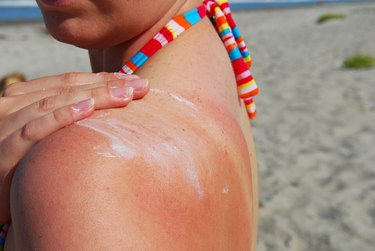
Skin blisters, sometimes called sun poisoning, are an extreme clue to overexposure to ultraviolet rays. According to the National Institutes of Health, blisters typically appear several hours or days after the overexposure. Such an outbreak might also be an indication that the body has sun allergies or sensitivities.
Sun Sensitivity
Bodily diseases are linked to increased sun sensitivity and facial blistering. The American Porphyria Foundation reports that a deficiency of the urophyrinogen decarboxylase enzyme (UROD) assists in developing the disease porphyria cutanea tarda, also known as PCT, that contributes to skin blistering after exposure to the sun. The face and hands are most commonly affected by PCT, with even minor sun exposure causing blistering and peeling. There is no known cure for PCT.
Sun Allergies
According to the Harvard Medical School site Intelihealth, Sun allergies---present in approximately 10 percent to 15 percent of the U.S. population---can create small hives or blisters on the face, neck and back of the hands. This photosensitivity is caused by the immune system's inability to recognize the sun-exposed skin. Its response is an immunity defense that includes blistering. The blistering is classified either as a polymorphous light eruption (PMLE), which is typically seen in young adults, or as an actinic prurigo, a disease with similar results but caused by an inherited reaction. Native populations of North, South and Central America typically experience inherited PMLE, according to Intelihealth. PMLE currently has no cure.
Treatment
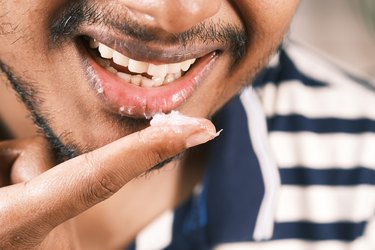
Although facial blistering is treated with cool compresses, lotion and gauze to prevent breakage, treatments for face blisters related to diseases are more complicated. The American Porphyria Foundation reports that porphyria cutanea tarda is managed by a blood treatment over time to lessen the disease's impact. PMLE (both acquired and inherited) requires a course of treatment using beta-carotene or prescriptions of thalidomide, corticosteroids and antimalarial drugs, according to Harvard Medical School's Intilhealth.
Implications
Scientists theorize that sunburn blistering at an early age contributes to an increased incidence of skin cancer as an adult. The Skin Cancer Foundation reports that a single episode of blistering in childhood or adolescence "more than doubles a person's chance of developing melanoma later in life."


