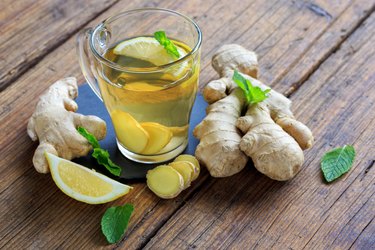
Ginger and green tea are two well-known, edible plants. They are enjoyed for their taste as well as for as their potential health benefits.
Ginger, in particular, has been shown to have medicinal qualities, while research is still ongoing to prove green tea's positive effect on cardiovascular health.
Green Tea Benefits to Health
Video of the Day
Green tea — like black and oolong teas — comes from the plant Camellia sinensis, an evergreen shrub that grows in mountainous areas in China, India and other countries. To make green tea_,_ fresh leaves from the plant are quickly steamed to stop oxidation, the chemical process that causes browning. Green tea has been used for medicinal purposes in China and Japan for thousands of years.
Video of the Day
Green tea as a beverage can be enjoyed simply for its taste. Other uses, whether in tea form or as a dietary supplement, include benefits like mental alertness, digestive relief, headaches and weight loss support.
Among their many biological activities, the predominant polyphenols in green tea ― EGCG, EGC, ECG and EC — have antioxidant activity. This has prompted clinical trials and studies to determine if green tea is effective in warding off cancer and other maladies. But, as the National Center for Complementary and Integrative Health points out, scientific evidence is lacking to show whether green tea is helpful for most of the purposes for which it is used.
In terms of other health benefits, scientists are still attempting to find conclusive links. In a May 2018 Harvard Health post, Dr. Howard Sesso, an associate professor in the Department of Epidemiology at Harvard Medical School, shares that green tea may positively impact cardiovascular health because they contain chemical compounds known as flavonoids. However, he cautions this benefit could also be circumstantial.
Read more: Do Green Tea Pills Help You Lose Weight?
Ginger Benefits to Health
Ginger, a tropical flowering plant with a fragrant root that's native to Southeastern Asia, is a produce aisle staple distinguished by its knobby brown appearance. Peeled and grated, ginger is a spicy addition to many dishes. In its dried form, it is used to flavor baked goods and sold as a tea.
As a dietary supplement, ginger is used for post-surgery nausea, along with nausea caused by motion, chemotherapy and pregnancy. It's also used for rheumatoid arthritis and osteoarthritis, among other ailments. Ginger can be purchased in various forms:
- Fresh
- Dried
- Pickled
- Tablets
- Capsules
- Liquid extracts
- Teas
Perhaps even more importantly, ginger is now being explored as a treatment for more serious conditions, such as cancer. Ginger for medicinal use has been a traditional medicine approach for centuries, and modern medicine is now taking note.
The major pharmacologically active component of ginger is called 6-gingerol. It is known to exhibit a variety of biological properties including anticancer, anti-inflammation and anti-oxidation.
An article in the January 2017 issue of the Journal of Developing Drugs cites ginger's low toxicity and broad spectrum of biological and pharmacological applications including anti-tumor, antioxidant, anti-inflammatory, anti-apoptotic, cytotoxic, anti-proliferative and anti-platelet activities.
Read more: How Much Raw Ginger Can You Eat?
Ginger and Green Tea Effects
Ginger, when used as a spice, is believed to be generally safe to consume for most people. Mild side effects could include abdominal discomfort, heartburn, diarrhea and gas. Research has not definitely shown whether ginger interacts with medications, but concerns have been raised that it might interact with anticoagulants (blood thinners).
Green tea, when consumed as a beverage, is believed to be safe when used in moderate amounts. Liver problems have been reported in a small number of people who took concentrated green tea extracts. It is also worth mentioning that green tea and green tea extracts contain substantial amounts of caffeine.
- National Center for Complementary and Integrative Health: "Ginger"
- NCBI: Natural Product Communications: "Biological Properties of 6-Gingerol: A Brief Review"
- Journal of Developing Drugs: "6-Gingerol Is the Most Potent Anticancerous Compound in Ginger (Zingiber officinale Rosc.)"
- National Center for Complementary and Integrative Health: "Green Tea"
- Harvard Health Publishing: "Flavonoids: The Secret to Health Benefits of Drinking Black and Green Tea?"
- Cochrane Library: "Green Tea (Camellia sinensis) for the Prevention of Cancer"
- National Cancer Institute: "Tea and Cancer Prevention"
- University of Rochester Medical Center: "Ginger"
- Missouri Botanical Garden: "Camellia sinensis"