




















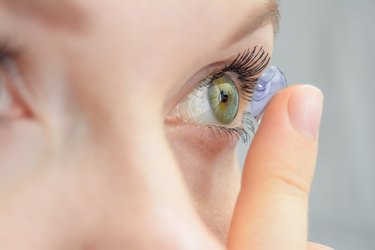
















Though used for cosmetic purposes to change your eye color, colored contact lenses are still considered medical devices. Federal law prohibits sellers from providing you with any type of contacts, even colored lenses, without a valid prescription. Wearing colored contact lenses that haven't been fitted to your eyes can cause permanent eye damage.
Infection
Infection of the cornea--called keratitis--is the most common infection associated with contact lens use, according to the American Academy of Ophthalmology. Improper cleaning of contacts or wearing the lenses for long periods can contribute to infection. Wearing someone else's contacts or allowing another person to wear your lenses can also lead to eye infection.
A corneal infection can be viral, fungal, bacterial or parasitic. The parasite acanthamoeba, which can be found in water, can cause severe infections if you rinse your colored contact lenses with water or wear them while swimming.
Symptoms of a corneal infection may include pain or redness in the eye, abnormal tearing or discharge, blurred vision, sensitivity to light or the sensation of having a foreign body stuck in your eye. Keratitis can rapidly progress to more serious conditions, so see your eye doctor as soon as possible if you develop symptoms.
Corneal Ulcer
If left untreated, a corneal infection can lead to an ulcer, which is a sore that forms on the cornea. Abrasions to the cornea--such as from sand, fingernails or improperly fitted contact lenses--can become infected, which may lead to ulcers.
The symptoms of a corneal ulcer are similar to those of an infection but may also include pus coming from the eye, swelling of the eyelids and a white spot on your cornea. Corneal ulcers can be treated with eye drops suited to the type of infection or damage present. Some corneal ulcers may not respond to medical treatment, and it may be necessary to perform a corneal transplant in order to restore vision in the affected eye.
Vision Loss and Blindness
Infections of and damage to the cornea caused by colored contact lenses can lead to impaired vision or even blindness. If they aren't treated, corneal ulcers can cause irreversible damage such as scarring that permanently affects vision. Ulcers can also cause holes to form in other parts of the eye, allowing the infection to spread. In some cases, the eye may be lost entirely, according to Medline Plus.


