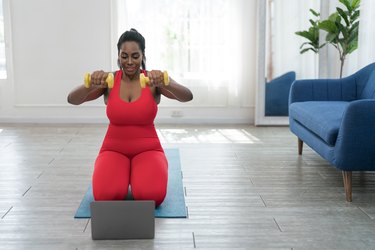
Take it to the mat — with or without light weights — and carve out some arm muscles. Pilates is a perfect, all-around body workout that promises to tone your body and improve your posture.
One of the benefits of Pilates is that certain exercises and series are meant to target specific areas of the body. If sleek arms are your goal, try the Pilates arm series below from certified Pilates instructor Ashley Adams. You can do it holding lightweight dumbbells — or go without — depending on your level of fitness.
Video of the Day
"I love incorporating these exercises at the end of a mat session to deepen the mind-body connection and awareness," Adams says. "This series is a great opportunity to learn proper shoulder positioning and good posture."
Molly Bock, mat Pilates instructor, demonstrates these arm-toning moves below. Begin with 3 sets of the first 3 moves — in order, without rest — resting 30 seconds between each set. "These have become my go-to moves," Adams says. "You can get great benefits in a short period of time."
When you're ready for a bigger challenge, add in the final three exercises for a complete series. Adams suggests doing these in front of a mirror, as a visual reminder to stand tall and maintain proper body alignment.
1. Shave the Head
- Begin sitting in a cross-legged position and sit up straight.
- Place your hands behind your head, forming a triangle with your fingers.
- As you inhale, press your hands overhead, maintaining the triangle position with your fingers. Straighten out your elbows and press up and away from the body.
- As you exhale, bring your hands back to their starting point behind your head.
- Do 10 to 15 reps.
Got the mat version down? Dial it up a notch by taking it to the reformer. “On the reformer you are in a sitting position using straps, but still focused on engaging the core and maintaining both shoulder stabilization and good posture,” Adams says.
2. Arm Circles
"These small movements pack a punch," Adams says. "You're not only stretching and strengthening the arms, but also challenging core engagement while working the muscles of the upper body."
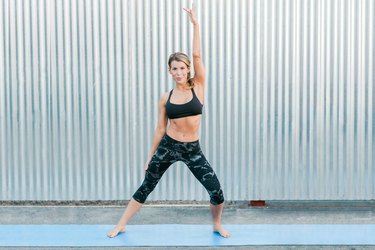
- Stand with your legs hip-width apart and toes turned out, letting your arms hang long in front of you.
- Make small, controlled clockwise circles with your fists while raising your arms up toward the ceiling.
- Reverse the direction of the circles as you slowly lower your arms back to start for one rep.
- Do 10 to 15 reps.
3. Elevated Biceps Curl
- Stand with your legs hip-width apart and toes turned out.
- Extend your arms straight out in front of you with palms facing upward. If holding weights, make fists.
- Inhale and bend your elbows to curl your wrists and forearms toward your shoulders. Keep your upper arms parallel to the floor and keep your shoulders down.
- Exhale and extend your elbows, lengthening your arms back out.
- Do 10 to 12 reps.
4. Boxing
Taking a page from the boxing ring, this move builds rock-solid arms and core muscles. Grab a set of light weights in the range of 2 to 5 pounds — depending on your current ability — to use throughout.
- Start by standing with your feet hip-width distance and your knees soft.
- Bend your elbows so that they're next to your ribs, fists together at your chest. This is your starting position.
- Simultaneously extend one arm forward and upward and the other behind you and down.
- Return to the starting position. Repeat on the opposite side. Make each punch deliberate and move with intention to strengthen the mind-muscle connection.
- Do 16 total alternating reps.
5. Hug the Tree
- Stand with your legs pressed together firmly, toes turned out, holding weights in both hands. Your palms should right below shoulder height facing forward, arms extended with a slight bend in the elbows.
- Slowly bring arms together until palms touch, then return to the starting position, squeezing your shoulder blades together.
- Do 8 to 10 reps.
6. Serve the Platter
- Stand with your legs either together or shoulder-width apart.
- Hold a light weight or a Pilates ball in each palm.
- Bring your elbows close to your body, rotating your arms out at 45 degrees, palms up.
- Lift your arms out up until your elbows are in line with your shoulders, keeping your elbows bent.
- Do tiny circular motions 8 times forward. Reverse for 8 more circles.