






























































Follicular Hair Transplants

Follicular Hair Transplants
Photo Credit Bald man from backside image by TekinT from Fotolia.com

Hair restoration surgery provides patients with a permanent solution for hair loss. With over 800,000 hair transplant surgeries performed worldwide in 2008, according to the International Society of Hair Restoration Surgery, patients should understand the most commonly chosen technique for transplantation, follicular unit grafting.

History

The first noted example of hair transplant surgery appeared in a doctoral thesis written by the German J. Dieffenbach in 1882, in which he reported on the performance of his procedure on birds as a test of its viability. In 1952, the first hair transplant for male pattern baldness was performed by Dr. Norman Orentreich. Early transplants involved large numbers of hairs in each graft, sometimes referred to as plugs. Unfortunately, the results were less than optimal, with an obvious "doll's head" appearance. On October 21, 1988, Dr. Robert Limmer carried out the first pure follicular unit transplantation. Since that time, the procedure has taken hold as the gold standard in hair transplant surgery, producing natural, lasting results, according to "Hair transplantation: Standard guidelines of care," appearing in the online "Indian Journal of Dermatology, Venereology and Leprology."
.

Candidates

The best candidates for follicular unit transplants are people who suffer from androgenic alopecia, sometimes referred to as male pattern baldness. Though this most commonly effects men, it can effect women as well. Some small studies have suggested that follicular unit grafting can also be used for patients who suffer from alopecia areata, a hair loss condition believed to be caused by an autoimmune process. Eyebrow restoration, eyelash restoration, beard transplants and body hair transplants can also be undertaken in selected patients using the follicular unit grafting technique.

Technical Details

Follicular unit grafting is a surgical procedure in which hair is taken from the back of the head, dissected under a microscope, to separate and isolate follicles, and transplanted to a bald area. The procedure relies on the fact that hair on the back and sides of the scalp will not fall out as a result of the factors which cause hair on the top of the head to fall out in cases of androgenic alopecia.
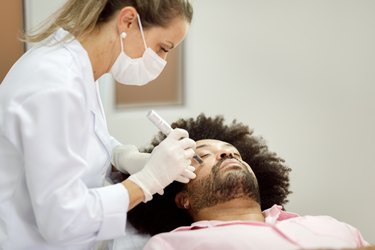
The surgery begins by harvesting either a strip of hair or small groups of follicles, the part of the hair which grows the shaft, the part that we see. The harvested follicles are dissected, using magnification, into individual follicles or very small follicular units containing one to four follicles. Small incisions are then made in the bald area to be covered, using a special knife. Again with magnification and special forceps, the dissected follicles are implanted into the recently made holes. The procedure can transplant just a few follicles or several thousand follicles in one surgery. Patients are awake for the entire procedure, and anesthesia is accomplished with numbing injections in the area to be operated on.

Risks and Complications

While your particular risks and complications will depend on the exact procedure performed and any underlying medical conditions, there are a few complications common to all hair transplant procedures. Some numbness can be expected in the transplanted and donor areas, which generally resolves over time. Infection and signficant bleeding are always possible, but the risk is small. Bruising and swelling will variably occur but generally resolve within a week after surgery. Scabs will form at the recipient sites, and some redness will occur. Ingrown hairs usually occur within the first several months after a transplant but are easily treated by unroofing the hair with a needle.

Expected Results

Immediately after a hair transplant, a certain percentage of the transplanted shafts will fall out. The follicles will generally remain intact and simply enter a dormant state. These start to grow within three to six months, and full results after a hair transplant may take six months or longer to be evident. Most studies conducted on hair transplant graft survival indicate a greater than 90 percent graft survival over time.

References

Article reviewed by demand32474 Last updated on: Aug 11, 2011

Must see: Photo Galleries

Member Comments