








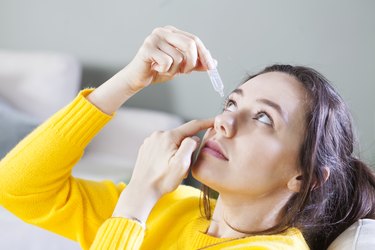

























Over-the-counter eye drops known as "artificial tears" are commonly used to treat milder cases of dry eye syndrome. A dry cornea and conjunctiva is due to abnormal tearing. Symptoms may include itching, burning or eye redness. There are many types of artificial tears to choose from that will ease symptoms. However, an ophthalmologist can assess a patient's exact needs, which may include a prescription medication in severe cases.
High Viscosity Drops
Dry eye syndrome has many causes including inadequate tear production, tears that evaporate too quickly and tears that lack the needed mucus to stick to the eye's surface. Artificial tears help provide relief by wetting and lubricating the eyes. According to ophthalmologist Dr. Steven L. Maskin, author of "Reversing Dry Eye Syndrome," artificial tears contain a "viscosity-enhancing" component that sticks to the mucus membrane of the eye. The higher the percentage of cellulose in the product, the longer the liquid will stick. Although this can be beneficial, the high viscosity drops may cause blurry vision and be best taken at bedtime to lubricate the eyes overnight. Artificial tears do not increase the ability of the eyes to produce tears or change the quality of the tears. The effects are temporary; therefore, users typically apply the drops repeatedly throughout the day.
Types of Artificial Tears
Optometrist Marc Grossman, author of "Natural Eye Care" recommends that patients only use artificial tears that do not contain preservatives because they can aggravate the condition, even kill corneal cells. Authors on the USAeyes.org website report that it is especially important to choose preservative free eye drops after Lasik surgery to aid in the healing process. The newer so-called "preservative free on contact" artificial tears have a chemical that dissipates quickly. However, the rate of dissipation varies. Dr. Grossman recommends the brand Thera Tears which appears to aid in healing and Viva-Drops which contain antioxidants and vitamin A. Antioxidants are substances that slow down the chemical reaction called oxidation, which damages cells. According to Dr. Maskin, Thera Tears have a low salt concentration which helps reduce the high salt concentrations that occur in the dry eye and may lead to inflammation. Dr. Maskin also recommendss a relatively new drop called Systane, developed by its maker, Alcon, to strengthen the tear film by forming a soft gel that adheres to the cornea. According to Alcon's Systane website, the product adjusts to the pH level of the user's tears so that it matches to the person's own chemistry. They suggest that it is ideal for people who wear contact lenses and suffer from dry eyes because it can make wearing them more comfortable. Most artificial tears products appear to be in the form of eye drops. However, sprays such as Nature's Tears EyeMist increase tear film on the eye and are easier for some patients to administer.
Reducing Red Eyes
Dry eyes can cause redness that is embarrassing and cosmetically unattractive. Perhaps even worse, it can be misconstrued as the result of a long night of partying or drug use. According to the ophthalmologists who write on the Eyes.com website, some eye drops are decongestants or vasoconstrictors designed to decrease redness by shrinking the eye's blood vessels. Some patients find that these work well if used for a short time. However, some people find that if used long term, they may actually cause dryness. Dr. Maskin reports that these products can cause a rebound effect, resulting in inflammation, irritation and possibly more serious problems such as increased blood pressure. He recommends consulting with an ophthalmologist to determine the best product for any individual.
References
- Eyes.com: Artificial Tears
- Systane: Soothing Dry Eye
- University of Illinois at Chicago: Dry Eyes
- USA Eyes: Artificial Tear Eye Drops After Lasik
- "Reversing Dry Eye Syndrome"; Steven L. Maskin, M.D.; 2007


