Foot strength and mobility is a crucial yet often-neglected component of a runner's strength and recovery regimen. The foot absorbs shock as you run (or do a lot of other workouts), functioning as a rigid surface for the push-off.
As a result, that first moment of impact becomes the most important moment, says physical therapist Lauren Loberg, a board-certified clinical orthopedic specialist with TRIA Orthopaedic Center.
Video of the Day
Video of the Day
In addition, muscular imbalances and dysfunctions in your feet can result in injury. Incorporate these seven moves into your routine to improve foot health, and you'll run stronger for longer.
Toe Spread and Press
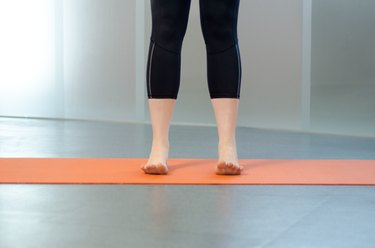
Plantar fasciitis — a condition that involves pain and inflammation of the tissue that runs across the bottom of your foot — is common among runners. To treat and prevent this condition, Loberg prescribes this arch-strengthening exercise.
- Stand with feet hip-width apart.
- Lift your toes and spread as far apart as possible and hold until lightly fatigued.
- Then, with your toes spread on the ground, press the ball of your big toe down without letting any part of your foot lift.
Reps: 3 sets of 10 after a run
Read more: 12 Easy, Anytime Exercises to Strengthen Your Ankles
Standing Calf Raise

The big toe is the primary push-off point during running, but many runners have limited range of motion in this area, experiencing foot pain and cramping as a result. Mark Schneider, medical massage therapist and certified personal trainer, recommends a calf raise with a focus on the big toe to build arch strength.
- Stand with feet shoulder-width apart.
- Raise your heels and lift onto the big toe, keeping the ball of each foot on the ground throughout the movement.
Reps: 4 to 5 sets of 20 reps before a run
Write the Alphabet
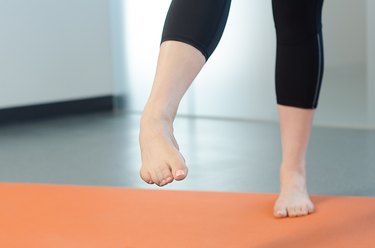
To increase ankle and big toe mobility, Schneider recommends writing the alphabet with your big toe. This exercise will combat muscle and tendon tension on the top of the foot that results from tight shoelaces and running shoes that artificially flex the toes.
- Sit or stand comfortably.
- Lift the foot a few inches off the floor and write the alphabet in the air with your big toe, beginning with uppercase letters.
- Exaggerate downward strokes. Once you reach the end of the alphabet, write lowercase letters.
- Repeat on the other foot.
Reps: perform periodically throughout the day
The Asterisk
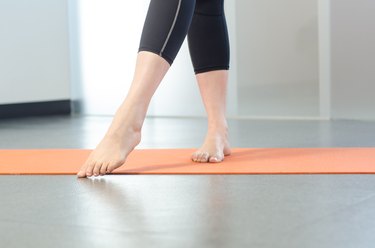
This exercise strengthens the heel, the big toe and the little toe. It also increases ankle mobility under full body weight, taxing the ankle in a manner similar to running, Schneider says.
- Stand tall with your weight on the right leg.
- Point your right toe and tap the floor in front of the left toe.
- Return to start, then tap directly in front of you.
- Repeat, moving counter-clockwise.
- End by tapping the pointed foot behind and across the other foot.
- Repeat on the left side moving clockwise.
Reps: perform periodically throughout the day
Bent-Knee Heel Raises
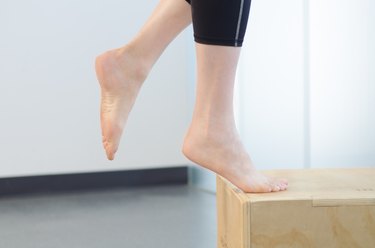
Bent-knee heel raises strengthen the collagen within the Achilles tendon, training it to withstand the impact of your foot striking the ground, Loberg says.
- Stand on a bench or box, heels hanging over the edge.
- Steady yourself by placing hands on wall in front of you.
- Transfer weight onto your left leg.
- Lower left heel toward floor, then push up to raise heel above height of box or bench.
- Keep leg bent throughout. Repeat on right leg.
Reps: 2 sets 15 reps per leg three times a week
Band Ankle Strengthening
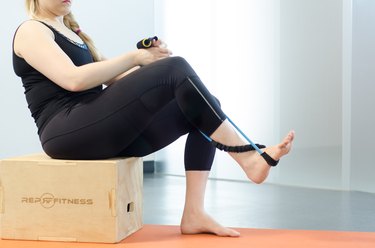
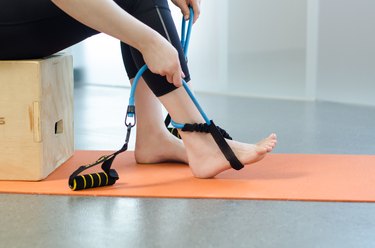
To prevent ankle injuries, you have to strengthen the ankle joint and increase its range of motion. Band ankle strengthening accomplishes both tasks, so when you inevitably slip or get caught off-balance during a run, your ankle will be stable enough to handle the impact.
- Hold a resistance band behind your left ankle.
- Wrap the right part of the band over the foot and around the left side the arch; loop under the arch and back across the foot, as pictured.
- Hold the ends of the resistance band at the inside of the leg.
- Straighten your leg to create tension, keeping your left foot straight and pivoting it side to side.
- Maintain tension in the band throughout the movement.
- When your foot begins to fatigue, switch feet. Perform the exercise throughout day.
Multi-Directional Single-Leg Hops
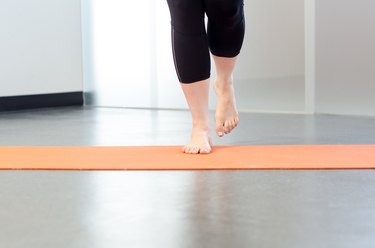
If your hips are weak when running, your body will compensate by sending greater impact to the foot and ankle with every step, thereby increasing risk of injury. Single-leg hops not only strengthen hips, but coordinate foot, ankle and hip movement.
- Stand on your left leg and jump forward, landing softly with your knee bent.
- Return to start and repeat the movement in different directions, going counter-clockwise until 6 o'clock.
- Perform five times on left leg before switching to the right, this time moving clockwise.
Reps: 3 sets of 5 reps per side three times a week