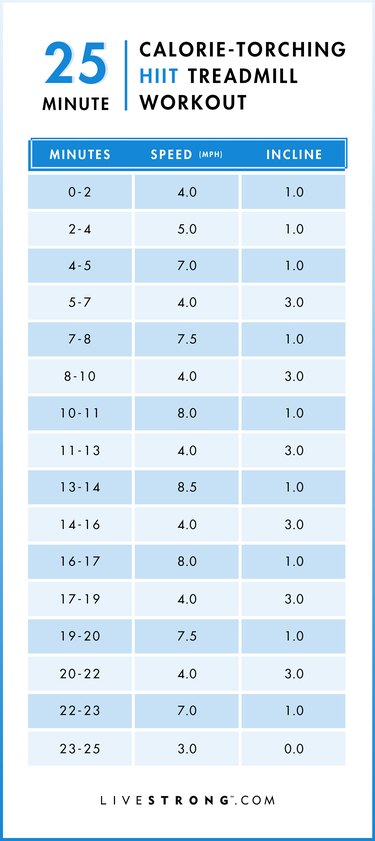
High-intensity interval training can take your old treadmill workout from blah to BOOM! Instead of plodding away incessantly at a steady pace, vary your pace with periods of intensity and periods of recovery. Not only will HIIT keep you from boredom burnout, but you'll also potentially burn more calories and get fitter in less time.
The Details
Video of the Day
Running and sprinting are intense activities that many people can't sustain for a long time, but they carry a lot of benefits for your weight and cardiovascular health. HIIT allows you to exercise with more intensity than you normally would, because you don't have to sustain that intensity through the entire workout.
Video of the Day
When you push yourself in a HIIT workout, you reap the benefits, which include improved aerobic fitness, increased total fat and belly fat loss, lower blood pressure and blood sugar and an improved cholesterol profile.
You can achieve all the benefits of a HIIT session in as few as 20 minutes if you are willing to exercise beyond your comfort zone.
Don't Skip the Warm Up
Warm up on the treadmill for 10 minutes. Walk or jog at a very slow pace to encourage blood flow to your muscles and get your body ready for higher intensity activity. After the warm-up you're going to dramatically increase the intensity; doing so without a proper warm up could lead to injury.
Once you've warmed up, increase your pace to your normal walking, jogging or running pace. This should be at a moderate intensity at an exertion level of five or six on a scale of zero to 10. Maintain this pace for a couple minutes.
Let 'Er Rip
Once you've established your base pace, it's time to speed things up. Whether you're running or walking, you're going to increase the pace to an exertion level of seven or above. At that level, you're working hard. You begin to sweat more heavily, your breathing becomes more labored and you would find it difficult to carry on a conversation if you had to.
This pace will vary depending on your fitness level. If you've only been walking during your workouts, increasing your pace to a jog could feel very hard. If you've been running for a while, sprinting is going to take everything you've got.
The goal during these intense work sessions is to work close to or at your maximum heart rate, or MHR. Your MHR is, theoretically, your highest possible heart rate, although many people can exceed this. It's used to determine your target heart rate zones so you can know when you're working at a moderate or intense pace.
To find MHR, subtract your age from 220. As a general rule, your heart rate during work periods should be about 80 to 95 percent of MHR.
Work periods may last between 5 seconds and 8 minutes depending on your goals and how intensely you're working.
Take a Break
At this point, if you're working heard enough, you're ready for a break. Depending on a few variables, you'll either slow down a little or a lot. If, for example, you're sprinting at an all-out pace, you might need to come back to a jog or fast walk, rather than a run. If you're keeping your recovery periods short, you'll also need a lower intensity because you'll have less time to recover.
But for clarity's sake, you're going to reduce your pace to a comfortable place where your heart rate can come down to about 40 to 50 percent of MHR. Stay here for about as long as your work period. The ratio between work to recovery varies depending on your pace and goals, but typically it's 1:1, 1:2 or 1:3, work to recovery.
Read more: The Fat Loss From Long Cardio vs. HIIT
Keep It Going
For the duration of your workout, you'll continue to alternate between work and recovery periods. Try to be consistent, even when you get tired. However, if you're finding it hard to sustain the work periods, you may need to either reduce the intensity or increase recovery time.
At the end of your workout cool down by walking for five minutes. HIIT workouts typically last between 20 and 60 minutes, including warm up and cool down.
Ready to give it a try? Follow this HIIT treadmill workout on your next indoor run. Happy HIIT-ing!