It's Not That Simple
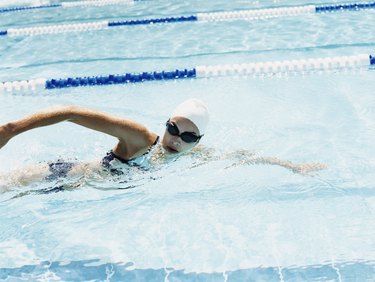
A 150-pound athlete burns about 272 calories by swimming 1,500 yards in 30 minutes. Swimming butterfly for the same amount of time will burn 38 percent more calories, while breaststroke burns only 25 percent more and backstroke burns 12 percent less. A 120-pound athlete burns only 218 calories swimming the same 1,500-yard workout (60 lengths in a 25-yard pool).
If all those numbers left your head swimming, remember that calories burned depends on stroke, effort, speed, gender, weight and skill. Most swimmers swim a mix of strokes at various intensities, so calorie counts should be taken with a grain of salt.
In general, the faster an athlete swims, the more calories she will burn in an hour. For example, if the 150-pound swimmer in the previous example can swim one more length per minute, she will burn 102 more calories in the same 30 minute period. If you do the math, that actually works out to almost half a calorie LESS per length. Surprised? In swimming, efficiency is more important than effort. The Exercise and Sports Science Review has shown that competitive male swimmers expend only 280 calories to swim a mile (about 70 lengths), while swimmers of average ability will incinerate about 440 calories to cover the same distance. At that rate, how can swimming faster possibly burn more calories? Even though efficient swimmers burn fewer calories per lap, they cover more distance in the same period of time. All those extra lengths can add up to over 100 additional calories in 30 minutes.
Swimming Compared to Other Exercise
A study by Jang, et al., in 1987 found that collegiate male swimmers and distance runners burn equal numbers of calories in training. Female swimmers actually burned more calories than their on-land counterparts. This is probably because competitive swimmers do more high-intensity intervals, which burn more calories and require more energy for recovery than the steady efforts frequent in a distance runner's training.
Many studies have been done to find out why elite swimmers, on average, have 5 percent more body fat than other endurance athletes. Luise Burke reviewed several studies published in the American Journal of Sports Medicine and International Journal of Sports Medicine in her book Practical Sports Nutrition. She concluded that these studies failed to provide satisfactory answers to the puzzle (see references below for more information). Swimmers' high body fat percentages remains a mystery.
Best Workout for You
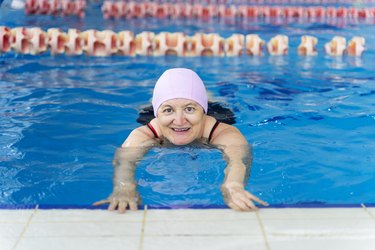
Swimming is an excellent full-body aerobic workout, burning as many calories per hour as running or cycling at the same intensity. It is a safe option for overweight, elderly and pregnant athletes whose bodies cannot handle high-impact sports. If swimming floats your boat, then keep at it. It doesn't matter if you're splashing around with your kids burning 400 calories an hour, or burning 748 calories per hour honing your butterfly for the Olympic trials. Any kind of swimming burns calories. Whatever sport gets you off the couch most often is the one that will burn the most calories in the long run.


Member Comments