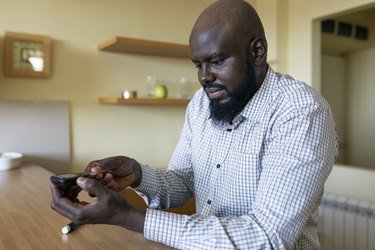
Your doctor took a blood sample at your annual physical and you just got the report: You have high glucose levels, also called high blood sugar levels. What does that mean for you and what should you do about it?
High Glucose and Diabetes
Video of the Day
When you eat, your body breaks food down into glucose, a form of sugar, explains the American Diabetes Association (ADA). That glucose is carried through your bloodstream to your cells and tissues, which use it for energy. (Some types of tissues can also store glucose to use later.)
Video of the Day
The hormone insulin plays an important role in this process. It helps transfer sugar out of your bloodstream and into the cells that will use or store it, says ADA. A high blood glucose level means this process isn't working the way it should because your body can't make enough insulin, doesn't use it effectively or both.
It's not a situation to be ignored, even though you may not have any symptoms yet. Prediabetes — when your blood sugar level is higher than normal but not high enough to be considered diabetes — can develop into diabetes if you don't make needed lifestyle changes, according to the American Academy of Family Physicians. Diabetes, undiagnosed or untreated, can lead to serious complications over time, including heart disease, blindness and kidney failure as a result of your blood sugar being too high all the time, according to the Mayo Clinic.
There are two main kinds of diabetes. Says Robert H. Eckel, MD, president of medicine and science at the ADA, "90 to 95 percent of diabetes is type 2 diabetes." Type 1 diabetes develops most often in young people, the ADA notes, although it can also be diagnosed in adulthood. A third type, gestational diabetes, occurs during pregnancy.
Read more: Normal Glucose Levels in Men and Women
What’s Considered High Glucose in a Blood Test?
If your doctor asked you to avoid eating and drinking for several hours before your blood test, you likely had what's called a fasting blood sugar test. According to Mayo, a fasting blood glucose test result of less than 100 milligrams per deciliter is considered normal. If your result was between 100 and 125, your doctor may evaluate you for prediabetes, and if your result was 126 or higher, your doctor likely will evaluate you for diabetes.
A1C Test for Blood Glucose
If your fasting blood sugar result was above the normal range, your doctor may repeat the test to confirm it or may order a hemoglobin A1C test, which shows blood sugar levels over the past three months. "That fasting value only gives us a certain snapshot of how the person is doing," says Deena Adimoolam, MD, an assistant professor of endocrinology at the Icahn School of Medicine in New York City. "The hemoglobin A1C will help us to understand how long this issue has been going on and how high the person's blood glucose levels have been over a certain amount of time."
A hemoglobin A1C result of 6.5 percent or higher confirms a diagnosis of type 2 diabetes. An A1C result between 5.7 and 6.5 percent is considered prediabetes. While prediabetes puts you at higher risk of developing type 2 diabetes, Dr. Eckel notes that your A1C result can give you a clearer picture of your risk. "If your hemoglobin A1C is 5.8 or 5.7, that chance of developing type 2 diabetes is less than if it's 6.3 or 6.4," he says.
Read more: How Your Body Handles Excess Glucose
How Can I Lower My Blood Glucose?
If you've been diagnosed with diabetes, follow your doctor's instructions for taking medicines and monitoring and managing your blood sugar.
If you have prediabetes, here's what you can do to reduce your risk for developing diabetes:
- Lose weight if you're overweight. "Diabetes is increasingly more common, and the largest driving force is the excess body weight people carry these days," says Dr. Eckel.
- Be physically active. You may be able to prevent or delay type 2 diabetes by exercising 150 minutes a week and losing about 7 percent of your body weight, according to the Mayo Clinic.
- Eat a healthy diet. That means fewer sugary or processed foods and more vegetables, fruits, whole grains and lean proteins.
- Mayo Clinic: “Diabetes: Diagnosis”
- Mayo Clinic: “Diabetes: Overview”
- American Diabetes Association: “Blood Sugar and Insulin at Work”
- U.S. National Library of Medicine: “Blood Glucose Test”
- American Academy of Family Physicians: “Prediabetes”
- Robert H. Eckel, MD, president, medicine and science, American Diabetes Association.
- Deena Adimoolam, MD, assistant professor, endocrinology, Icahn School of Medicine, New York City.
Was this article helpful?
150 Characters Max
0/150
Thank you for sharing!
Thank you for your feedback!
Is this an emergency? If you are experiencing serious medical symptoms, please see the National Library of Medicine’s list of signs you need emergency medical attention or call 911.