
A low-back disc herniation can be a harrowing experience. One minute you're going about your day and the next you're laid up with pain, numbness or tingling into your back and legs. Luckily, in many cases, this issue is treatable and doesn't require surgery. With a little knowledge and some specific L4-L5 spine exercises, it's possible to get back to feeling like your normal self.
Tip
Core-strengthening exercises targeting the abdominal, back and hip muscles can help alleviate the pain associated with an L4-5 disc herniation.
Video of the Day
What Is a Disc Herniation?
The bones in your back, called the vertebrae, are stacked one on top of another and are separated by discs. These discs contain a tough outer layer, known as the annulus, and a jelly-like inner layer, known as the nucleus.
Video of the Day
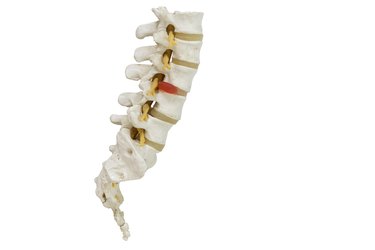
In the case of a herniation, the nucleus of the disc begins to push through the annulus and, in some cases, goes into the spinal canal. When this occurs, it can contact the nerves along your spine and cause numbness, tingling, pain and weakness down the legs.
What Does L4-L5 Control?
A 2016 study published in the Journal of Neurosurgery found that over 90 percent of low-back disc herniations involved the L4-5 or L5-S1 levels (the two lowest vertebral levels in the spine).
In an L4-5-level herniation, the L5 spinal nerve is usually involved. This nerve supplies the sensation to the outside of your lower leg and to the top of your foot and may cause pain in these areas. In addition, the muscles that move your foot and big toe in an upward direction may be affected since the L5 nerve controls their movement.
Can Exercise Help?
If you're unlucky enough to experience a herniated disc, it's probably a relief to know that surgery is not your only option. A 2014 study in Clinical Rehabilitation found that 70 percent of low-back discs that extrude or herniate can move back in without surgery.
Conservative treatments like L4-L5 disc bulge exercises, physical therapy, pain relievers or epidural injections are normally helpful in facilitating the pain relief.
Try Some L4-L5 Spine Exercises
Core stabilization workouts, which target the muscles in the abdomen, hips and pelvis, may be helpful in relieving your L4-L5 disc bulge symptoms. A 2015 study published in the International Journal of Clinical and Experimental Medicine found that patients with a lumbar disc herniation who followed a 12-week spinal stability program showed significant improvements in both pain and overall function.
Try the following exercises for a bulging disc in the lower back.
Activate Your Transversus Abdominis
The transversus abdominis is a core muscle that lies deep within your abdomen. A 2018 study in the Journal of Manipulative and Physiological Therapeutics found that improving the activation of this muscle was associated with lower pain and better day-to-day function in patients with a lumbar disc herniation.
HOW TO DO IT: Lie on your back with your knees bent to a 90-degree angle. Without allowing your back or pelvis to move, draw in your abdominal muscles and hold the contraction for 10 seconds before relaxing again. Be sure not to hold your breath. Complete three sets of 10 repetitions.

Perform the Pelvic Bridge
The pelvic bridge targets the gluteus maximus, a large muscle that provides support and stability to the low back.
HOW TO DO IT: Lie on your back and bend your knees. Begin by tensing your abdominal muscles and then lift your butt in the air. Hold it there for five seconds before lowering back down to the floor. Again, try three sets of 10 reps.
Do Some Bird Dogs
The multimuscle technique known as bird dogs strengthens the muscles in the hips and abdomen while keeping the low back in a relatively neutral position.
HOW TO DO IT: Get on your hands and knees and squeeze your stomach muscles. Without allowing your pelvis to drop, lift your right arm out in front of you and extend your left leg behind you.
Hold this position for 10 seconds before lowering your arm and leg and repeating the exercise with the opposite arm and leg. Complete this movement 10 times on each side.
Add a Side Bridge
The side bridge, also known as a side plank, activates a muscle on the outer portion of the hip called the gluteus medius.
HOW TO DO IT: Lie on your side and prop yourself up on your forearm with your elbow underneath your shoulder. Keeping your knees straight, lift your hips off the floor as you rise on to your forearm and feet. Try to keep your spine from rolling forward or backward.
Hold this position for five to 10 seconds before lowering to starting position. Complete 10 repetitions per side.

Give Planks a Try
Planks focus on a variety of spine-stabilizing abdominal muscles, including the rectus abdominis and the internal and external obliques.
HOW TO DO IT: Lie on your stomach with your elbows on the floor beneath your shoulders and your arms shoulder-width apart. Keeping your abs squeezed, lift your body off the floor as you go on to your toes and forearms. Don't allow your low back to sag as you maintain the plank for 10 seconds. Repeat the exercise 10 times.
Is Walking Good?
Following an acute episode of low-back pain from a disc herniation, it's important to remain active and to avoid bed rest. In addition to the L5 lower-back pain exercises, Mayo Clinic recommends trying to continue with your daily activities and adding in walking to your routine.
Start off with a shorter walk and increase the distance as your pain allows. As the symptoms subside over the next few weeks, more strenuous cardio exercises, like biking or swimming, may also be added as pain allows.
Warnings and Precautions
While exercises for a bulging disc in the lower back may help relieve your pain, it's important to speak to your doctor if certain red flag symptoms are present. These include intense or constant low- back pain, weakness in one or both legs, bowel or bladder problems, fever, abdominal pain or unexplained weight loss.
Be sure to call your physician immediately if you have any of these symptoms as they could signify a more serious issue.
- American Association of Neurological Surgeons: Herniated Disc
- Journal of Neurosurgery: Clinical Outcomes After Percutaneous Transforaminal Endoscopic Discectomy for Lumbar Disc Herniation: A Prospective Case Series
- Current Reviews in Musculoskeletal Medicine: Lumbar Disc Herniation
- Clinical Rehabilitation: The Probability of Spontaneous Regression of Lumbar Herniated Disc
- International Journal of Clinical and Experimental Medicine: Comparison of Lumbar Spine Stabilization Exercise Versus General Exercise in Young Male Patients With Lumbar Disc Herniation After 1 Year of Follow-Up
- Journal of Manipulative and Physiological Therapeutics: Comparison Between Transcutaneous Electrical Nerve Stimulation and Stabilization Exercises in Fatigue and Transversus Abdominis Activation in Patients With Lumbar Disk Herniation
- International Journal of Sports Physical Therapy: Electromyographic Analysis of Gluteus Maximus, Gluteus Medius, and Tensor Fascia Latae During Therapeutic Exercises With and Without Elastic Resistance
- Journal of Sport Rehabilitation: A Systematic Review of Rehabilitation Exercises to Progressively Load the Gluteus Medius
- Journal of Electromyography and Kinesiology: Comparison of EMG Activity on Abdominal Muscles During Plank Exercise With Unilateral and Bilateral Additional Isometric Hip Adduction
- Harvard Health Publishing: Herniated Disc
- Mayo Clinic: Symptom Checker: Low Back Pain
- Mayo Clinic: Back Pain
Is this an emergency? If you are experiencing serious medical symptoms, please see the National Library of Medicine’s list of signs you need emergency medical attention or call 911.