





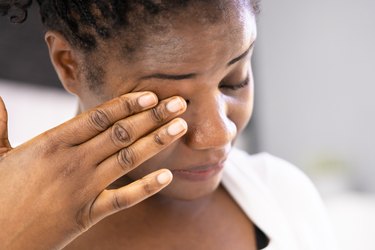























Subconjunctival hemorrhages, or burst eye capillaries, produce bright red spots in the white of the eye. The affected eye may also feel full or become slightly irritated. In most cases, it is not serious and resolves on its own in a couple of weeks. However, it may also be a sign of an underlying disease. A physician should be consulted if this condition occurs in both eyes at the same time or multiple times, or if it causes pain or changes in vision. To treat and possibly prevent burst eye capillaries, it is important to understand the common causes.
Sneezing and Coughing
The eye contains a thin membrane that covers the inner surface of the eyelid and the white part of the eyeball, called the conjunctiva. Just underneath this layer are many small blood vessels. While the exact cause of a burst eye capillary may remain unknown, vomiting, a strong sneeze, or forceful and repeated coughing can cause this symptom, states the Mayo Clinic. Since the conjunctiva is unable to quickly absorb extra blood, the red spot could remain for a few weeks.
Straining and Heavy Lifting
Lifting heavy objects or straining to push or pull an object can also be an underlying cause of burst eye capillaries, explains the Columbia University Medical Center. Conditions that cause an increase in eye pressure or damage to the eye's blood vessels, such as high blood pressure or diabetes, raise the risk. Burst eye capillaries are also more common in patients who take blood-thinning medications. Since the cause for this condition is often unknown, no definitive steps can be taken to prevent it. However, it is always best to avoid straining to lift a heavy object, especially for those who have conditions that raise the risk.
Inflammatory Conditions
According to MedlinePlus, several conditions can lead to eye inflammation and possibly a subconjunctival hemorrhage. This includes conjunctivitis, or pinkeye, and uveitis. These conditions should always be evaluated by a medical professional. To help control the redness, avoid rubbing the eyes. Applying a warm compress and resting the eye can also help.
Injuries
Any injury or irritation to the eye can also contribute to a burst capillary. This can include getting poked in the eye or having something stuck in the eye. If the conjunctiva becomes scratched or irritated from sand, wind, dust or pollen, a red spot may appear. To prevent this from happening, wear protective eyewear if eye injuries can occur at work and also to protect the eyes on days that are windy, recommends the Columbia University Medical Center.


Member Comments