






























































Inner Ear & Yoga Balance

Inner Ear & Yoga Balance
Photo Credit Yoga image by Yvonne Bogdanski from Fotolia.com

In general, yoga is known to increase your body’s balance. Yoga stimulates your nervous system and strengthens an organ in your inner ear called the labyrinth, which controls your feeling of balance. Inner ear issues can make you feel dizzy while your body is still. This problem usually results from a head injury or a disease, such as labyrinthitis, Meniere syndrome and benign paroxysmal positional vertigo, according to the Mayo Clinic.

Significance

Certain yoga postures can naturally rehabilitate your inner ear function--without the use of medications. Yoga postures slowly move the fluid through the canals of your labyrinths, which helps you to activate the sensors in your ears. According to the Vivekananda Yoga Anusandhana Samsthana, a yoga research foundation, yoga therapy challenges and corrects your body’s balancing system and increases your ability to focus while in different postures.

Types

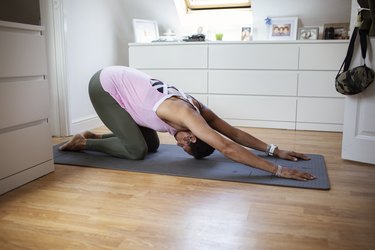
The Malasana, Ardha Matsyendrasana and Halasana poses are recommended to effectively restore inner ear balance. To try the Malasana pose, squat with the buttocks a few inches from the floor. Keep your feet together and flat on the floor. Widen your knees slightly wider than your torso. Exhale and slowly move forward to position your torso between your thighs. Grab the back of your ankles and gradually lean your forehead as close as you can to the floor, while keeping your gaze focused on elements in the room while you move. If you need additional support, stretch your arms in front of you along your ears and touch your fingertips to the floor. Hold this position for 30 to 60 seconds.
Other therapeutic postures for the ears are the Ardha Matsyendrasana, also known as the “half spinal twist,” and the Halasana, or “plough posture.” To accomplish the half spinal twist, sit on your right thigh with knees bent. Bring the left leg over the right side of the bent right knee and put your foot on the floor. Place your arms in front of your left leg and at your sides as you twist to the right. Breathe deeply, and repeat on the left side with your right leg over your left knee.
You can do the plough posture by simply lying flat on your back and raising your legs straight and together at a 90-degree angle from the floor. Continue lifting your legs towards your head as far as you can. Hold for eight breaths, and gently return your legs to the floor.

Effects

The effects that the inner ear has on balance are to minimize the feeling of spinning and to keep your vision clear and focused. When there is an issue with the inner ear and balance, people complain of symptoms of intense uncontrollable spinning as if they are riding a roller coaster.

Benefits

Yoga can assist in energizing your nervous system, strengthening your core abdominal muscles and working your inner ear fluid to gently add pressure on the sensory hairs within your labyrinth, all of which increases your balance.

Warning

There are yoga poses that may cause inner ear issues and vertigo, so be careful when deciding which yoga moves are appropriate for your body. Yoga moves to avoid if you are concerned about your inner ears are those that completely invert you such as the bridge or upward bow, which is also called Urdhva Dhanurasana. Consult with your doctor if you have a current inner ear issue, before any exercise. Also, if you have any medical conditions ask your yoga instructor to customize a yoga routine for your body.

References

Article reviewed by demand32474 Last updated on: Apr 29, 2012

Must see: Photo Galleries