






































Shingles, according to the National Institute of Neurological Disorders and Stroke, is the common name for the disease that results from reactivation of the varicella-zoster virus---the virus that causes chickenpox during its first manifestation---within the roots of the nerves. Facial symptoms of shingles reflect involvement of the cranial nerves, which supply motor and sensory functions to the face. Specific symptoms vary by the area of the face that is involved.
Rash
Shingles cause a one-sided blistering rash on the skin that also affects the mucous membranes of the mouth, the lining of the eyelids and the ear canals. On skin, says National Institutes of Health dermatologist Stephen E. Straus in the 2008 edition of "Fitzpatrick's Dermatology in General Medicine," blisters appear as clusters of 2 mm to 3 mm, elliptical lesions filled with clear fluid on a base of red, swollen skin. Within the mouth and the eye lids, the blisters rupture almost immediately, leaving behind yellow-gray, shallow depressions about the same size as a blister, also surrounded by red, raised tissue. Blisters typically develop in crops, says Straus, so it's not uncommon to see many lesions in different stages of development.
Asymmetry
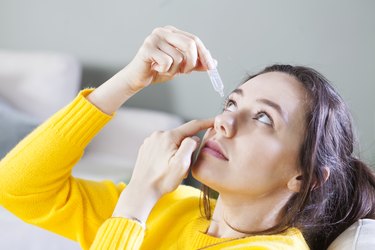
Facial shingles results in marked asymmetry because the virus disrupts the motor fibers that supply one half of the face. Common complaints, according to University of Alabama Professor Richard J. Whitely, M.D. in the 2008 edition of "Harrison's Principles of Internal Medicine," include one-sided facial droop, asymmetrical smile or frown, difficulty completely closing one eye, and impaired tearing and salivation. Patients who exhibit facial asymmetry should be advised to tape the affected eye closed during sleep, wear eye protection such as glasses or sunglasses whenever possible and frequently apply lubricant eye drops to avoid permanent damage to the cornea due to abrasions or dryness.
Sensory Deficits
Facial shingles affects the eyes, ears and mouth. Because cranial nerve five supplies taste sensation to the front two-thirds of the tongue, says Whitely, significant decreases in taste sensations are typical. Involvement of cranial nerve seven results in hearing loss, ringing in the ears, loss of balance and vertigo, according to MayoClinic.com. Eye involvement occurs in 10 percent to 30 percent of shingles cases, according to Mayo Clinic ophthalmologist Thomas J. Liesegang in a 2008 review published in the medical journal, "Ophthalmology." Symptoms range from irritation and eye pain that is often severe to blindness. Patients who experience eye symptoms of facial shingles should contact their doctors immediately, advises Liesegang.
References
- "Harrison's Principles of Internal Medicine, 23rd Edition"; A.S. Fauci et al.; 2008
- "Fitzpatrick's Dermatology in General Medicine, 7th Edition"; K. Wolff et al.; 2008
- MayoClinic.com: Ramsay Hunt Syndrome
- National Institute for Neurological Disorders and Stroke: Shingles: Hope Through Research
- "Ophthalmology"; Herpes Zoster Ophthalmicus; T.J. Liesegang; February 2008


