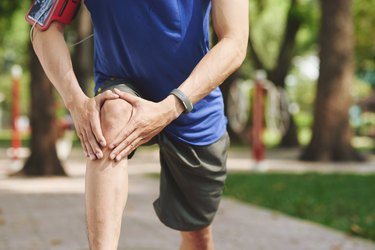
Your knee is a complex part of your body. Various ligaments and bones, different types of cartilage, and the iliotibial band are located in and around your knee.
A number of problems with these structures can lead to pain on the outside of your knee. These problems are often the result of repeatedly bending your knee during sports or during years and years of everyday activities. Trauma to the knee can also lead to outside knee pain. Treatment depends on the underlying cause.
Video of the Day
Video of the Day
1. Iliotibial Band Syndrome
Iliotibial band syndrome is a type of overuse syndrome that produces outer knee pain. The iliotibial band is a strip of fibrous tissue running along the outside of your leg from your pelvis to the upper part of your tibia — the larger of your two lower leg bones. With repeated knee bending, the band repeatedly rubs against the outside of the lower part of your thigh bone, producing inflammation and pain.
The pain from iliotibial band syndrome typically worsens when walking up or down stairs or a hill. Running and cycling are common activities that lead to this syndrome. Unbalanced thigh muscle strength, inadequate stretching, poor training, inappropriate footwear and flat feet may also contribute.
2. Patellofemoral Syndrome
Patellofemoral syndrome, also known as runner's or jumper's knee, is another type of overuse syndrome caused by a misaligned kneecap, or patella. The patella usually travels up and down a path called the trochlear groove as the knee bends and straightens. This groove is located in the lower part of the thigh bone, or femur. In patellofemoral syndrome, the patella is pushed out of the groove toward the outside of the leg.
Patellofemoral syndrome produces pain in the front or outside of your knee. The pain is particularly noticeable with such activities as squatting, sitting with your knees bent, walking up stairs and jumping. Patellofemoral syndrome is more common in women than in men. Patellar misalignment is often caused by imbalance of the thigh muscles.
3. Knee Osteoarthritis
Osteoarthritis occurs when repeated movement of a joint, often during years and years of everyday activities, causes destruction of articular cartilage. This cartilage is the slippery material covering the ends of your bones within joints, allowing the bones to slide smoothly across each other. As the cartilage wears away, your bones begin to grind against each other and become irritated, causing pain.
When articular cartilage on the outer part of your knee joint wears out, the result is outside knee pain. Factors that contribute to knee osteoarthritis include older age, obesity and a previous knee injury.
Osteoarthritis of the knee typically causes early-morning knee stiffness that improves as you move around, difficulty standing up from a sitting position, and difficulty climbing stairs. Other types of arthritis involving the knee, such as rheumatoid arthritis, psoriatic arthritis or gout, may also cause outer knee pain.
4. Lateral Collateral Ligament Injury
Knee trauma, especially during sports, may injure ligaments of your knee joint — strong fibrous bands connecting your femur and lower leg bones. The lateral collateral ligament is the ligament joining these bones on the outer, or lateral, part of your knee.
This ligament can be sprained or torn when a force on the inside of your knee pushes the knee outward, overstretching the ligament. When this injury occurs, you may feel a snap and your knee may become unstable. Injuries to the lateral collateral ligament are less common than most other knee injuries. They are often caused by a tackle in football or a car accident.
5. Lateral Meniscus Tear
Knee trauma may also injure the menisci — two C-shaped pieces of cartilage located deep within the knee joint that cushion and stabilize your knee. Outside knee pain commonly develops when you tear the lateral meniscus.
This can occur when your upper leg suddenly turns in one direction while your foot remains firmly planted in another direction. In addition to being painful, a torn meniscus may cause your knee to catch or lock, making it difficult to straighten. Your knee may also give way when you try to stand on that leg.
Other Causes
Pain in your lower back or hip sometimes travels to your knee. This pain may feel like a burning sensation on the outside of your knee. Other causes of outside knee pain include muscle strain involving muscles attached to the outside of your knee joint, injury or compression of a nerve or artery that runs along the outside of your knee, or fracture of the femur or lower leg bones within or near the outer part of your knee joint.
Next Steps
Depending on the cause of your pain, treatment may include a combination of therapies, such as rest, medications, physical therapy and knee bracing. In some cases, surgery might be needed.
See your doctor if you experience frequent, persistent or worsening outer knee pain, especially if it does not improve after a few days of rest or it interferes with your usual activities. Seek immediate medical care if you cannot put weight on your knee or if you have severe pain, especially if it was caused by a fall, sports injury or accident.
Reviewed by Mary D. Daley, M.D.
- National Institute of Arthritis and Musculoskeletal and Skin Diseases: Knee Problems
- Knee Surgery, Sports Traumatology, Arthroscopy: Patellofemoral Pain Syndrome
- American Family Physician: Evaluation of Patients Presenting With Knee Pain: Part II. Differential Diagnosis
- North American Journal of Sports Physical Therapy: Clinical Testing for Extra-Articular Lateral Knee Pain. A Modification and Combination of Traditional Tests
- American Academy of Orthopedic Surgeons: Common Knee Injuries
- Journal of the American Academy of Orthopedic Surgeons: Iliotibial Band Syndrome -- Evaluation and Management
- Emory Healthcare: IT Band Syndrome
- American Academy of Orthopedic Surgeons: Patellofemoral Pain Syndrome
Is this an emergency? If you are experiencing serious medical symptoms, please see the National Library of Medicine’s list of signs you need emergency medical attention or call 911.