


































































How Many Calories Are Burned Doing Various Exercises?

How Many Calories Are Burned Doing Various Exercises?
Photo Credit Jupiterimages/Goodshoot/Getty Images

Calculating the amount of calories burned during a specified exercise is far from a perfect science. We can come close, but it is an estimate. The amount of calories burned depends on many factors, including intensity of work performed, body weight, body/skill efficiency, age, sex, body composition and size.

Exercise

To calculate the amount of calories burned doing one of the activities below, use the following equation:

(Number given below) * (Body weight in pounds) * (Time in hours) = Calories burned

The following is a list of the calories per hour per pound of body weight burned during exercise at a comfortable pace:

Badminton: 2.6
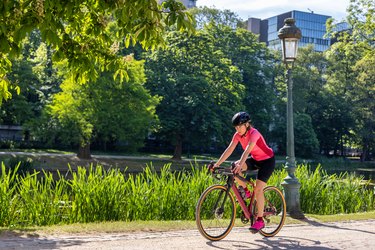
Bicycling, 10 mph: 2.7
Dancing, ballroom: 1.6
Dancing, modern: 2.6
Golf, walking: 2.3
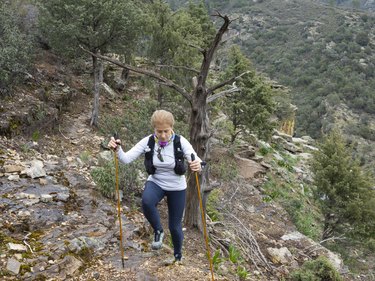
Hiking, hills: 3.6
Horseback riding, trot: 2.8
Jogging, 6 mph: 4.2
Jumping rope: 3.8
Racquetball: 4.1
Rowing machine: 3.1
Scuba diving: 3.8
Skating, ice: 2.6
Skiing, downhill: 2.6
Skiing, cross-country: 3.7
Snowshoe walking: 4.5
Soccer: 3.7
Squash: 4.3
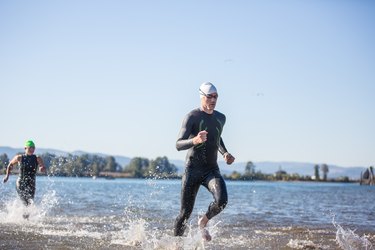
Swimming, slow crawl: 3.5
Table tennis: 1.9
Tennis, singles: 2.9
Tennis, doubles: 1.8
Volleyball: 2.2
Walking, 3.5 mph: 2.4
Water-skiing: 3.0
Weight training: 1.9

Daily Work Activities

The following is a list of the calories per hour per pound of body weight burned during daily activities at a comfortable pace:

Farming, light: 2.3
Farming, heavy: 3.2
Gardening, hoe, dig: 3.2
Chopping wood: 2.3
Horse grooming: 3.5
House cleaning: 1.6
Mopping: 1.7
Painting, outside: 2.1
Sawing, by hand: 3.3
Scrubbing floors: 2.9
Snow shoveling, light: 2.9

Beware of Straight Numbers

Tables and figures like the ones above are a good estimate of how many calories are burned only while performing the actual task, but they do not take into account the anaerobic aspects of exercise and the excess postexercise oxygen consumption (EPOC). As an example, weight training burns fewer calories while performing it than does walking, but weightlifters have less fat and are in better shape (as a general rule) than people who just walk. There are several reasons for this, two of which being:

• Weightlifting builds muscle, which in turn raises the body's basil metabolic rate (BMR). BMR is the amount of calories needed to sustain basic cellular functions. Therefore, when BMR is raised, you burn a greater amount of calories 24 hours a day.

• EPOC from weightlifting, sprinting and other anaerobic activities causes elevated metabolic rates above resting levels. This means you are burning calories after you are done participating in said activities.

The majority of tables documenting calories burned during exercise do not take into account these factors. Therefore, actual number of calories burned by participating in various activities, particularly those anaerobic in nature, is greater than stated.

References

  • Physiology of Sport and Exercise; Jack H. Wilmore and David L. Costill; 2004
  • Sports Nutrition Guidebook; Nancy Clark; 1997

Article reviewed by demand305 Last updated on: Aug 11, 2011

Must see: Photo Galleries

Member Comments