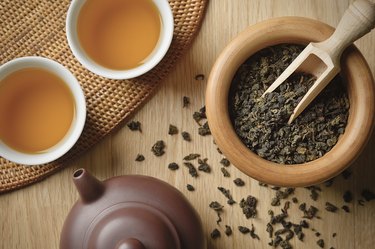
You might have heard a lot about the benefits of tea, especially when it comes to green tea. But what about oolong tea? Is there actually a connection between this type of tea and weight loss? Does oolong tea have side effects?
Like green tea, oolong tea has several compounds that can promote weight loss and, unlike unnatural weight-loss supplements, oolong tea doesn't cause side effects in most people.
Video of the Day
Video of the Day
What Is Oolong Tea?
Tea originated in China thousands of years ago and has since spread throughout the world, becoming the most commonly consumed beverage worldwide, after water. There are many different types of tea, from black to green to herbal, and each type comes with its own health benefits, many of which are similar.
One specific type — oolong tea — is especially rich in compounds called polyphenols, which are credited with most of the health benefits of tea.
Like black and green tea, oolong tea comes from the leaves of the Camellia sinensis, or C. sinensis, plant. While black tea and green tea are made through the processes of full fermentation and nonfermentation, respectively, oolong tea is made through semi-fermentation. That puts it right in the middle of the spectrum between green and black teas.
Beneficial Compounds in Oolong Tea
Most of the health benefits of oolong tea, and tea in general, are due to its high content of polyphenols, which is a general term that encompasses hundreds of different beneficial and health-promoting plant compounds. Polyphenols are connected to a wide variety of benefits, including reduced risk of heart disease, cancer and some neurodegenerative diseases.
One of the major classes of polyphenols in tea that's connected to weight loss is a group of compounds called catechins. Other beneficial compounds in oolong tea include:
- Caffeine
- Theanine
- Gamma-aminobutyric acid
- Vitamin C
Oolong Tea and Weight Loss
According to a report published in the American Journal of Clinical Nutrition in December 2013 that followed more than 1,200 adults for a period of 10 years, people who drank tea regularly had a 19.6 percent lower body fat percentage and a 2.1 percent smaller waist-to-hip ratio than people who weren't regular tea drinkers.
The researchers from the study credited this weight loss and body fat reduction in large part to the catechins found in the tea. Since oolong tea is only partially oxidized, it contains a higher amount of a specific catechin called epigallocatechin gallate, or EGCG, than black tea.
Although the mechanisms of how EGCG helps boost weight loss aren't completely understood, researchers believe that it helps boost the amount of calories you're able to burn and helps you break down and burn off fat more efficiently.
The Effect on Digestion
Another way oolong tea may help promote weight loss is by shutting down the activity of certain enzymes that are involved in digestion. According to a report published in Molecules in May 2018, the polyphenols in the tea specifically act on the enzymes pancreatic lipase, amylase and glucosidase.
When these enzymes are shut off, your body can't absorb fats and sugars as effectively, so the amount of calories that are absorbed decreases and you lose weight (or at least don't gain weight as quickly or easily).
The same report also described the importance of short-chain fatty acids, or SCFAs. When exposed to certain compounds, the bacteria that naturally live in your digestive tract produce SCFAs as a byproduct.
These SCFAs travel from the small intestine to the blood and then eventually to the liver. When they reach the liver, they can increase the amount of calories and fat you burn and slow down the conversion of simple carbohydrates, like glucose, into fat.
Although green tea is often hailed as the best tea for you, the study noted that the polyphenols in oolong tea (and black tea) actually allow your body to produce more SCFAs than the polyphenols in green tea.
Oolong Tea's Effect on Bacteria
The polyphenols in oolong tea also positively effect the bacteria in your gut, which can boost weight loss and benefit your health in a number of other ways. Because approximately 90 percent of the polyphenols in tea pass through the digestive system unabsorbed, they go right to the bacteria in your gut, feeding them and helping to boost the good bacteria and kill the bad bacteria.
When the good bacteria outnumber the bad and your digestive ecosystem is balanced, it helps to balance the hormones (ghrelin and leptin) that signal hunger and satiety, that improve the way your body responds to glucose and insulin and that have a positive effect on the amount of body fat you store.
In other words, your blood sugar stays balanced, your body burns fat instead of storing it and you feel hungry only when truly hungry and full when you've had enough to eat. All of these factors together can boost weight loss and help you reach your weight goals.
Read more: 13 Surprising and Beneficial Probiotic Foods
The Caffeine in Oolong Tea
Oolong tea also contains caffeine, which can boost metabolism and increase the amount of fat your body burns by stimulating the central nervous system. According to the December 2013 American Journal of Clinical Nutrition report, caffeine has these weight-loss benefits on its own, but when it's combined with the catechins in oolong tea, the effect may be even greater.
Researchers from the study noted that when people consume the same amount of caffeine without the added catechins, they don't experience the effects to the same degree.
Although oolong tea and black tea are different as a result of processing and fermentation methods, they contain similar amounts of caffeine. An 8-ounce serving of oolong tea contains around 37 to 38 milligrams of caffeine, which is about one-fourth of the amount of caffeine in the same amount of coffee.
Read more: 10 Everyday Ailments Soothed by Tea
A Healthy Diet Approach
Even though the facts about oolong tea and weight loss point to the positive effects of including oolong tea in your diet, you have to keep in mind that the tea can't take the place of a healthy diet and lifestyle. It's only a portion of it. If you're trying to lose weight, you have to eat right and exercise, in addition to drinking tea.
The good news is that, unlike other supplements and medications, oolong tea side effects are almost nonexistent, so it's safe for most people. Of course, it's always a good idea to talk to your doctor before including anything new in your diet, especially when you're trying to lose weight.
- American Journal of Clinical Nutrition: "Catechin- and Caffeine-Rich Teas for Control of Body Weight in Humans"
- Nutrients: "Effects of Coffee and Tea Consumption on Glucose Metabolism: A Systematic Review and Network Meta-Analysis"
- Molecules: "A Review on the Weight-Loss Effects of Oxidized Tea Polyphenols"
- Food and Function: "Six Types of Tea Reduce High-Fat-Diet-Induced Fat Accumulation in Mice by Increasing Lipid Metabolism and Suppressing Inflammation"
- Molecules: "Beneficial Effects of Tea and the Green Tea Catechin Epigallocatechin-3-Gallate on Obesity"
- International Journal of Food Properties: "Alternative Treatments for Weight Loss: Safety/Risks and Effectiveness of Anti-Obesity Medicinal Plants"
- Journal of Zhejiang University Science B: "Tea and Human Health: Biomedical Functions of Tea Active Components and Current Issues"
- Harvard T.H. Chan School of Public Health: "Other Healthy Beverage Options"
- Mayo Clinic: "Caffeine Content for Coffee, Tea, Soda and More"
- USDA National Nutrient Database for Standard Reference: "Beverages, Tea, Oolong, Brewed"
- European Food Information Council: "Polyphenols"