



















































Broken blood vessels in the skin often occur from sun exposure or other skin damage, appearing most frequently on the face and legs as people age. Broken blood vessels, often called telangiectasia, can also develop as part of a disease such as rosacea, a skin condition that causes dilated and broken blood vessels on the face. A number of treatments can eradicate broken blood vessels.
Intense Pulsed Light Therapy
Intense pulsed light therapy, or IPL, targets the lower layer of skin, the dermis, while leaving the upper layer intact. Intense pulsed light therapy delivers high intensity light energy to specific areas of damaged skin. The damaged areas are more highly colored and attract light energy. Intense pulsed light therapy takes about 20 minutes per session and may require a course of four to six treatments every three to six weeks to achieve desired results, notes DermNet NZ. Some people feel a small amount of discomfort during the procedure; topical anesthetics and cooling gels can decrease sensation and discomfort during the procedure. The skin may appear sunburned or may feel tender after the procedure. Sun exposure must be avoided before and after the treatment for as long as several weeks. Bruising at the site occurs in 10 percent of people, says DermNet NZ.
Laser Therapy
During laser therapy, laser light energy of a specific wavelength is aimed at the lesions to destroy the blood vessels. Many lesions, particularly nasal lesions, require more than one laser treatment, the Rosacea Guide reports. Laser treatment can be mildly to moderately uncomfortable. The most common side effect is bruising, which usually resolves within seven to 10 days. Other side effects may include crusting at the site, which occurs in 20 percent of people and lasts five to seven days; and pain and redness, which normally resolve within 24 to 48 hours, says the Rosacea Guide. Sun exposure should be avoided for the period prescribed by the physician.
Sclerotherapy
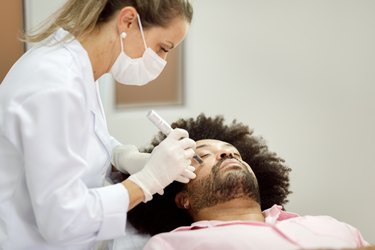
During sclerotherapy, a technique used to treat varicose and spider veins, a doctor injects sodium chloride or another solution directly into the blood vessel, irritating the lining of the blood vessel. The sides swell and stick together, causing blood within the vessel to clot. Scar tissue forms in the damaged vessel over time, and the blood vessel disappears over a period of weeks or months. Sclerotherapy, which can cause mild discomfort, normally takes 30 to 40 minutes a session. In 50 to 80 percent of cases, one injection eliminates the problem, the Cleveland Clinic reports. Less than 10 percent of veins don't respond to the treatment at all. Skin discoloration and bruising can occur at the site after treatment. Brown spots that may occur from iron leakage at the site remain permanently about 5 percent of the time.


