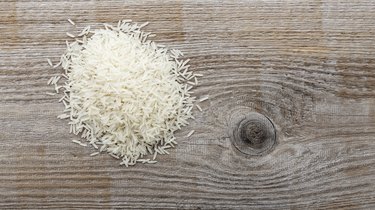
Fragrant basmati rice is frequently used as the base for pilafs or paired with curries. Like all other types of rice, this long-grain Indian variety is available in both brown and white forms.
Brown basmati rice retains its outer bran layer. As a result, brown basmati rice nutrition contains more fiber and nutrients than white basmati rice, which has been milled and stripped of its bran. The U.S. Department of Agriculture recommends that at least half of the grains you eat daily should be whole grains like brown rice.
Video of the Day
Video of the Day
Read more: Which Rice Is Healthiest for Consumption?
Basmati Rice Calories and Carbs
A 1/4-cup serving of uncooked white basmati rice contains 160 calories, while the brown version has 170 calories, according to the USDA. It does not contain any fat.
White basmati rice has 35 grams of carbohydrates in each 1/4-cup serving, while brown basmati rice carbs are slightly higher, with a 1/4 cup providing 37 grams. The two differ primarily in how much of these carbohydrates come from dietary fiber.
The fiber in basmati rice is less than impressive. Only 1 gram of the carbohydrates in white basmati rice is contributed by dietary fiber, while a 1/4-cup serving of brown basmati rice has 2 grams. For a man, this amount is 5 percent of his recommended daily allowance of fiber; for a woman, it supplies 8 percent of her requirement per day, according to the National Academies of Sciences.
Pump Up Your Protein
White and brown basmati rice protein clocks in at 3 and 4 grams. This amount supplies approximately 6 to 7 percent of a man's recommended daily protein intake and 7 percent to 9 percent of a woman's.
The protein in basmati rice is incomplete since it does not have all of the amino acids required by your body. You can complete basmati rice's protein without consuming any animal-based protein sources by eating a variety of whole grains, beans, legumes and produce throughout the day.
Read more: How Is White Rice Healthy for Our Body?
Consider the Enriched Version
Brown basmati rice is a source of minerals like iron and B vitamins such as thiamine, niacin and folate, though it does not contain a high concentration of any of these.
For rice that supplies more vitamins and minerals per serving is white basmati rice that's been enriched. A typical serving of cooked white rice contains 38 micrograms of folate, which is 4 percent of the recommended daily allowance for healthy adults, according to the National Academies for Sciences.
Watch Your Salt Intake
Too much salt in a person's diet can contribute to high blood pressure. According to the American Heart Association, daily sodium intake should be limited to a maximum of 2,300 milligrams per day — or 1,500 milligrams if you have risk factors for heart disease.
With the exception of the fortified version, which contains 1 milligram, basmati rice does not contain any sodium. However, common rice seasonings, such as soy sauce, can add a significant amount of sodium to your rice dish. According to the USDA, 1 tablespoon of soy sauce has a whopping 1,005 milligrams of sodium.
- U.S. Department of Agriculture: "All About the Grains Group"
- USDA National Nutrient Database: "Brown Basmati Rice"
- USDA National Nutrient Database: "White Basmati Rice"
- National Academies of Sciences: "Macronutrients"
- National Academies of Sciences: "Vitamins and Minerals"
- American Heart Association: "How Much Sodium Should I Eat Per Day?"
- USDA National Nutrient Database: "Soy Sauce Made From Soy (Tamari)"