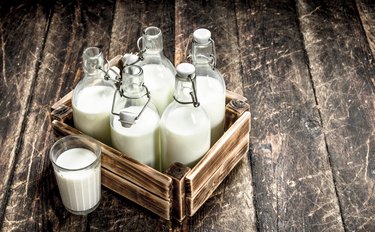
The Dietary Guidelines for Americans considers milk products to be an important part of a healthy diet. However, many milk products are considered to be very rich in carbohydrates, particularly for people following ketogenic and other low-carb diets. Although such diets don't have to be dairy free, few milk products are compatible with them as they tend to strictly limit carbohydrates.
Read more: 16 Diet-Friendly Healthful Carbs
Video of the Day
Video of the Day
Healthy Diets and Milk Consumption
The Dietary Guidelines for Americans recommends that most people who consume a standard 2,000 calorie diet should ingest about 3 cups of dairy each day. The healthiest products are considered to be fat-free or low in fat.
Dairy includes a variety of products, including milk, yogurt and cheese. Dairy can even include fortified soy products.
Fortified soy drinks contain nutrients like calcium, vitamin A and vitamin D. These products are considered to be equivalent to dairy products because they have similar nutritional profiles compared to other beverages made from animal milk. However, other plant-based products aren't considered to be equivalent.
Macronutrients in Milk
The macronutrients in milk are somewhat variable depending on whether or not you're choosing a fat-free or full-fat product. Milk products are particularly rich in protein. In each cup (8 ounces), they provide:
- 8.3 grams of protein for skim (fat-free) milk
- 8.2 grams of protein for 1 percent low-fat milk
- 8.1 grams of protein for 2 percent low-fat milk
- 7.7 grams of protein for full-fat milk
- 7 grams of protein for unsweetened soy milk
The amount of fat is the most variable between types of milk. In each cup (8 ounces), they have:
- No fat for skim (fat-free) milk
- 2.4 grams of fat for 1 percent low-fat milk
- 4.8 grams of fat for 2 percent low-fat milk
- 7.9 grams of fat for full-fat milk
- 4 grams of fat for unsweetened soy milk
While animal milk-based products have similar amounts of carbohydrates, soy beverages have much less. In each cup (8 ounces), they supply:
- 12.2 grams of carbohydrates for skim (fat-free) milk
- 12.2 grams of carbohydrates for 1 percent low-fat milk
- 11.7 grams of carbohydrates for 2 percent low-fat milk
- 11.7 grams of carbohydrates for full-fat milk
- 4 grams of carbohydrates for unsweetened soy milk
According to the Food and Drug Administration, the daily values for macronutrients in a standard diet are 300 grams of carbohydrates, 65 grams of fat and 50 grams of protein per day. However, dietary macronutrients can vary substantially. Low-carb diets are quite different to standard diets as they want people to consume far less carbohydrates and much more fat.
Low-Carb Diet and Weight Loss
Although they were originally created to help treat epilepsy, low-carb diets have become popular methods for weight loss. Low-carb diets alter macronutrient ratios so that you're consuming about the same amount of protein, but much more fat and far fewer carbohydrates. Typically, dieters count net carbs, which are carbohydrates other than the ones that come from fiber and sugar alcohols.
Low-carb diets can be somewhat liberal or may be very strict. One of the most liberal low-carb diets is the Atkins 100 diet, a variation of the standard Atkins diet that has followers consume about 100 net carbs per day. In contrast, a strict low-carb diet is the ketogenic diet, which has followers consume 20 net carbs per day or less.
Most people who aim for low-carb diet weight loss consume as few carbs as possible. Around 20 net carbs each day is usually considered to be a reasonable reduction. This amount of carbohydrates allows you to limit unhealthy carb-heavy foods but integrate nutrients from healthy foods, like fibrous vegetables, nuts and fatty fruits into your diet.
Carbs in Milk
Since milk doesn't have any fiber, this means that all of the carbohydrates in this beverage count toward the limited number of net carbs low-carb dieters are allowed. A fairly liberal low-carb diet, like Atkins 100, might let you consume a cup (or even multiple cups) of milk each day. However, a cup of milk would be unreasonable for people on stricter ketogenic diets.
Since there are about 12 carbs in milk per cup, drinking a single cup of milk on a strict ketogenic diet would mean you would only have eight net carbs left to consume in a day. This is not a large amount of carbohydrates: Eight net carbs is more than half a cup of cooked tomatoes, equivalent to 3 tablespoons worth of garlic and just under 1 cup of cooked Brussels sprouts.
Going dairy free on keto diets is by no means necessary, but other fat-rich dairy products, like butter, cream and hard cheeses are much more commonly consumed on low-carb diets compared to milk. If you're keen on drinking milk and are on a low-carb diet, fortified, unsweetened soy milk may be the best option as it has just a third of the carbohydrates per cup.
Saturated Fat and Milk
Although the Dietary Guidelines for Americans suggests consuming 3 cups of dairy per day, they recommend consuming low-fat or fat-free products. This is because the saturated fat in animal products is bad for your health.
According to the American Heart Association, most people should consume no more than 13 grams of saturated fat per day. Excessive consumption of saturated fat can increase your cholesterol and risk of heart disease and stroke. Many milk products are rich in saturated fat. Even 1 percent milk, which has substantially reduced amounts of fat, has 1.5 grams of saturated fat per cup.
Saturated Fat and Low-Carb Diets
Many people on a low-carb or ketogenic diet consume a large amount of saturated fat since these diets are high in fat and low in carbs. However, most of these fats should ideally be coming from plant-based sources, providing you with healthy polyunsaturated and monounsaturated fats.
Skim milk has virtually no saturated fat (0.1 grams of saturated fat per cup). However, its carbohydrate content makes it unsuitable for most low-carb diets. However, soy milk has just 0.5 grams of saturated fat per cup. If you're keen to drink milk on a low-carb diet, soy milk is probably the healthiest and most suitable choice.
- American Heart Association: The Facts on Fats Infographic
- MyFoodData: Nutrition Comparison of Unsweetened Soy Milk, Low-fat Milk 2%, Whole Milk, Low-fat Milk 1%, and Skim Milk
- Health.gov: Dietary Guidelines for Americans, 2015-2020, Eighth Edition
- U.S. Food and Drug Administration: Total Carbohydrates
- U.S. Food and Drug Administration: Protein
- Atkins: List of Low Carb Foods for Atkins 20, Phase 1
- U.S. Food and Drug Administration: Total Fat
- Journal of Clinical Neurology: Efficacy of and Patient Compliance With a Ketogenic Diet in Adults With Intractable Epilepsy: A Meta-Analysis