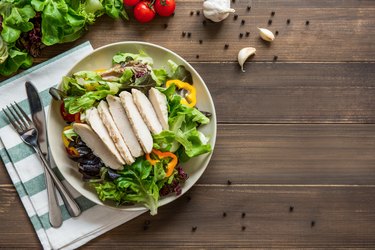
People rarely think about their bones, much less what's inside them. Without healthy bone marrow, your body can't make the white and red blood cells that support oxygen transportation, blood clotting and a strong immune system. Eating protein, iron and B vitamins will help bone marrow do its job.
Bone Marrow Basics
Video of the Day
Marrow is a spongy material found inside most of the bones in the body. It contains stem cells that develop into red and white blood cells and platelets. Each type of blood cell has an important function:
Video of the Day
- Red blood cells transport oxygen throughout the body.
- White blood cells support the immune system to fight infection.
- Platelets are required for proper blood clotting.
There are two types of white blood cells:
- Neutrophils and macrophages fight bacterial and fungal infections by consuming germs.
- Lymphocytes fight fungal, viral and bacterial infections. T lymphocytes, or T cells, attack germs.
Bone contains two different types of marrow: red and yellow. Red marrow contains the stem cells that become red and white blood cells and platelets, while yellow marrow is comprised primarily of fat.
Protein-Packed Bone Marrow Foods
Protein is a component of all your body's cells and tissues — your organs, bones, muscle, fat and connective tissue. It's even part of your blood, which is considered a connective tissue. A deficiency in protein can compromise bone marrow health and the production of healthy blood cells, according to a study published in the journal PLOS One in March 2013.
The Food and Nutrition Board of the National Academies of Medicine has set a recommended daily intake of protein of 46 grams per day for people assigned female at birth (AFAB) and 56 grams per day for people assigned male at birth (AMAB). These estimates are based on an average of 0.8 grams per kilogram of body weight. Whether you are AMAB or AFAB, if you weigh 155 pounds, you need about 56 grams daily. During pregnancy and lactation, aim for around 71 grams daily.
The best sources of protein are lean meats, poultry without skin, fish, beans, lentils, yogurt, milk, eggs, nuts and seeds. Some examples of the amounts of protein in one serving of these blood-building foods, according to Johns Hopkins Medicine, include:
- 3 ounces of beef, chicken, turkey, pork and lamb: 21 grams
- 3 ounces of tuna fish: 21 grams
- One egg: 6 grams
- One-half cup lentils: 9 grams
- One-half cup black, kidney and navy beans: 8 grams
- 3 ounces of tofu: 9 grams
- 1 ounce of nuts: 4 to 6 grams
- 5 ounces of nonfat Greek yogurt: 12 to 18 grams
- One-half cup cottage cheese: 14 grams
- One-third cup quinoa: 6 grams
These lean and healthy sources of protein also come packed with other nutrients you need to strengthen bone marrow.
Vitamins for Bone Marrow Health
Getting adequate amounts of all 13 essential vitamins is crucial for healthy bone marrow. But some of the B vitamins play an especially important role in supporting healthy red blood cell production.
Both vitamin B12 and folic acid, or B9, help the body make red blood cells to carry oxygen throughout the body. A deficiency in either of these nutrients leads to a condition called anemia. With vitamin B12 deficiency anemia, the body can't make enough red blood cells. With folate deficiency anemia, the body produces fewer red blood cells, and those it does produce are abnormally large and misshapen. They also may die more quickly than healthy red blood cells.
Symptoms of the two conditions are similar, reports the National Institutes of Health (NIH):
- Fatigue
- Weakness
- Shortness of breath
- Irritability
- Tender and smooth tongue
- Diarrhea
- Decreased appetite
- Heart palpitations
Other symptoms of B12 anemia may include:
- Dizziness
- Neurological changes
- Numbness and tingling in the hands and feet
- Poor balance
- Depression
- Confusion
- Dementia
- Memory problems
The daily recommended intake for B12 for adults is 2.4 micrograms, 2.6 micrograms for pregnant people and 2.8 micrograms for people who are breastfeeding, according to the NIH. B12 is found naturally only in animal foods, but some plant foods are fortified with the nutrient. The best sources include:
- Cooked clams: 84.1 micrograms per 3 ounces
- Beef liver: 70.7 micrograms per 3 ounces
- Cooked wild rainbow trout: 5.4 micrograms per 3 ounces
- Cooked sockeye salmon: 4.8 micrograms per 3 ounces
- Canned light tuna fish: 2.5 micrograms per 3 ounces
- Fortified breakfast cereal: 1.5 micrograms per serving
- Low-fat milk: 1.2 micrograms per cup
The recommended intake for folate for adults is 400 micrograms, 600 micrograms for pregnant people and 500 micrograms for people who are breastfeeding, according to the NIH.
Folate is found abundantly in plant foods, such as:
- Boiled spinach: 131 micrograms per one-half cup
- Boiled black-eyed peas: 105 micrograms per one-half cup
- Fortified breakfast cereals: 100 micrograms per serving
- Boiled asparagus: 89 micrograms in four spears
- Boiled frozen Brussels sprouts: 78 micrograms in one-half cup
- Cooked white rice: 54 micrograms in one-half cup
Iron and Red Blood Cells
The mineral iron is an essential part of hemoglobin, a red blood cell protein that transports oxygen from the lungs to all the tissues in the body. Dietary iron is used by the bone marrow to create red blood cells, and an iron deficiency can result in anemia.
Iron deficiency anemia has symptoms similar to those of folate and B12 deficiency anemias:
- Fatigue
- Weakness
- Sore tongue
- Dizziness
- Shortness of breath
Additional symptoms specific to iron deficiency anemia include:
- Sensitivity to cold
- Restless leg syndrome
- Pica — a desire to chew ice or non-food items, including dirt
- Loss of interest in work, relationships, recreation and intimacy
People AMAB need 8 milligrams of iron each day, but people AFAB have different daily iron needs at different life stages. Before menopause, they need 18 milligrams of iron each day to account for blood loss during menstruation. After menopause, those needs decrease to 8 milligrams daily. During pregnancy, iron needs greatly increase to 27 milligrams; during lactation, they drop to 9 milligrams.
Foods contain two types of iron — heme iron found in animal foods and non-heme iron found in plant foods. Heme iron is more bioavailable than non-heme iron. In addition, its absorption is less affected by other dietary components. For example, the non-heme iron in spinach may be poorly absorbed because it contains plant chemicals called polyphenols that inhibit iron absorption.
According to NIH, sources of heme iron include:
- Cooked oysters: 8 milligrams in 3 ounces
- Pan-fried beef liver: 5 milligrams in 3 ounces
- Sardines canned in oil: 2 milligrams
- Braised beef: 2 milligrams in 3 ounces
Non-heme iron can be found in:
- Canned white beans: 8 milligrams per cup
- Dark chocolate: 7 milligrams in 3 ounces
- Boiled lentils: 3 milligrams per one-half cup
- Firm tofu: 3 milligrams per one-half cup
NIH reports that approximately 14 to 18 percent of iron in a mixed diet containing plant and animal foods is bioavailable, while vegetarian diets may provide 5 to 12 percent of bioavailable iron. If you eat a strict vegetarian diet, talk to your doctor about whether you are getting enough iron to support healthy red blood cell production.
- UCSF: "What Is Bone Marrow?"
- NIH: "NCI Dictionary of Cancer Terms"
- Open Oregon State: "Anatomy & Physiology: 4.3 Connective Tissue Supports and Protects"
- PLOS One: "Protein Malnutrition Induces Bone Marrow Mesenchymal Stem Cells Commitment to Adipogenic Differentiation Leading to Hematopoietic Failure"
- National Academies of Medicine: "Summary Tables, Dietary Reference Intakes"
- Johns Hopkins Medicine: "Protein Content of Common Foods"
- Johns Hopkins Medicine: "Vitamin B12 Deficiency Anemia"
- Johns Hopkins Medicine: "Folate-Deficiency Anemia"
- NIH: "Folate"
- NIH: "B12"
- NIH: "Iron"
- University of Utah: "Diseases of Iron Metabolism:
- Iron Disorders Institute: "Iron Deficiency Anemia"
Is this an emergency? If you are experiencing serious medical symptoms, please see the National Library of Medicine’s list of signs you need emergency medical attention or call 911.