
















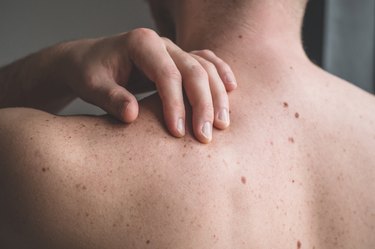







































Any red bumps that appear on your upper torso also can appear on your breasts. Many times these bumps are a common occurrence and some bumps don't even need treatment. A few types of red bumps on the breasts, however, can indicate a serious problem, and knowing how to differentiate between common bumps and problematic bumps is critical. If there is ever any doubt, consult your doctor for a definitive diagnosis.
Eczema and Paget Disease
Eczema is a common skin condition and common on the breasts. If you have had eczema before and it appears the same and is on both of your breasts, it may be just another outbreak. However, if your regular eczema treatments don't clear it up soon, it is safer to have it checked. If the red bumps appear to be eczema but are only on one breast and on the nipple or the surrounding areola, it must be evaluated by your doctor. There is a chance that it may be Paget disease of the nipple, which is a malignant condition. In men, Paget disease is rare, but aggressive.
Fox-Fordyce Disease
Another benign condition sometimes seen on the areola, Fox-Fordyce disease appears as flesh-colored to reddish bumps, which are caused by clogged apocrine gland ducts. These bumps only appear on the areola, underarms and pubic areas, as these are the only locations of these special sweat glands. The bumps usually itch, sometimes enough to disturb sleep. These spots are located near hair follicles. They are most common in women aged 13 to 35, but also can occur in children and men.
Seborrheic Keratosis
Seborrheic keratosis can develop anywhere on the body, including the areola. The medical text "Clinical Dermatology" explains that it usually appears much like a wart or mole and may enlarge and darken with time. These bumps can become red if they are irritated, as by clothing. They may resemble a melanoma, and so should be evaluated. If the bumps are diagnosed as seborrheic keratosis, they are harmless and may be removed for cosmetic reasons.
Inflammation
The skin of the breast itself can become infected. Red bumps can be localized infections, as with acne. Injury can cause a deeper infection. However, any sudden or large redness or swelling of breast tissue must be diagnosed. The rare but aggressive condition inflammatory breast cancer can occur with or without a lump in the breast. Early diagnosis and treatment is essential. This disease is also seen in men, but usually at an older age, according to the National Cancer institute.
Skin Infection
Red bumps on the skin of the breast can be from insect bites, allergies or infectious diseases. Another cause of red bumps on the breast is hot tub folliculitis, which is a skin infection caused by the pseudomonas aeruginosa bacteria. It can occur on the breasts as red bumps as well as on other skin areas, usually where the swimsuit covers the skin. This is an unsightly and itchy condition, but usually is self limited and may not require treatment. You can prevent this infection by avoiding exposure to contaminated water and by proper treatment of your own hot tub.
Cherry Angioma
If the red bumps are small and don't itch or hurt, and just seem to have appeared for no reason, they may be cherry angiomas. These tiny vascular malformations appear as you get older, as soon as age 30 in some people. They are very common on the torso, and are harmless but permanent. Cherry angiomas increase in number as you age, and almost everyone gets them. They vary in color, but often are bright red.
Caution
Breast cancer is usually not visible on the breast surface in its early stages. Paget disease and inflammatory breast cancer are exceptions to that. Have any changes in breast tissue evaluated by your doctor if they don't go away completely with simple treatment. Even the most benign breast conditions can be itchy or unsightly, and professional help may rid you of symptoms.
References
- DermNet NZ: Fox-Fordyce Disease
- "Clinical Dermatology, Third Edition"; Thomas P. Habif, M.D.; 1996
- National Cancer Institute: Inflammatory Breast Cancer, Questions and Answers
- "Harrison's Principles of Internal Medicine, 17th Edition"; Anthony Fauci, Eugene Braunwald, Dennis Kasper, Stephen Hauser, Dan Longo, J. Jameson, Joseph Loscalzo; 2008
- "Atlas of Internal Medicine"; Braunwald, editor; 2010
- National Cancer Institute: Paget Disease of the Nipple


