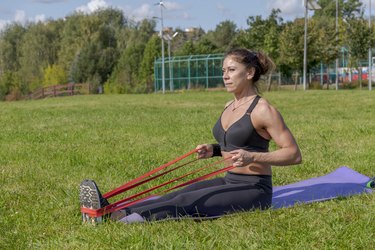
Posture often breaks down due to excess time spent crouched in front of a computer, cradled in a couch or confined to a chair. But your workout can help improve your posture — as long as you're focusing on the right muscles, particularly your upper back and shoulders.
In order to keep your shoulders pulled back and down, your first order of business is to strengthen the backs of the shoulders, known as the posterior deltoids. You also want to train the large diamond-shaped upper-back muscle called the trapezius and the rhomboids, positioned at the back of the shoulder blades and responsible for scapular retraction. And lastly, you'll need to increase chest flexibility.
Video of the Day
Integrate several of these exercises to pull shoulders back into your regular shoulder or back workouts, working up to 3 sets of 8 to 12 repetitions.
Tip
While performing these pulling exercises for shoulders (and periodically throughout the day), draw your abdominals in and up, as if you had a small zipper that starts at your pelvic floor and rises up your spine.
This action will stabilize your torso to give your shoulders a solid platform. The abdominals and the upper back muscles work as a team to create a healthy and upright spine.
1. Rear Deltoid Row
Use a barbell, dumbbells or a cable machine (or a resistance band) to perform rear deltoid rows. Many variations of each version exist, but the key to any of them is to keep your elbows perpendicular to the body as your row to emphasize the backs of your shoulders.
This move uses the posterior deltoids primarily, as well as the rhomboids and upper/middle trapezius for assistance.
Chest-Supported Dumbbell Row
- Lie prone (on your stomach) on a workout bench inclined to 45 degrees.
- Hold a dumbbell in each hand and allow your arms to hang down toward the floor.
- Pull your elbows back, in line with your shoulders, as you squeeze your upper back and rear shoulders together.
- Lower the weights back down to complete one rep.
Barbell Bent-Over Row
- Hold the barbell with a wide overhand grip.
- Lean forward from your hips until your back is parallel to the floor.
- Bend your elbows to pull the barbell up toward your upper chest — elbows flaring out to the sides of the room.
- Extend your elbows and lower the weight back down for a complete rep.
Tip
To perform this move on a cable machine, sit upright at a seated pulley station fixed with a bar attachment. Hold the bar with a wide grip and pull it to and from your chest as you squeeze your shoulder blades together. Keep your elbows parallel to the floor and pointed to the sides of the room to best target the upper back and shoulders.
2. Reverse Fly
A dumbbell or cable machine helps you execute the reverse fly exercise. It helps you train the shoulders to remain retracted, so you stand taller and straighter.
- Lean forward from your hips until your back is parallel to the floor.
- Hold a dumbbell in each hand and allow your palms to face one another.
- With a slight bend in your elbows, open your arms widely to squeeze the shoulder blades together.
- Draw the arms back together to complete one rep.
Tip
To use a cable machine, face a dual pulley machine, feet planted hip-distance apart. Grasp the handle of the right pulley in your left hand and the handle of the left pulley in your right hand. The cables will cross.
Step back slightly to feel tension in the cables. Open your arms to squeeze your shoulder blades together. Maintain straight arms with a slight softness in the elbows. Pause, and release to start.
3. Y Raise
The Y raise is also known by the formal name: prone scapular retraction. It's simple to perform with or without light dumbbells. This move can be done daily as it's about functional strength and won't overly tax your muscles.
- Lie on your belly on a mat.
- Stretch your legs behind you as your arms extend wide and above your head so you look like the letter "Y."
- Keep your legs and the tops of your feet connected to the floor as you slowly raise your arms, head, chest and fronts of the shoulders. Try to maintain the arms at the same height as the head by squeezing your shoulder blades together.
- Pause for a count or two and lower back down for one rep.
4. Chest Stretch
Opening up and stretching the front side of your chest undoes forward rounded posture and trains your shoulders to stay more integrated down your back. Do these moves multiple times per day to seal in the benefits.
Tight chest muscles can limit your ability to keep your shoulders back. Stretch these muscles with the chest opening stretch.
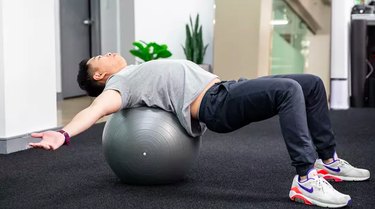
- Lie back on a rounded pillow, stability ball or workout bench.
- Reach your arms out to the sides of the room and let them hang open to release the muscles of your chest.
- Hold light weights in each hand to increase the stretch as long as it doesn't create too intense of a sensation.
- Hold 20 to 30 seconds.
5. Shoulder Roll

- Stand or sit up straight with your arms resting at your sides.
- Shrug your shoulders up as far as possible toward your ears. Hold for three to five seconds, then relax. Repeat 10 times.
- Next, roll your shoulders: Shrug them up toward your ears, then slowly roll them shoulders back and down.
- Continue to make a circle by bringing your shoulders forward and back up. Circle backward 10 times, then forward 10 times.
6. Cobra Pose
The cobra pose stretches tight abdominal muscles that can limit your ability to keep your shoulders back.
- Lie on your belly on the floor, legs extended behind you.
- Align your hands under the creases of your armpits and squeeze your elbows in against your ribs.
- Lift up your face, chest and fronts of the shoulders. Keep little weight in your hands — let the squeeze of your shoulders do the lifting work.
- Hold for 20 to 30 seconds.
7. Standing Lat Stretch
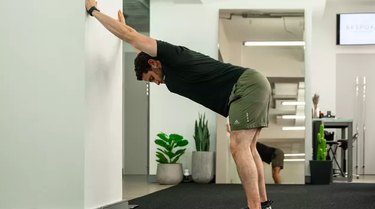
- Find a ledge that is approximately chest-height, such as a fireplace mantle. You can also perform this stretch by placing your hands on a wall at the same height.
- Grasp the ledge with your hands shoulder-width apart and keep your back flat.
- Keeping your arms still and straight, slowly hinge forward at your hips. Allow your head to drop toward your chest.
- Sink down until you feel a stretch on the sides of your upper and mid-back.
Was this article helpful?
150 Characters Max
0/150
Thank you for sharing!
Thank you for your feedback!