
Gone are the days when lifting weights was just for bodybuilders and pro athletes. In fact, the Physical Activity Guidelines for Americans recommend that all adults do at least two full-body strength-training workouts each week.
Why? Because the benefits of strength training extend to every aspect of your physical, mental and emotional health, Jason Li, CPT, a certified personal trainer and weightlifting coach with SoHo Strength Lab in New York City, tells LIVESTRONG.com.
Video of the Day
Video of the Day
Already lift on the regular? Or just aren't convinced you need to strength train? (Trust us, you do.)
Whatever your current relationship with weights, here are 13 strength training benefits worth celebrating.
1. Strong Muscles
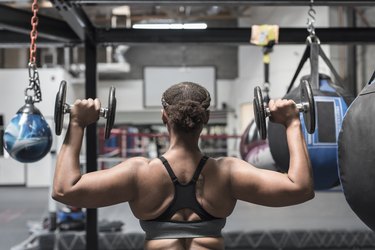
Strength training involves any activity that works your muscles against resistance (why it's also called resistance training). And by stressing your muscles, it stimulates them to grow and become stronger.
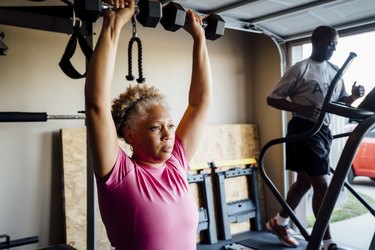
It happens fast. In fact, in one August 2020 study in the Journal of Aging and Physical Activity, older adults significantly improved their total-body muscle strength after just 16 hour-long resistance workouts.
2. Healthy Body Fat Levels
Weightlifting for fat loss isn't just a thing — it might the thing. Strengthening your muscles has a significant effect on your body's fat cells. In a large December 2014 Obesity study, Harvard researchers found that, minute per minute, strength training does more to regulate age-related abdominal fat than does cardio. There are multiple reasons.
Challenging weightlifting exercises trigger a temporary metabolic boost, called excess post-exercise oxygen consumption, or EPOC, according to the American Council on Exercise. That's because your body needs extra oxygen to cool down and repair itself after weight training. What's more, over the long term, building lean muscle mass increases your resting metabolic rate.
Strength training may also support healthy body fat levels by affecting hormone levels and reducing inflammation.
3. Mental and Emotional Health
Many people first pick up weights for the physical health benefits of weightlifting, but stick with it for the mental and emotional ones.
Research, including a May 2018 study in JAMA Psychiatry, has shown that resistance training reduces the frequency and severity of depressive symptoms. And that's regardless of physical changes. It also help in the management of anxiety.
Strength training increases levels of feel-good chemicals (like endorphins and endocannabinoids) in the brain. It also affects levels of drain-derived neurotropic factor (BDNF), which supports brain health.
4. Self Confidence
"Most people don't start out able to do great push-ups or pull-ups, but training to achieve these things and unlocking those new skills is highly motivating," certified strength and conditioning specialist Albert Matheny, RD, CSCS, says.
Don't be surprised if the confidence that comes with reaching new strength goals carries over into your life outside of the gym.
5. Solid Balance and Stability
"Many strength-training movements require balance and mobility from your body," Matheny says. As you move in different planes of motion and at different angles while strength training, your major muscle groups and the smaller muscles throughout your body become stronger and more stable.
Falls are the leading cause of injury-related death in adults over 65, per the Centers for Disease Control and Prevention. So feeling balanced and stable in your body becomes increasingly important as you age.
6. Ease During Acts of Daily Living
What are acts of daily living? Also called ADLs, they're common everyday tasks like showering, carrying groceries, walking and taking the stairs.
"If you have trained to deadlift a heavy kettlebell, for example, you feel much more confident — and are safer — picking up boxes for, say, moving," Matheny says.
The stronger you are in your strength training workouts, the stronger you are out in the world.
7. Good Posture
Being stuck in one position all day — like sitting at your computer — weakens the stabilizer muscles in your torso, which play a major role in your posture, Li says.
Regular strength training can helps increase the endurance of the muscles in your trunk that are responsible for proud posture, he explains.
8. Athletic Strength
Weight training might also help you get better at your favorite non-gym activities. "Sports that require a lot of short bursts of power and longer periods of low activity or rest benefit tremendously from strength training," Li says.
A large body of research backs this up. For example, a June 2016 study in the Journal of Strength and Conditioning Research found that six weeks of strength training benefitted professional soccer players' sprinting ability. And a May 2014 study in Scandinavian Journal of Medicine and Science in Sports found that 25 weeks of heavy lifting helped cyclists pedal more powerfully.

9. Strong Bones
Strength training is important both for supporting bone growth during our younger years and maintaining as much of that bone density and strength as possible as we age.
How does weight training benefit your bones? When you forcefully contract your muscles, they end up pulling on and gently stressing your bones. Plus, if you do your strength workouts from a standing position, you effectively load (and again, gently stress) your spine, hips and leg bones.
10. Balanced Blood Sugar Levels
People with moderate levels of muscle strength have a 32 percent lower risk of developing type 2 diabetes than those with low levels of muscle strength, according to April 2019 research in Mayo Clinic Proceedings.
Plus, in people who have diabetes, strength training is an effective way to manage blood sugar and reduce the risk of complications.
Researchers think resistance training has this effect by helping to regulate body composition and sensitivity to the sugar-regulating hormone insulin, according to a November 2016 position statement in Diabetes Care.
11. A Healthy Heart
Though cardio has long gotten all of the heart-health glory, more and more research shows that resistance training deserves some, too.
For example, in a January 2017 research in Medicine and Science in Sports and Exercise, cis women who reported doing any strength training had a 17 percent lower risk of developing cardiovascular disease than those who reported never strength training.
12. A Long, Healthy Life
Together, all of these health benefits of strength training can add up to a longer life and better quality of life.
Research backs this up. For instance, one June 2016 study in Preventative Medicine found strength training twice per week reduces the risk of all-cause mortality. Researchers followed older adults for 15 years, and determined that those who strength trained at least twice per week were 46 percent less likely to die during that time.
13. Healthier Skin
The benefits of weight training are aesthetic in more ways than one: Lifting weights may increase your skin elasticity and dermal thickness, which can help you look younger, according to a June 2023 study in Scientific Reports.
The small study, conducted with middle-aged Japanese women, found that both aerobic exercise and resistance training improved mechanisms that relate to skin health, but that the benefits of weight training more directly influenced the dermal layer.
14. Lessens Pain
Sore knees? Bad back? Strength training can help: A March/April 2020 analysis of multiple studies in Sports Health found that resistance training improved pain in people with knee osteoarthritis, and a November 2015 study in BMJ Open Sport & Exercise Medicine found that training with free weights reduced pain in people with chronic low back pain.
An October 2018 meta-analysis in Advances in Rheumatology concluded that strength training benefits people with fibromyalgia, including by lowering their pain. And a March 2022 analysis in the International Journal of Environmental Research and Public Health found that resistance training effectively lowers inflammation (which often contributes to pain) in older adults.
- World Health Organization: "Diabetes"
- Centers for Disease Control and Prevention: "Falls Among Older Adults: An Overview"
- Mayo Clinic Proceedings: "Association of Muscular Strength and Incidence of Type 2 Diabetes"
- Journal of Strength and Conditioning Research: "Effects of Strength Training on Squat and Sprint Performance in Soccer Players"
- Diabetes Care: "Physical Activity/Exercise and Diabetes: A Position Statement of the American Diabetes Association"
- Medicine and Science in Sports and Exercise: "Strength Training and the Risk of Type 2 Diabetes and Cardiovascular Disease"
- American Council on Exercise: "7 Things to Know About Excess Post-exercise Oxygen Consumption (EPOC)"
- Scandinavian Journal of Medicine and Science in Sports: "Strength Training Improves Performance and Pedaling Characteristics in Elite Cyclists"
- Journal of Aging and Physical Activity: "Efficacy of an 8-Week Resistance Training Program in Older Adults: A Randomized Controlled Trial"
- Obesity: "Weight training, aerobic physical activities, and long-term waist circumference change in men"
- JAMA Psychiatry: "Association of Efficacy of Resistance Exercise Training With Depressive Symptoms"
- Preventative Medicine: "Is strength training associated with mortality benefits? A 15year cohort study of US older adults"
- Scientific Reports: "Resistance training rejuvenates aging skin by reducing circulating inflammatory factors and enhancing dermal extracellular matrices"