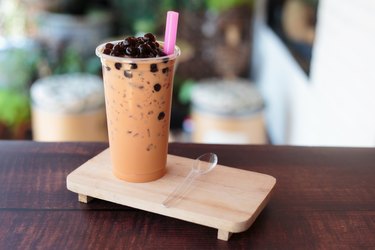
Boba milk tea, also known as bubble tea, boba tea, pearl milk tea and tapioca bubble tea comes in several flavors, including the popular taro milk tea, green boba tea and strawberry milk tea. The original is simply a blend of black tea, sugar, cow's milk and tapioca pearls — a combo that can make those boba milk tea calories add up pretty quickly.
Because most of the calories in boba milk tea come from sugar and carbs, there's not a lot to offer when it comes to boba nutrition. All things considered, you should probably enjoy bubble tea in moderation.
Video of the Day
Video of the Day
What Is Boba Milk Tea?
Boba milk tea became really popular in Asia in the 1990s and then spread throughout Europe and the United States starting in the early 2000s.
Bubble tea originated in the 1980s in Taiwan when a shopowner named Liu Han-Chieh was experimenting with different mixtures of ingredients, including fruit, syrup and tapioca balls, according to a March 2016 report in Food Science and Nutrition.
Liu Han-Chieh settled on a combination of "boba" or "pearl" balls, which are made of tapioca or cassava that is boiled to produce a round, chewy ball, and a mixture of black tea, high-fructose corn syrup, milk and ice.
Since the original boba milk tea came out, many different variations have hit the market. Some of them use coffee instead of tea, while others add fruit flavors and are blended, more like a smoothie. Others include egg pudding or jelly in their milk tea base.
Boba milk tea is often served with a large straw, so when you sip the tea, the boba pearls travel through the straw and you can take a sip of your tea while chewing on the tapioca pearl.
No matter what version you get, though, you'll find one thing that's similar across the board — boba milk tea has a lot of calories and added sugar, which can harm your health if you drink it often.
Boba Milk Tea Calories and Nutrition (Original Flavor)
Because of the different flavors, the calories in boba milk tea will vary depending on what's actually in your drink. It's estimated that plain boba milk tea (made with black tea, milk, sugar and tapioca pearls) has around 300 calories per 16-ounce beverage and a rather high 38 grams of sugar, according to the Food Science and Nutrition report.
As for other variations of bubble tea, the researchers found that a 16-ounce serving of boba milk tea can have anywhere between 200 and 400 calories and 38 to 58 grams of sugar. Most of the calories in boba milk tea come from added sugar and carbohydrates.
All that being said, the nutrients and calories in your boba milk tea will vary depending on where you buy it or how you make it. If you visit a bubble tea chain restaurant for example, a 12-ounce taro bubble tea with tapioca pearls (per the USDA); will give you:
- Calories: 274 calories
- Total fat: 7 grams
- Saturated fat: 4 grams
- Trans fat: 0 grams
- Cholesterol: 14.7 milligrams
- Sodium: 176 milligrams
- Total carbs: 48 grams
- Dietary fiber: 0 grams
- Sugar: 44 grams
- Protein: 5 grams
This version of boba milk tea does not have additional fruit flavors in it as many bubble tea varieties do. Flavored bubble teas, such as strawberry milk tea and mango milk tea typically have more calories and added sugar.
Nutrition and Calories in Boba (Tapioca Pearls)
According to the USDA, a 1-ounce serving of boba, aka tapioca pearls, has:
- Calories: 95
- Carbohydrates: 24 grams
- Sugar: 0 grams (for tapioca pearls made without high-fructose corn syrup)
There is no fat, cholesterol, sodium, fiber or protein in tapioca pearls, and they're not particularly high in any vitamins or minerals.
Keep in mind, your bubble tea may have more than this serving size of boba in it, so it's best to mind your portions.
Green Tea Boba Calories and Nutrition
Green tea boba is pretty popular among the many bubble tea flavors. You can order your green boba tea with or without milk, and there are different types to choose from including matcha green tea, honey green tea, oolong green tea and jasmine green tea.
Milk adds calories and some sugar to your boba tea. If you get your tea without milk or sub in an unsweetened milk alternative like almond or oat milk, the calories and sugar will be less.
According to popular boba tea chain Kung Fu Tea, a medium-sized green boba tea with milk (depending on the type) will give you about:
- Calories: 290 calories
- Total fat: 3 grams
- Saturated fat: 3 grams
- Trans fat: 0 grams
- Cholesterol: 1 milligram
- Sodium: 115 milligrams
- Total carbs: 66 grams
- Dietary fiber: 3 grams
- Sugar: 32 grams
- Protein: 1 gram
This is pretty consistent with other types of boba milk tea.
Taro Boba Milk Tea Calories and Nutrition
Taro is one of the most popular flavors of bubble tea, and it's made from the taro root which is a tubular purple veggie that gives the tea its hue.
According to Kung Fu Tea, a medium-sized taro boba milk tea will have about the same nutrition information as the green tea listed above.
Sometimes, however, taro milk tea is slightly lower in calories, carbs and sugar compared to plain boba milk tea and other types of bubble tea. This will largely depend on the place you get your tea from.
Strawberry Milk Tea Calories and Nutrition
According to chain restaurant Boba Nation, a 16-ounce strawberry milk tea will give you:
- Calories: 296
- Total fat: 11 grams
- Cholesterol: 0 grams
- Sodium: 117 milligrams
- Total carbs: 49 grams
- Dietary fiber: 1 gram
- Sugar: 33 grams
- Protein: 1 gram
Strawberry milk tea is significantly higher in calories, carbs and sugar compared to plain boba milk tea.
Pros and Cons of Boba Milk Tea
While there's nothing wrong with enjoying it once in a while, you'll want to practice moderation with boba milk tea. The drink might be yummy, but some versions are pretty high in calories, carbs and sugar.
Problems With Sugar-Sweetened Beverages
Because it's made with a lot of sugar, boba milk tea is classified as a "sugar-sweetened beverage" or SSB — the same classification that's given to soda, per the report in Food Science and Nutrition. Aside from the boba milk tea calories, that extra sugar comes with its own health risks.
Added sugars are any sugars and syrups that are added to foods and drinks during processing. Health professionals used to say that added sugars were only a problem because they contributed empty calories, but research has since proven otherwise. According to the Mayo Clinic, added sugars have been linked to:
- Poor overall nutrition
- Weight gain
- Tooth decay
- Imbalanced blood sugar levels
But added sugars in beverages, and especially high-fructose corn syrup, have been connected to even bigger problems. Drinks that contain fructose can increase insulin resistance, which means that it's harder for your body to use insulin properly, per an August 2016 report in The Journal of Pediatrics.
Sugar can also increase stomach fat, which also increases the risk of metabolic syndrome and increases the amount of uric acid in your blood. Uric acid is a waste product that's connected to the formation of kidney stones and a form of arthritis called gout.
Drinking sugar-sweetened beverages, especially those that are sweetened with fructose, was associated with a larger waist and hip circumference, an increased body mass index, increased uric acid levels and high triglyceride levels, per a January 2014 study in PLOS One.
Sugar-sweetened beverages have been linked to chronic inflammation, obesity, Type 2 diabetes, metabolic syndrome and heart disease, per October 2020 research in Nutrients.
Problems With Tapioca Pearls
Tapioca pearls often have added sugar in the form of high-fructose corn syrup. You can buy tapioca pearls without it, but if you're buying bubble tea from a chain restaurant, there's no way to know for sure what the pearls are made with (unless, of course, you ask).
Tapioca pearls also don't have the fiber that regular tapioca has, making them far less nutritious.
- Food Science & Nutrition: "Calories and Sugars in Boba Milk Tea: Implications for Obesity Risk in Asian Pacific Islanders"
- PLOS One: "Elevated Serum Triglyceride and Retinol-Binding Protein 4 Levels Associated with Fructose-Sweetened Beverages in Adolescents"
- UC Berkeley California Alumni Association: "Will the Bubble Burst? Inside Berkeley’s Boba Tea Craze"
- University of California Berkeley Wellness: "Tapioca Pearl Problems"
- The Journal of Pediatrics: "Fructose-Rich Beverage Intake and Central Adiposity, Uric Acid, and Pediatric Insulin Resistance"
- Advances in Nutrition: "Retinol Binding Protein 4 in Relation to Diet, Inflammation, Immunity, and Cardiovascular Diseases"
- USDA MyFoodData: Eastland Corporation Tapioca Pearls
- Tapioca Express: Milk Tea Nutrition
- Nutrients:Identification of Inflammatory and Disease-Associated Plasma Proteins that Associate with Intake of Added Sugar and Sugar-Sweetened Beverages and Their Role in Type 2 Diabetes Risk
- USDA: "Taro Bubble Tea with Tapioca Pearls"
- Kung Fu Tea: "Calorie Information"
- Boba Nation: "Strawberry Milk Tea"