
When your goal is to jump higher, the emphasis is often on becoming stronger and more explosive. What you might not realize is how important it is to be flexible. Stretching is an important part of any jump-training program, both to improve performance and prevent injury. However, there are different types of stretching exercises that should be performed at different times. Know what they are and when to use them, and be sure to stretch before and after each training session.
Dynamic Stretching Before Jumping
Video of the Day
Dynamic stretching may be new to people who are used to traditional long-held stretches as the norm. With dynamic stretching, you don't hold the stretch; you gradually increase flexibility and range of motion and warm up your muscles with active movements.
Video of the Day
Dynamic stretching is used before a workout to prime the muscles for activity and transition them from rest to activity. A study by researchers at the Department of Physical Therapy at Wichita State University found that athletes who performed dynamic stretches before jumping performed better than those who performed static -- held -- stretches.
The hip flexors are some of the most important muscles to target with dynamic stretches before jumping. Many people have chronically tight hip flexors from sitting all day. To jump your highest, you need your hip flexors to fully contract and extend.
Leg swings: Stand perpendicular to a wall with your hand on the wall for support. Contract your core muscles for stability. Pick up your outside foot and begin to swing the leg back and forth, keeping the leg straight. Keep the pelvis slightly tucked and don't arch the back. Do 10 to 20 swings, then switch sides.
Lateral leg swings: Stand facing the wall with your hand out for support and swing your leg side-to-side in front of your body. Perform 10 to 20 swings, then switch sides.
Squats: Stand with your feet hip-distance apart. Bend at the knees and hips and lower your butt back and down as if sitting into a chair. Keep the torso upright and the shoulders back and down. Go as low as you can without the heels coming up or the torso leaning far forward. Press back up to standing. Repeat for a total of 10 to 20 reps.
Lunge: Get into a lung position with your back knee on the floor and the front knee and hip at 90-degree angles. Place your hands on your glutes and contract your core. Gently push your pelvis forward while keeping your torso still. Hold the position for 2 seconds. Release and repeat for a total of 10 reps, then switch sides.
Standing hip circles: Hold onto a wall or other stable support. Lift one leg, raising the knee to a 90-degree angle. Open the knee out to the side as far as possible then bring it back down, making a big circular motion. Do 10 to 20 reps on one side, making the circles larger and larger, then switch sides.
Read more: The Best Workout to Jump Higher
Static Stretching After Jumping
Dynamic stretching before a workout or competition is crucial to performance, but stretching afterwards is equally as important. Taking time to stretch the stressed muscles helps release tightness. This leads to better recovery time, less soreness, continued performance improvements and injury prevention.
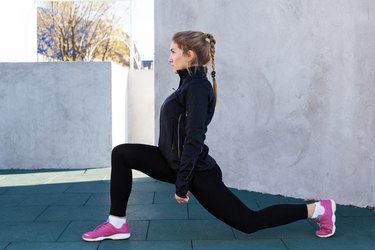
Warrior lunge stretch: Get into a lunge position with your right knee behind you on the floor and your left knee and hip in front at 90-degree angles. Raise your arms up over your head and grasp the left wrist with the right hand. Contract your core and tuck your pelvis slightly. Maintaining this position, lunge forward slightly until you feel a stretch in your right hip flexor. Extend your torso and arms up and lean over slightly to the right. Hold for 60 seconds and release. Switch sides. Repeat two or three times.
Standing quad stretch: Stand holding on to a support with one hand. Bend the opposite leg at the knee and take hold of the ankle with the same-side hand. Keeping the knees in one line, pull the lifted foot into the glute. Press out gently through the pelvis. Hold for 60 seconds, then switch sides. Perform two or three times on each side.
Seated groin stretch: Sit on the floor and bend both knees. Open the knees out to the side pressing the soles of the feet together. Grasp your toes with both hands and, keeping your back flat, slowly pull your torso down toward your legs. Hold for 60 seconds, then release. Perform two or three times.
Lying glute stretch: Lie on your back. Bend your right knee and place your foot flat on the floor. Bend your left knee and place the ankle across the top of the of the right thigh just above the knee. Open the left knee out to the side. Lift your right leg up and thread your hands through to grasp the back of the right thigh with both hands. Pull the leg in towards you and hold for 60 seconds. Switch sides. Repeat two or three times.
Read more: Do You Lose Jumping Ability?