Walnuts have long been hailed as a healthy diet staple, and it's clear to see why. This tree nut is a fantastic source of nutrients that can help lower your blood pressure, support brain health, benefit the digestive system and much more.
Most of the walnuts in the United States are harvested in the Central Valley of California. They make a versatile and nutrient-boosting addition to meals but can also stand on their own as a hearty snack.
Video of the Day
Video of the Day
Walnut Nutrition Facts
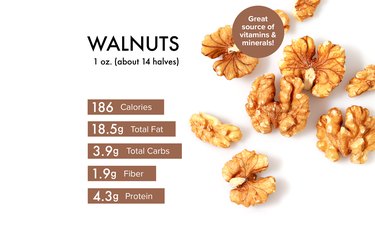
A single serving size of walnuts is equal to 1 ounce of (about 14 halves). One ounce of walnuts contains:
- Calories: 186
- Total fat: 18.5 g
- Cholesterol: 0 mg
- Sodium: 0.6 mg
- Total carbs: 3.9 g
- Dietary fiber: 1.9 g
- Sugar: 0.7 g
- Added sugar: 0 g
- Protein: 4.3 g
Calories in 1/4 Cup Walnuts
There are 196 calories in 1/4 cup walnut pieces, per the USDA. That's about an ounce of walnuts or about 14 halves. There are about 26 calories in one walnut.
The calories in walnuts mostly come from healthy fats.
Walnut Macros
- Total fat: One ounce of walnuts has 18.5 grams of total fat, which includes 13.3 grams of polyunsaturated fat, 2.5 grams of monounsaturated fat, 1.7 grams of saturated fat and 0 grams of trans fat.
- Carbohydrates: One ounce of walnuts has 3.9 grams of carbs, which includes 1.9 grams of fiber and 0.7 grams of naturally occurring sugars.
- Protein: One ounce of walnuts has 4.3 grams of protein.
Vitamins, Minerals and Other Micronutrients
- Copper: 50% of your Daily Value (DV)
- Manganese: 42% DV
- Magnesium: 11% DV
- Vitamin B6: 9% DV
- Vitamin B1: 8% DV
- Zinc: 8% DV
- Vitamin B9: 7%
- Iron: 5% DV
- Potassium: 3% DV
- Selenium: 3% DV
Walnuts vs. Other Tree Nuts
Per 1 oz., raw | Walnuts | Almonds | Pecans | Cashews | Macadamia Nuts |
|---|---|---|---|---|---|
Calories | 186 | 164 | 196 | 157 | 204 |
Total Fat | 18.5 g | 14.2 g | 20.4 g | 12.5 g | 21.5 g |
Carbs | 3.9 g | 6.1 g | 3.9 g | 8.6 g | 3.9 g |
Fiber | 1.9 g | 3.6 g | 2.7 g | 0.9 g | 2.4 g |
Protein | 4.3 g | 6 g | 2.6 g | 5.2 g | 2.2 g |
Health Benefits of Walnuts
They might be high in fat, but walnuts are good for you thanks to their variety of important nutrients.
1. They Can Help Lower Blood Pressure
"Even more than other nuts, walnuts appear to exert powerful benefits on controlling diastolic blood pressure," says Bethany Doerfler, RDN, a clinical research dietitian at Northwestern Medicine.
"Diastolic blood pressure is a really important cardiovascular marker because it measures the pressure in the blood vessels when the heart is resting."
Walnuts were observed to reduce diastolic blood pressure in people at risk for heart disease, per a May 2019 JAHA study. Eating walnuts was also observed to reduce blood pressure in older adults, particularly in those with mild high blood pressure, per a May 2019 Hypertension study.
Although it's not fully known why walnuts are good for your blood pressure, there may be a combination of factors at play: "It's likely due to the way gut bacteria feed off the fiber and other innate nutrients in walnuts to produce anti-inflammatory compounds," Doerfler says.
2. They're Linked to Healthier Cholesterol Levels
Diets rich in walnuts could lower cholesterol and triglycerides, according to a July 2018 meta-analysis in The American Journal of Clinical Nutrition.
"Nuts like walnuts also contain compounds such as plant sterols, soluble fiber and phenolic compounds, which can directly lower cholesterol and work as antioxidants," Doerfler says.
And, a preliminary August 2021 Circulation research letter found that eating walnuts daily for 2 years is associated with lower cholesterol in older adults.
What's more, women who noshed on walnuts (and other types of nuts) at least once a week were observed to have a 13 to 19 percent lower risk of total heart disease and 15 to 23 percent lower risk of coronary heart disease than those who didn't eat nuts, a November 2017 study in the Journal of the American College of Cardiology found.
3. They're Linked to Better Brain Health
Eating walnuts is linked to preventing brain damage and may even improve cognition. "We have enough evidence now to suggest that what's good for the blood vessels and heart is also good for the brain," Doerfler says.
"Walnuts exert their benefit on brain and heart health, not just because of their healthy fats, but also because of their direct ability to reduce blood pressure and modify gut bacteria."
Walnuts contain alpha-linolenic acid (ALA), a plant-based omega-3 fatty acid. "Walnuts are a really important way to get polyunsaturated fats, including omega-3 fatty acids," Doerfler says. "They have more omega-3 fatty acids than any other nut or legume."
Not only are walnuts high in ALA but they also contain more polyphenolic compounds (a type of antioxidant) than any other nut. Both ALA and polyphenolic compounds are important brain foods that may help reduce oxidative stress and inflammation that lead to cognitive decline, per the American Society for Nutrition. This means they could benefit cognition.
In fact, eating walnuts was observed to slow cognitive decline, specifically in older adults who are at risk, according to a January 2020 study in The American Journal of Clinical Nutrition.
Eating more walnuts was also observed to increase adults' performance on cognitive tests, regardless of their age, a December 2014 study in The Journal of Nutrition, Health and Aging found. This research was funded by the California Walnut Council, but the findings are still important as this was the first large representative study to analyze walnut intake and cognition and to include all available cognitive data across the National Health and Nutrition Examination Survey (NHANES) research program.
Tip
“Walnuts can be great [on their own], but they can also act as a power booster to other healthy foods,” Doerfler says. “Because of the healthy fats in walnuts, they could help you better absorb vitamin D or antioxidants found in foods like berries.”
4. Walnuts Can Benefit the Digestive System
It was once thought that people with diverticula (small, pouch-like structures that can form in the colon's muscular wall) should avoid nuts and seeds, but experts now know it's not necessarily the case.
Nuts like walnuts provide the fiber that's important for gut health and maintaining regularity, according to Harvard Health Publishing.
"It's possible that people with digestive issues will really benefit from the fiber in walnuts, but I often advise people to make sure they're chewing them well or puréeing them into recipes," Doerfler says. "That way, you are modifying the fiber so your gut has less mechanical chopping to do, and access to the nutrients in food is optimized."
The magnesium in walnuts can also help keep you regular. "Walnuts are one of the richest plant-based sources of magnesium, which can prevent constipation by helping the muscles of intestines contract," Doerfler says.
Related Reading
5. They're Linked to a Lower Cancer Risk
Ongoing research is investigating the link between walnuts and cancer prevention.
Evidence has been mixed, but emerging research shows that walnuts have the potential to contribute to a cancer-preventive diet through the synergy of various compounds such as melatonin, ellagitannins and gamma-tocopherol, which all might work together to lower oxidative stress, inflammation and gene expression that can result in cancer, according to the American Institute for Cancer Research.
Overall, swapping the typical Western diet (which is high in red meat, refined grains and high-fat dairy products like butter) with a plant-based diet that includes nuts like walnuts is associated with a lower risk of cancer.
"The research for diet and cancer right now is very focused on dietary patterns, and eating a Western diet particularly increases your risk of solid organ cancers, such as breast, colon, esophageal and stomach cancers," Doerfler says. "Conversely, eating a more plant-based diet that revolves around plant-based proteins and fats is protective against cancer."
6. They Might Help With Weight Management
"The healthy fat and fiber content in walnuts can help increase fullness, curb hunger and slow blood glucose absorption, which can limit intake of extra calories between (or even during) meals," Mandy Enright, RDN, dietitian and fitness instructor, tells LIVESTRONG.com.
"While eating walnuts isn't directly correlated to weight loss, a diet that includes walnuts, along with fruits, vegetables, whole grains and lean proteins, can help with weight management," she says. "They're one of the more calorie-dense nuts, but those are the calories from natural fat, fiber and protein that we want."
Plus, that July 2018 article in The American Journal of Clinical Nutrition also reported that eating a moderate amount of nuts didn't result in weight gain.
Enright recommends eating an ounce, or about 14 walnut halves, a day.
7. Eating Walnuts Is Linked to Better Bone Health
A few walnuts a day can also provide ample amounts of the minerals needed to help stave off brittle bones. Walnuts contain high levels of copper, which can improve bone density, says Enright. Copper also plays a role in maintaining collagen and elastin, which help to form bone and connective tissue structures.
Walnuts are also loaded with manganese, which is essential for healthy bone mineralization as well as cartilage and collagen production, according to a February 2017 review in Clinical Cases in Mineral and Bone Metabolism.
They also contain plenty of magnesium, the third mineral in this bone-boosting trio. The same 2017 article reported that magnesium has a protective effect on bone quality. In fact, a magnesium deficiency may even lead to osteoporosis.
8. Walnuts Are Associated With Less Inflammation
Researchers found that the potency of antioxidants in walnuts ranked higher than all other nuts, including almonds, pecans and pistachios, per a February 2012 study in Food & Function.
What's more, the antioxidants in raw walnuts were up to 15 times as potent as vitamin E, which is well-known for its ability to protect cells from damaging free radicals.
Considering the antioxidants in walnuts may help fight against oxidative stress — the imbalance of free radicals and antioxidants in the body — they may also reduce inflammation, Enright says.
In fact, a diet rich in nuts is associated with less inflammation that plays a role in inflammatory diseases like atherosclerosis, according to a September 2016 review in The American Journal of Clinical Nutrition.
English Walnuts vs. Black Walnuts
Generally, the walnuts you see on your supermarket shelf are the English variety. Harder-to-find black walnuts have a bold, earthy flavor and require a lot of work to get them out of their shells. They're difficult to hull, and the husks can stain your hands. Black walnuts are a popular ingredient in ice cream and are more expensive than English walnuts.
Both types offer plenty of benefits, but black walnuts contain 2.5 grams more protein, 1.7 fewer grams of fat and 10 fewer calories.
Walnut Health Risks
Allergies
Allergy to tree nuts such as walnuts affects an estimated 0.5 to 1 percent of the population in the United States, and is one of the most common types of food allergies, according to the American Academy of Allergy, Asthma & Immunology (AAAAI).
If you're allergic to one tree nut, it doesn't mean you'll be allergic to all of them, but some are closely related (like walnuts and pecans, or cashews and pistachios) and may cause similar reactions.
Talk to an allergist to assess your risk: Tree nut reactions can be severe and may include life-threatening anaphylaxis, so it's important to always have epinephrine with you if you have a tree nut allergy, according to the AAAAI.
Drug Interactions
High-fiber foods like walnuts may affect the absorption of thyroid drugs such as levothyroxine. You may need to take your medication at a different time of day than when you would normally eat walnuts — say, at bedtime rather than at breakfast, per Consumer Reports.
If you have questions or concerns about when to take your medication, talk to your doctor.
Walnut Recipes
Walnut Preparation and Useful Tips
Walnuts are harvested in the fall but can be found year-round in grocery stores. Follow these tips to store and prepare them as part of a snack or meal.
Opt for whole, plain varieties. Many packaged nuts come with added sodium, sugar or other ingredients, so it's best to look for plain raw or roasted walnuts. If you'd like, add your own herbs or spices such as thyme or cinnamon.
Walnuts are also found in a number of protein and granola bars, but opt for whole walnuts if possible.
"In bars, you might have preservatives, added sugars, refined grains or even sugar alcohols and other artificial sweeteners that can disrupt your healthy gut bacteria," Doerfler says. "It's best to eat whole foods. When you look for real foods that are satisfying and beneficial for your entire body, nuts are a natural inclusion — and walnuts, in particular, are an all-star."
Store in a cool place. Proper storage is important for walnuts, as warm temperatures can cause their healthy fats to go rancid, according to Michigan State University Extension.
Walnuts are no longer fresh if they are shriveled or rubbery, or if they have an odor similar to paint thinner, per Michigan State University.
Tip
Walnuts tend to absorb odors, so store them away from other foods with strong scents, such as onions — preferably in an airtight container.
Store shelled or unshelled walnuts in a cool, dry place. They’ll stay fresh for up to 3 months in the refrigerator, or up to 1 year in the freezer.
Use them to add texture to recipes. Walnuts are often sprinkled into oatmeal or added to trail mix, but their texture can also make them a unique ingredient in sauces or sautés.
"Walnuts can be a nice meat substitute in dishes when they're puréed," Doerfler says. "You can finely mince or purée walnuts with mushrooms, cauliflower, canned diced tomatoes and herbs to make a high-fiber, high-protein pasta sauce."
Alternatives to Walnuts
Walnuts have a rich nutrient profile that may help improve your blood pressure. They contain a number of antioxidants, which can boost your brain health and lower your risk of cancer. The fiber and magnesium in walnuts can also benefit digestive health.
For similar health benefits, you can swap walnuts for other tree nuts such as:
As with all nuts, it's important to eat walnuts in moderation because they're calorically dense.
- My Food Data: "Walnuts"
- My Food Data: "Almonds"
- My Food Data: "Pecans"
- My Food Data: "Cashews (Raw)"
- My Food Data: "Macadamia Nuts"
- National Heart, Lung, and Blood Institute: "DASH Eating Plan"
- Mayo Clinic: "DASH diet: Healthy eating to lower your blood pressure"
- Harvard Health Publishing: "Information about the OmniHeart diets"
- Mayo Clinic: "High blood pressure dangers: Hypertension's effects on your body"
- Johns Hopkins Medicine: "The Brain-Gut Connection"
- American Society for Nutrition: "Can walnut consumption benefit brain health?"
- Springer Nature: "A cross sectional study of the association between walnut consumption and cognitive function among adult us populations represented in NHANES"
- Harvard Health Publishing: "Avoiding nuts and seeds for better gut health? You shouldn’t"
- American Institute for Cancer Research: "Walnuts"
- American Academy of Allergy, Asthma & Immunology: "Everything You Need to Know About Tree Nut Allergy"
- Consumer Reports: "Food and Drug Interactions You Need to Know About"
- Michigan State University Extension: "Preserving fresh walnuts to maintain nutritional content"