When eaten as part of a healthy diet, oranges can benefit your skin, heart and digestive health. The refreshing citrus fruit is famously known for its high levels of vitamin C, an antioxidant that may help shorten the duration of colds and is linked to a lower risk of cancer.
Delicious eaten raw, slightly frozen or blended into a smoothie, this fruit is an easy way to make your diet more nutritious. If you love to grill or roast meat, a squeeze of orange can also double as a healthy tenderizer.
Video of the Day
Video of the Day
Oranges have the added benefit of being convenient to toss in a lunch bag for a quick snack or part of a meal.
Orange Nutrition Facts
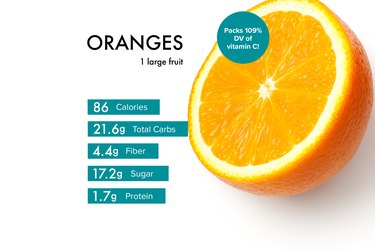
One orange is equal to a single serving. One orange (3 inches in diameter) contains:
- Calories: 86
- Total fat: 0.2 g
- Cholesterol: 0 mg
- Sodium: 0 mg
- Total carbs: 21.6 g
- Dietary fiber: 4.4 g
- Sugar: 17.2 g
- Added sugar: 0 g
- Protein: 1.7 g
Orange Macros
- Total fat: One large orange has 0.2 grams of total fat, which includes 0.04 grams of polyunsaturated fat, 0.04 grams of monounsaturated fat, 0 grams of saturated fat and 0 grams of trans fat.
- Carbohydrates: One large orange has 21.6 grams of carbs, which includes 4.4 grams of fiber and 17.2 grams of naturally occurring sugars.
- Protein: One large orange has 1.7 grams of protein.
Vitamins, Minerals and Other Micronutrients
- Vitamin C: 109% of your Daily Value (DV)
- Vitamin A (IU): 14% DV
- Folate (B9): 14% DV
- Thiamin (B1): 13% DV
- Copper: 9% DV
- Potassium: 7% DV
- Riboflavin (B2): 6% DV
- Calcium: 6% DV
- Magnesium: 4% DV
- Niacin (B3): 3% DV
- Choline: 3% DV
- One large orange is not a significant source of manganese (2% DV), phosphorus (2%), vitamin E (2%), selenium (2% DV), zinc (1% DV) and iron (1% DV).
Health Benefits of Oranges
Oranges can improve the health of your skin, heart and digestive system. Their high levels of vitamin C may contribute to healthy collagen levels, shorter colds and lower risk of cancer.
1. They're Linked to Improved Skin Health
The vitamin C in oranges plays a number of protective roles in the body, including keeping your skin healthy and youthful. One large orange provides more than your entire DV of this nutrient.
Vitamin C plays a key role in the production of collagen, which is the structural protein that gives skin elasticity. The vitamin C content in your skin and your body's production of collagen naturally decline as you age, according to Oregon State University.
This decrease in collagen contributes to wrinkles. It may also cause health issues like weakening muscles, joint pain, osteoarthritis or even gastrointestinal problems due to the thinning of your digestive tract lining, per the Cleveland Clinic. After aging, a poor diet is the most common cause of low collagen levels in the body.
Although you may think of skin health as largely involving topical treatments, dietary intake of healthy nutrients is generally linked to improved appearance of the skin. Nutrient supplementation improved both the perception of skin health and actual skin health — including appearance, roughness, wrinkling and elasticity — in a March 2015 review in the journal Nutrition Research.
More research is needed to determine the effect of nutrient-rich foods and vitamin C on skin appearance. However, antioxidant-rich foods like oranges generally seem to have a protective effect, per the Mayo Clinic.
Vitamin C also helps to repair wounds and even affects your oral health. In fact, vitamin C may contribute to a lower risk of periodontal (gum) disease and can improve gingival bleeding in gingivitis, according to a July 2019 review in the International Journal of Environmental Research and Public Health.
"Vitamin C benefits your gum health because its antioxidant properties help to renew, rebuild and constantly keep tissue healthy," says Natalie Allen, RD, clinical assistant professor of biomedical sciences at Missouri State University.
2. They're High in Fiber
One orange contains 4.4 grams of fiber, which is 18 percent of the DV. Fiber is an essential part of a healthy diet, according to the Mayo Clinic. A high-fiber diet:
- helps lower cholesterol levels
- helps control blood sugar levels
- normalizes bowel movements and maintains bowel health
- helps you maintain a healthy weight
- is associated with a longer life
Oranges are filled with soluble fiber, which is also found in apples, oats, peas, beans and carrots.
"The soluble fiber in oranges is very helpful in lowering cholesterol and keeping your gastrointestinal tract healthy, and also slows down the digestion of food," Allen says.
Americans generally don't get enough fiber: While the recommended total dietary intake of fiber is 25 to 30 grams per day, adults average about 15 grams per day, per UCSF Health, so eating oranges can help fill that gap.
3. Oranges Are Tied to a Healthy Immune System
Perhaps most famously associated with vitamin C, oranges can help keep your immune system functioning at its best.
That said, vitamin C is not a cure-all or sure bet for preventing the common cold (or other illnesses). Only extremely active people like marathon runners and skiers who took at least 200 milligrams of vitamin C daily (about the amount in two oranges) appeared to cut their chances of getting a common cold in half in a January 2013 review published in the Cochrane Database of Systematic Reviews.
The same effect wasn't seen for the general population. However, taking at least 200 milligrams daily vitamin C did appear to shorten the duration of cold symptoms by an average of 8 percent in adults and 14 percent in children — which equates to about one day less of sickness — according to Harvard Medical School.
When possible, it's best to get nutrients like vitamin C from food rather than supplements.
People with high intakes of vitamin C from fruits and vegetables might have a lower risk of getting several types of cancer, including lung, colon and breast cancer, per the National Institutes of Health (NIH). Vitamin C supplements don't appear to have the same protective effect.
People who eat many fruits and vegetables also appear to have a lower risk of heart disease, which may be due to antioxidants that stave off oxidative damage, a major cause of heart disease. More research is needed to determine if vitamin C plays a role in this protective effect and if it can slow down the progression of heart disease and those who already have it.
Fruits, like oranges, and vegetables are the best sources of vitamin C. Although most people in the U.S. get enough vitamin C from foods and beverages, people who smoke or are exposed to secondhand smoke may not, per the NIH.
Smokers need 35 milligrams more vitamin C daily than nonsmokers, partly because smoke increases how much vitamin C your body needs to repair free radical damage.
Is Orange Juice Healthy?
Orange juice is not necessarily unhealthy in moderation, but whole fruit has far more health benefits. “I always recommend the whole fruit over juice, because you’ll get more fiber than you would in the juice,” Allen says.
“Half a cup of juice is a serving, which isn’t very much. You might end up drinking two to three servings of juice, which is a lot more calories and sugar than you would get from one orange.”
While eating whole fruits was associated with a lower risk of type 2 diabetes, a greater intake of fruit juice was associated with a higher risk in an August 2013 BMJ study. If you like orange juice, opt for a calcium-fortified variety and dilute it with seltzer water.
Orange Health Risks
Allergies
Although rare, citrus allergy has been reported with oranges, mandarins and grapefruits, per the American Academy of Allergy, Asthma & Immunology (AAAAI).
Many people with fruit allergy are sensitive to pollen and may react to a number of other fruits, according to the University of Nebraska-Lincoln Food Allergy and Resource Program. About 39 percent of children and young adults with hay fever also had a sensitivity to citrus fruits in a small January 2013 study of 72 participants in PLOS One.
Citric acid, a chemical naturally found in citrus fruits but also used as an additive in foods, does not provoke an immune response — including in people with citrus allergy, according to the AAAAI.
It's important to speak to an allergist if you suspect you have a food allergy, which can cause symptoms such as vomiting, hives, shortness of breath or even life-threatening anaphylaxis. If you have a food allergy, you may need to carry epinephrine with you at all times in case of a severe reaction.
Drug Interactions
Oranges are a good source of potassium, a mineral that helps send electrical signals to heart-muscle cells and other cells. Too much potassium can interact with certain drugs, such as ACE inhibitors including:
- Captopril (Capoten)
- Enalapril (Vasotec)
- Lisinopril (Prinivil, Zestril)
These medications are used to lower blood pressure or treat heart failure and could increase levels of potassium in your body when combined with oranges (which contain potassium), per Consumer Reports. This may lead to heart palpitations or irregular heartbeat, which can be fatal.
For the same reason, you might want to avoid mixing oranges with some diuretics like triamterene (Dyrenium), used to lower fluid retention and treat high blood pressure.
Tip
If you take in many oranges or orange juice, talk to your doctor or pharmacist to understand if you need to limit portions.
Seville oranges (bitter oranges), which are often used in orange marmalade, can affect the same enzyme as grapefruit juice — so it's best to avoid them if your medication reacts with grapefruit juice, per the U.S. Food & Drug Administration (FDA).
Depending on the active ingredient, grapefruit can lower the effectiveness of a drug or cause dangerous drug levels in the body by interfering with transporters in the intestine.
Ask your doctor if you can have fresh grapefruit juice while on your medication (and if not, avoid Seville oranges). Currently, there are more than 50 prescription and over-the-counter drugs known to have negative interactions with grapefruit.
Orange Preparation and Helpful Tips
In the U.S., most oranges are grown in California, Florida and Texas, and can be found in supermarkets year-round. Follow these tips to incorporate oranges into your diet.
Check oranges before buying. You should be able to squeeze a fresh orange slightly, and its orange hue should predominate over green, according to the USDA.
Oranges vary in characteristics by type. For instance, navel oranges are easy to peel and don't have seeds. Valencia oranges do have seeds and are more difficult to peel, but are generally less expensive than navel oranges.
Wash oranges before using them. The USDA recommends washing oranges under cold, running water before peeling them. If you're using the skin for zest, scrub the orange peel with a vegetable brush.
Slice easily and store properly. Place the orange on its side, with the stem ends between your hands, then carefully cut into wedges. This makes it easy to remove the wedges from the skin, per the USDA.
Florida and Texas oranges are best stored at 32 to 34 degrees Fahrenheit, while California oranges are ideally stored at 38 to 48 degrees Fahrenheit. Refrigerated oranges have a shelf life of about 10 days. For a refreshing treat, freeze orange wedges for up to one hour.
Alternatives to Oranges
Oranges provide a range of healthy nutrients that can benefit your skin, digestive health and immune system.
They're packed with vitamin C, and provide 18 percent of the daily value of fiber. As such, they're considered a heart-healthy addition to your diet.
Citrus fruits are similar in nutritional value. You can replace oranges for other fruits such as grapefruit, clementines and tangerines for similar health benefits.
- My Food Data: "Oranges"
- Oregon State University Linus Pauling Institute Micronutrient Information Center: "Vitamin C and Skin Health"
- Cleveland Clinic: "The Best Way You Can Get More Collagen"
- Nutrition Research: "Can dietary intake influence perception of and measured appearance? A Systematic Review"
- Mayo Clinic: "What are the best foods for healthy skin?"
- International Journal of Environmental Research and Public Health: "The Relationship between Vitamin C and Periodontal Diseases: A Systematic Review"
- Harvard Medical School: "Easy ways to stay regular"
- American Heart Association: "Heart-Check Food Certification Program"
- UCSF Health: "Increasing Fiber Intake"
- Cochrane Database of Systematic Reviews: "Vitamin C for preventing and treating the common cold"
- Harvard Medical School: "Can vitamin C prevent a cold?"
- National Institutes of Health: "Vitamin C"
- American Academy of Allergy, Asthma & Immunology: "Citric Acid and Citrus Allergy"S ALLERGY"
- University of Nebraska-Lincoln Food Allergy and Resource Program: "Fruits"
- PLOS One: "Citrus Allergy from Pollen to Clinical Symptoms"
- Consumer Reports: "Food and Drug Interactions You Need to Know About"
- U.S. Food & Drug Administration: "Don't take this with that!"
- U.S. Food & Drug Administration: "Orange Information Sheet"
- BMJ: "Fruit consumption and risk of type 2 diabetes: results from three prospective longitudinal cohort studies"