

























































High levels of testosterone contribute indirectly to your ability to sprint. And with the right training and diet, you can make sure your levels are at their peak at all times. This will allow you to not only become stronger, but recover faster. Consult your physician before beginning any diet or exercise program.
Effects of Testosterone
Testosterone is a steroidal hormone secreted by the testes in men and the adrenal glands in women, but men produce approximately 10 times the amount women do. Testosterone is the primary anabolic hormone, or the hormone most responsible for the growth of muscle tissue. Even if you are not trying to grow muscle, low levels of testosterone can make it difficult for you to retain the muscle that you do have, which not only gives you less power when you run, but also slows your metabolism.
Sprint Training
Sprinting itself has no effect on testosterone, unless you over train, in which case your testosterone levels will drop. The method in which you train can have some bearing on it, as training at high intensities with short rest intervals, can not only give your testosterone levels a brief boost, but can also do this without elevating cortisol levels. Cortisol is a hormone responsible for, among other things, muscle wasting and fat storage, so keeping levels low is exactly what you need.
Keeping Your Testosterone Levels Up
Diet is the primary method of ensuring that your endocrine system, of which testosterone production is a part, operates optimally. A diet too low in fat will cause your levels to drop, as cholesterol and other dietary sterols are necessary for your body to absorb then later convert into steroidal hormones like testosterone. Omega-3 and omega-6 fatty acids are particularly critical, and these can be found in oily fish such as salmon, flax, nuts and seeds. If you have trouble getting these foods in your diet, fish oil and flax oil can be supplemented in liquid or capsule form.
Training
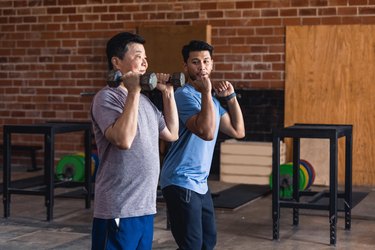
Additional training can increase your strength as well as increase your testosterone levels. Heavy resistance training with exercises such as squats will build some of the same muscles you run with. This training should be performed in a manner similar to that in which you run: short and intense. Train with at least 75 percent of your one-repetition maximum, and keep your rest periods short, no more than 90 seconds, to get the maximal response from your endocrine system. Between lifting and running, the only other thing you need to do is rest and recover.
References
- PubMed.gov: "Fiziol Cheloveka": Acute Testosterone and Cortisol Responses to High Power Resistance Exercise
- PubMed.gov: "European Journal of Applied Physiology": Acute Hormonal and Neuromuscular Responses to Hypertrophy, Strength and Power Type Resistance Exercise
- PubMed: Journal of Steroid Biochemistry: Decrease of Serum Total and Free Testosterone During a Low-Fat High-Fibre Diet
- PubMed.gov: Dietary Omega-3 Fatty Acid Supplementation Increases the Rate of Muscle Protein Synthesis in Older Adults: a Randomized Controlled Trial
- PubMed.gov: The Effects of Short-term Resistance Training on Endocrine Function in Men and Women.
- PubMed.gov: "Journal of Steroid Biochemistry": Decrease of Serum Total and Free Testosterone During a Low-Fat High-Fibre Diet


