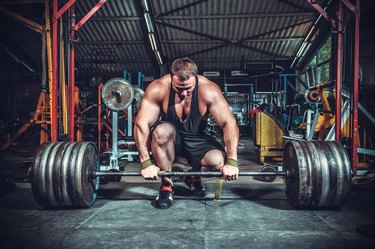
Even if you don't compete in the sport of powerlifting, you can learn a thing or two about how to improve your bench press from competitors' training routines. Powerlifting is a strength sport that consists of three lifts: the bench press, squat and deadlift. You get three tries to lift the most combined weight possible to beat out your competitors.
Because the amount of weight you bench is intrinsic to powerlifting success, your obvious goal during powerlifting training routines is to develop the muscle, power and form to enable you to lift the most weight you can.
Video of the Day
Video of the Day
The best powerlifting routines combine multiple sets of a small number of reps, completely different than the three to four sets of eight to 12 reps routines of bodybuilders. They also include a lighter day to work on technique and force production.
Westside Bench Routine
The Westside Barbell powerlifting routines come from the Ohio-based gyms and coaching of Louie Simmons, an acclaimed strength coach and powerlifter. His gyms are the only ones in the world that have produced multiple athletes who can press more than 2,700 pounds.
The approach to lifting involves four workouts per week, with two being for the lower body and two for the upper body. A typical heavy bench day starts with eight to 12 sets of one to three reps of a a max effort bench press. You then do two to four sets of six to 10 reps of the following:
- close grip incline bench press
- lying triceps extension
- lat pulldown
- upright rows
The second upper-body strength day of the week is more dynamic and functional. It begins again with focus on the bench press resisted with a band, using a lighter weight than your earlier workout of the week. Do nine sets of about three reps. Follow with two to four sets of six to 10 reps of the following:
- dumbbell bench press
- rows
- shoulder press
- hammer curls
These are sample routines; the Westside program has you change exercises every three weeks.
Gillingham Program
Brad Gillingham is a world-ranked powerlifter. He developed a bench press powerlifting routine that involves doing one light day and one heavy day each week.
Over 12 weeks, the heavy workout weekly is when you'll bench:
- week 1: three sets of five reps of 90 percent of your max
- weeks 2 through 4: five sets of three reps of 92 to 95 percent of your max
- week 5: three sets of five reps of 92 percent of your max
- weeks 6 through 8: five sets of three reps of 95 to 100 percent of your max
- week 9: three sets of five reps of 95 percent of your max
- weeks 10 through 12: five sets of 3 reps of 97 to 102 percent of your max
On the light bench press day, you'll start week one with two sets of eight reps and week two will involve the eight sets of three reps. Use weights that vary between 60 percent and 77 percent of your max. Continue to alternate the two workouts once per week for the 12 weeks as the second bench press day.
Doug Young's Approach
Doug Young won the world title in powerlifting multiple times and coached Arnold Schwarzenegger in increasing his muscle size. This is not a routine for the beginning lifter.
He warmed up and then did one rep of the bench press at each of the following weights:
- 435 pounds
- 465 pounds
- 485 pounds
- 500 pounds
- 551 pounds
Next, he completed two one-rep sets at 540 pounds. Rest was 3 to 5 minutes between each one-rep set. He finished the routine with nine reps at 490 pounds and 14 reps at 300 pounds.
Each upper body/bench press day also included cable flyes, front arm raises, triceps presses, concentration curls and rows with moderate to heavy weight — but nothing comparable to the max weight lifted during the bench. He'd do this complete workout three times per week and, over the course of eight months, he added considerable muscle to his bench press.
While you might not be able to lift the exact weight of this champion powerlifter, you get the idea. Start with a weight that's 80 percent of your max and slowly add 5 to 10 percent for each consecutive lift until you reach your one-rep max. Finish the bench press portion of your workout with multiple reps at a lighter weight.
Read More: Powerlifting Chest Workout