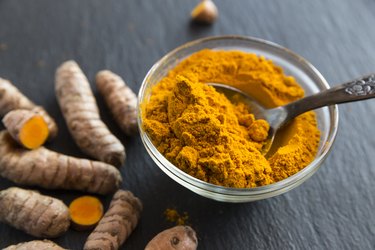
Turmeric has long been used as a remedy for a wide range of issues, including wound healing, rheumatoid arthritis and digestive disorders, according to the book Herbal Medicine: Biomolecular and Clinical Aspects, 2nd Edition.
"In Ayurvedic practices, turmeric is thought to have many medicinal properties, including strengthening the overall energy of the body, relieving gas, dispelling worms, improving digestion, regulating menstruation, dissolving gallstones and relieving arthritis," note the authors.
Video of the Day
Video of the Day
Some liquid turmeric supplements even recommend putting the ingredient under your tongue for health benefits. (But there's not enough evidence to support those claims.)
Turmeric's active ingredient is curcumin, the potent antioxidant thought to be mainly responsible for turmeric's health-supportive properties. But curcumin (and thus, turmeric) is difficult to study because of its unstable nature (it easily transforms into other substances) and low bioavailability (meaning not much of it actually makes it into your bloodstream) when taken orally, per the National Center for Complementary and Integrative Health.
Because the effects of turmeric and its components in humans are complex and not well understood, experts have not reached clear conclusions about whether or not these substances have health benefits.
Here, we'll dig into the specific claims around turmeric, then talk about the possible risks and side effects.
Potential Health Benefits of Turmeric
There are some potential reasons turmeric is good for you — but there are also plenty of unfounded turmeric claims you should be wary of. Here's what you should know about the possible health benefits of turmeric.
1. May Reduce Inflammation and Swelling
Curcumin supplements appear to help lower inflammation, but studies are limited. The only other application that shows a similar effect is applying turmeric paste to the skin for swelling, per UnityPoint Health.
Hot turmeric paste (known as haldi lep in Hindi) is a popular remedy for sprains and swelling, per a July 2010 report in Oman Medical Journal, but there are risks associated with it, such as burning. This is especially a concern if the swelling is over a fracture, the report notes.
Many blogs and skin-care companies also recommend using turmeric topically for inflammation, often advising people to make a face mask from turmeric and honey, and some studies have shown that using turmeric helps reduce the severity of inflammatory skin diseases, including acne and psoriasis, per an August 2016 review in Phytotherapy Research. But the researchers note that more studies need to be done to confirm the benefits of turmeric for skin health.
Some claim that turmeric can help with edema, or swelling caused by excess fluid trapped in your body's tissues, but this remedy is not widely accepted by the medical community. Edema typically goes away on its own, but more severe cases can be treated with drugs that help your body get rid of excess fluid in the form of urine (aka diuretics), per the Mayo Clinic.
Tip
You should always speak to your doctor before taking turmeric or curcumin supplements, especially if you have pre-existing conditions like diabetes or cancer or if you take other medications.
2. Can Ease Some Dental Health Issues
Turmeric has been used as a tool to detect dental plaque, according to a June 2017 article in the International Journal of Oral Care and Research. After rinsing with or eating turmeric, the bright yellow color stains plaque between the teeth. Dentists can then easily detect the location of plaque with a specialized tool.
According to the above-mentioned research, turmeric water has also been used as a mouth rinse in dental offices to quickly relieve inflammation in the gums, teeth and tongue. Rubbing ground turmeric on swollen gums or teeth has also been shown to reduce pain.
Some clinical trials have tested the efficacy of topical curcumin in treating oral lichen planus, a chronic inflammatory condition that affects the mucous membranes in the mouth, according to a January 2019 review in Oral Diseases.
While topical curcumin has shown some positive preliminary data, and it's generally considered safe to use, it still hasn't been shown to effectively replace more common topical treatments like corticosteroid ointments or gels.
3. Linked to Improved Herpes Symptoms
Curcumin has been found to inhibit the genital herpes virus in lab studies, but its delivery method is important, per a January 2020 study in the International Journal of Molecular Sciences. Curcumin needs to be encapsulated and delivered into human cells via tiny nanoparticles, which the researchers found can increase the amount that reaches your bloodstream by 117 percent.
As an alternative approach, the researchers note that curcumin nanoparticles could also be delivered directly into the vaginal tract to reduce local tissue inflammation, but this is a treatment option that needs to be studied more — and you should not try this yourself for herpes.
Researchers note that the anti-inflammatory properties could potentially reduce the severity of HSV-2 infection, but more studies are needed. (HSV-2, or herpes simplex virus type, is one of the most prevalent sexually transmitted viruses and is a risk factor for HIV.)
There is no cure for herpes, but certain approved antiviral medications can prevent or shorten outbreaks while you take them, per the Centers for Disease Control and Prevention. When antiviral drugs are taken daily it's called suppressive therapy, which can lower your chances of transmitting herpes to partners.
Currently, antiviral medications for genital herpes include acyclovir (Zovirax) and valacyclovir (Valtrex), per the Mayo Clinic.
What About Turmeric for Cold Sores or Canker Sores?
Cold sores are also caused by the herpes simplex virus. Like genital herpes, cold sores can’t be cured — and turmeric is not a widely accepted treatment for them.
Instead, certain medications like antiviral ointments (like acyclovir and penciclovir), antiviral oral medicines (like acyclovir, famciclovir and valacyclovir) and over-the-counter topical pain relief medications may help, per Cedars-Sinai.
Cold sores, also known as fever blisters, take about one to three weeks to heal.
Don’t confuse cold sores with canker sores, which are not caused by the herpes simplex virus and are not contagious. Canker sores can be caused by food allergies, stress, hormone changes, vitamin deficiencies, infections and hot, spicy foods, per Penn Medicine.
Turmeric is also not a widely accepted remedy for canker sores. These sores are best treated with targeted ointments, creams and mouth rinses — and it’s best to avoid hot and spicy foods (including spicy curry with turmeric) when you have canker sores.
4. Could Benefit People With Depression
Researchers have also explored curcumin as a supplement to treat depression. A June 2017 meta-analysis in the Journal of the American Medical Directors Association examined several trials, finding that curcumin appeared to be not only safe but beneficial in treating depression symptoms.
That said, it's not a widely accepted remedy, and there's no data to show that turmeric is more effective than more traditional treatments for depression, such as talk therapy or prescription medications.
It's important to speak to a mental health professional if you think you're experiencing symptoms of depression, which include feeling sad or having a depressed mood, loss of interest in activities you once enjoyed, trouble sleeping or sleeping too much, feeling worthless and guilty or having thoughts of death or suicide, per the American Psychiatric Association.
5. Likely Reduces Muscle Soreness
Taking curcumin was found to ease the pain associated with delayed-onset muscle soreness in a small August 2015 study in the European Journal of Applied Physiology.
There's some evidence for its use in enhancing recovery and muscle performance, but more research is needed to pinpoint how it works and what this means for people who have muscle soreness from sports or work.
6. May Lower the Risk of Blood Clots
Turmeric may "cause" bleeding in the sense that curcumin thins the blood. Researchers found that curcumin has antithrombotic activities — meaning it reduces the formation of blood clots — and that taking turmeric daily may help maintain blood thinning, per an April 2012 study in BMB Reports.
Your physician will likely recommend you avoid taking curcumin or turmeric supplements if you're on blood thinners or about to have surgery, which is another reason it's so important to speak to your doctor before trying new supplements.
What About Turmeric for Periods?
Not much research has been done on turmeric and menstrual bleeding, or using turmeric to get periods, but it might provide some relief during that time of the month: Turmeric may help non-steroidal anti-inflammatory (NSAID) medications work better by increasing their anti-inflammatory effects and making them more effective for period cramps, per an April 2021 study in the Journal of Gynecology Obstetrics and Human Reproduction.
7. Could Aid in the Treatment of Ulcers
Turmeric has been studied as a remedy for ulcers, particularly stomach ulcers or peptic ulcers. Curcumin could help reduce inflammation triggered by the causes of ulcers, like NSAID use, alcohol, cigarettes and fast foods, per a June 2013 review in Pharmacognosy Review.
But while it may have anti-inflammatory properties, simply eating turmeric with your meals or drinking turmeric milk will likely not be enough to heal stomach ulcers. Treatment for stomach ulcers will depend on the cause, and usually involves killing H. pylori bacterium if it's present, eliminating or decreasing the use of NSAIDs and healing the ulcer with medications that protect the lining of your stomach and small intestine, per the Mayo Clinic.
8. May Help Reduce Back Pain and Sciatica
Due to curcumin's anti-inflammatory effects, turmeric may help with back pain if it's caused by osteoarthritis, according to the Mayo Clinic. Taking turmeric extract three times a day was comparable to taking a 1,200-milligram dose of ibuprofen daily, per one August 2016 study in the Journal of Medicinal Food. However, more research is needed to confirm the results.
Of course, how much turmeric you take will make a difference — there's likely not enough in your everyday recipes to have a significant effect. It's also important to speak to your doctor before you start taking turmeric or curcumin supplements for back pain, because they can interact with other medications.
Some early research shows that curcumin can also reduce sciatica pain, but the reasons why are still not clearly understood, according to a September 2017 study in Phytomedicine.
9. Might Improve Rheumatoid Arthritis Symptoms
As mentioned above, curcumin could play a role in reducing osteoarthritis pain — but it may also help with rheumatoid arthritis, an autoimmune disease.
When 45 patients with rheumatoid arthritis were randomized into three groups to take either curcumin (500 milligrams), an anti-inflammatory drug (50 grams) or a combination of both, the curcumin group had the greatest improvement in symptoms, per a March 2012 study in Phytotherapy Research. This was a small study, though, and more research needs to be done.
10. Linked to Reduced Cancer Risk
Lab studies suggest turmeric has some cancer-fighting effects, per Memorial Sloan Kettering Cancer Center. In particular, it may help prevent colon cancer from occurring and spreading by affecting several cell signaling pathways, per an October 2019 study in Nutrients.
Curcumin may also make chemotherapy more effective and help protect healthy cells. That said, most of the research has been in lab and animal studies, and human studies are still in the early stages, per the Mayo Clinic.
At this time, there isn't enough evidence to recommend curcumin for preventing cancer, but it's a fascinating area of research worth keeping an eye on.
11. May Have Heart-Healthy Benefits
Turmeric may help improve the function of your blood vessel lining, which regulates your blood pressure, blood clotting and other important heart-health factors, per Mercy Health.
Curcumin's role in lowering inflammation may also benefit those with heart disease. In fact, people undergoing coronary artery bypass surgery who took 4 grams of curcumin daily before and after the procedure had a lower risk of having a heart attack in the hospital, per a July 2012 study in The American Journal of Cardiology.
12. Linked to a Lower Risk of Alzheimer's Disease
Curcumin may benefit your brain health.
Adults ages 51 to 84 who took curcumin supplements experienced significant memory improvements compared to those in a placebo group in a small March 2018 study in the American Journal of Geriatric Psychiatry. They also had decreased plaque formation associated with Alzheimer's disease.
Claims Without Evidence
While turmeric boasts certain health benefits, there are also plenty of claims around the spice (and its active ingredient, curcumin) that just don't hold water. Here's a look at the purported benefits that lack scientific evidence:
- Digestion: Traditionally in India, turmeric was used for disorders of the digestive system, per the National Institutes of Health (NIH). But while some clinical studies have shown that curcumin from turmeric may help improve indigestion and ulcerative colitis symptoms, some people may experience an upset stomach, according to Consumer Lab. Indeed, turmeric may irritate the stomach and cause nausea, diarrhea and mild stomach distress, especially in those who take high doses of curcumin or turmeric for long periods of time. Additionally, some companies tout turmeric and bromelain supplements for better digestion or gas relief, but these are not widely recommended by medical organizations.
- Wound healing: Some people tout turmeric paste as a home remedy for wound healing, particularly for infection (such as wounds with pus). Curcumin is a potent antioxidant, anti-inflammatory and antimicrobial substance. But while animal studies have shown promise for curcumin in the healing of wounds, the same hasn't been found in humans, per an October 2012 review in Advances in Wound Care. What's more, the microbial activity of antibiotics may be reduced when used in combination with turmeric — for instance, curcumin impedes the effects of amoxicillin (a penicillin antibiotic), according to a 2015 study in Science International. That's important to keep in mind, because most wound infections are treated with antibiotics, per the National Library of Medicine. (Your doctor may also recommend specific wound care, such as regular cleaning and changing of dressing.)
- Turmeric leaves for skin health: Turmeric leaves or haldi leaves are sometimes touted for their health benefits, but not much research has been done on this topic. The turmeric plant is easy to grow in containers and can live inside, though it does benefit from time outside in warm weather, per The University of Vermont. Turmeric grows from a fleshy root, or a rhizome, that is the edible part of the plant. These rhizomes can be purchased from a nursery or even some grocery stores. Currently, many medical organizations do not provide medicinal uses for turmeric leaves and turmeric flowers. However, some claim that the turmeric plant has advantages for the skin. In general, ground turmeric does offer vitamins and minerals that are beneficial for overall health and skin — including iron, potassium, magnesium, manganese, vitamin E and copper. But there's no evidence to show that the leaves are beneficial for your skin.
- Hemorrhoids: Some home remedies for hemorrhoids call for using turmeric, but this is not widely accepted by the medical community. Instead, your doctor may recommend over-the-counter creams, ointments, suppositories or pads, which may include ingredients to temporarily relieve pain and itching like witch hazel or hydrocortisone and lidocaine, per the Mayo Clinic.
- Common cold: While turmeric does have antiviral properties, there is no clear evidence that it can cure colds, fight infections or serve as a flu remedy in humans. More research is needed to determine if turmeric is good for viruses or if turmeric capsules can be used for colds. Likewise, there is no scientific evidence that turmeric prevents COVID-19, according to the World Health Organization.
Risks and Side Effects
Although turmeric is considered safe when taken in the recommended doses (more on that in a minute), some people may experience side effects, including nausea, dizziness, diarrhea or stomach upset.
Excessive use of turmeric may pose a risk for pregnant people, according to the NIH. More research is needed to better understand these risks, as well as the risks associated with turmeric and breastfeeding.
1. May Interact With Certain Medications
Certain medications should not be mixed with turmeric or curcumin, according to UC San Diego Health:
- Warfarin or other blood-thinning medications: Warfarin is commonly used to treat blood clots. When warfarin interacts with anti-inflammatory medications or sources, it can affect the rate at which blood clots. The use of turmeric or curcumin with blood-thinning medications can result in longer bleeding times and should be avoided altogether, per St. Luke's Hospital.
- Drugs that reduce stomach acid: These include omeprazole (Prilosec) and lansoprazole (Prevacid), as well as drugs for diabetes, such as metformin (Fortamet, Glumetza), per Michigan Medicine.
Additional September 2017 research in the Journal of Ethnopharmacology found that some other types of medications may interact with curcumin, including:
- Antibiotics
- Antidepressants
- Antihistamines
- Chemotherapy
- Heart drugs
2. Associated With Skin Conditions
Curcumin has also been linked to some skin risks. It may cause reactions like contact dermatitis, according to a November 2015 study in Clinical and Aesthetic Dermatology. The study also references examples of past research that found some people may be allergic to curcumin and experience skin issues like hives.
3. Linked to Stomach Discomfort
As noted above, some people may experience an upset stomach when they take turmeric in large doses or for extended periods, according to the NIH.
How to Take Turmeric
While adding a spoonful of turmeric to your scrambled eggs or smoothie may provide a nice zing, using the spice in cooking alone is unlikely to provide enough of the active ingredient curcumin to make a difference.
For this reason, if your doctor approves of doing so, you may want to take turmeric in supplement form. Taking up to 12 grams of turmeric daily is considered safe, according to the Oregon State University Linus Pauling Institute Micronutrient Information Center. However, most turmeric supplements have just 1 to 2 grams, and your doctor may recommend sticking to this lower dose to avoid unpleasant side effects. Always ask your physician about dosing before starting a new supplement.
In addition to eating turmeric in cooked dishes and taking supplements, you can get more turmeric by adding the powder to hot water or milk and drinking it as a tea.
Turmeric powder used in amounts tested for health purposes is generally considered safe when taken by mouth or applied to the skin, according to the NIH. However, turmeric powder taken in large doses or used long-term could cause issues like gastrointestinal problems.
- Herbal Medicine: Biomolecular and Clinical Aspects, 2nd Edition: "Chapter 13: Turmeric, the Golden Spice"
- National Center for Complementary and Integrative Health: "Turmeric"
- International Journal of Molecular Sciences: "Curcumin Can Decrease Tissue Inflammation and the Severity of HSV-2 Infection in the Female Reproductive Mucosa"
- Centers for Disease Control and Prevention: "Genital Herpes Treatment and Care"
- Mayo Clinic: "Genital herpes"
- Cedars-Sinai: "Cold Sores"
- Penn Medicine: "Cold Sores vs. Canker Sores: What Are They and How Do I Get Rid of ‘Em?"
- International Journal of Oral Care and Research: "Turmeric: A Boon to Oral Health"
- Oral Diseases: "Curcumin, a turmeric extract, for oral lichen planus: A systematic review"
- Journal of the American Medical Directors Association: "Clinical Use of Curcumin in Depression: A Meta-Analysis"
- American Psychiatric Association: "What Is Depression?"
- Phytotherapy Research: "Effects of Turmeric (Curcuma longa) on Skin Health: A Systematic Review of the Clinical Evidence"
- Oman Medical Journal: "Complications of Hot Turmeric Use in Acute Trauma"
- The University of Vermont: "Growing Ginger and Turmeric Indoors"
- MyFoodData: "Ground Turmeric"
- BMB Reports: "Anticoagulant activities of curcumin and its derivative"
- The Seattle Times: "People on blood thinners must avoid turmeric"
- Journal of Gynecology Obstetrics and Human Reproduction: "Randomized, double-blind, placebo-controlled clinical trial studying the effects of Turmeric in combination with mefenamic acid in patients with primary dysmenorrhoea"
- Mayo Clinic: "Hemorrhoids"
- Pharmacognosy Review: "Turmeric (curcumin) remedies gastroprotective action"
- Mayo Clinic: "Peptic ulcer"
- Mayo Clinic: "Mayo Clinic Q and A: Turmeric’s anti-inflammatory properties may relieve arthritis pain"
- Journal of Medicinal Food: "Efficacy of Turmeric Extracts and Curcumin for Alleviating the Symptoms of Joint Arthritis: A Systematic Review and Meta-Analysis of Randomized Clinical Trials"
- European Journal of Applied Physiology: "Curcumin supplementation likely attenuates delayed onset muscle soreness (DOMS)"
- Phytomedicine: "Role of curcumin in the management of pathological pain"
- ConsumerLab.com: "I read that turmeric may be a GI irritant. I have GI problems and wonder if I should avoid turmeric and curcumin?"
- Michigan Medicine: "Turmeric"
- Advances in Wound Care: "Phytochemicals and Naturally Derived Substances for Wound Healing"
- Science International: "Influence of Curcumin on the Synthetic Drug Amoxicillin"
- U.S. National Library of Medicine: "Surgical wound infection – treatment"
- World Health Organization: "Fact or Fiction"
- UC San Diego Health: "Food and Supplement Interactions"
- St. Luke's Hospital: "Possible Interactions with: Turmeric"
- Journal of Ethnopharmacology: "Pharmacokinetic interactions of curcuminoids with conventional drugs: A review"
- Clinical and Aesthetic Dermatology: "Curcumin"
- Oregon State University Linus Pauling Institute Micronutrient Information Center: "Curcumin"
- Memorial Sloan Kettering Cancer Center: "Turmeric"
- Nutrients: "Curcumin and Cancer"
- Mayo Clinic: "Can curcumin slow cancer growth?"
- Mercy Health: "Top 5 Health Benefits of Turmeric"
- The American Journal of Cardiology: "Effects of Curcuminoids on Frequency of Acute Myocardial Infarction After Coronary Artery Bypass Grafting"
- Phytotherapy Research: "A Randomized, Pilot Study to Assess the Efficacy and Safety of Curcumin in Patients with Active Rheumatoid Arthritis"
- The American Journal of Geriatric Psychiatry: "Memory and Brain Amyloid and Tau Effects of a Bioavailable Form of Curcumin in Non-Demented Adults: A Double-Blind, Placebo-Controlled 18-Month Trial"
Is this an emergency? If you are experiencing serious medical symptoms, please see the National Library of Medicine’s list of signs you need emergency medical attention or call 911.