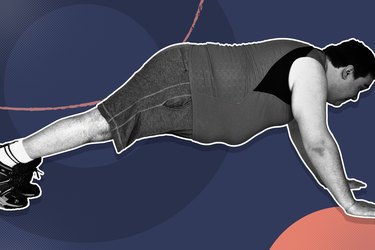

What Really Happens to Your Body When examines the head-to-toe effects of common behaviors, actions and habits in your everyday life.
There's no shortage of YouTube vlogs documenting week-, month- and year-long push-up challenges. In many cases, these fitness bloggers show off jaw-dropping results, but that's not the whole story.
Push-ups are an excellent strength exercise that will work your entire body. They even have some cardio benefits. But performing push-ups every day can lead overuse injury, especially if you're not using the right form.
Video of the Day
Video of the Day
To avoid winding up in the physical therapist's office, vary your strength-training exercises and workouts, giving your body ample time to strengthen and recover properly.
Your Total-Body Strength
Push-ups have been around forever. Considering it requires no equipment and builds total-body strength, it's no surprise this move has stuck around.
The main focus of the exercise is the muscles in your chest, arms and shoulders, according to the American Council on Exercise (ACE). But the move also requires core strength. As you move through the exercise, the muscles in your torso work to keep your body stable and in line.
But there's a limit to the amount of strength you can gain with a standard push-up. Eventually, you're going to hit a plateau, according to the ACE. Your body can only gain so much strength from doing the same motion over and over again. So, if you've only been doing push-ups every day for a while without any changes in reps or variations, your progress has likely stalled.
That's where progressions come in (more on that below). By upping your push-up intensity, variation or total sets and reps, you can introduce a new stimulus to your muscles. These strategies will cause new damage to the muscles, triggering an increase in strength.
But even if you incorporate more challenging variations, doing a push-up workout every day probably isn't the best idea. In order to increase your muscle strength and size, you need to give your body time to recover, according to Harvard Health Publishing.
Your Posture
Although they're usually used to target your chest muscles, your core plays a big role in proper push-up form, says Samuel Chan, physical therapist at Bespoke Treatments in New York.
"While most people think about the chest and pecs, push-ups are also great in terms of strengthening your arms, triceps and core," Chan says. "Your abdominal muscles must be active in order to maintain proper form during a push-up."
Strong abs can help improve your posture over time. Your core strength plays a role in your body's stability, balance and posture, according to the Mayo Clinic. It may also help reduce lower back pain.
Your Heart Health
Your ability to do push-ups may indicate more than just upper-body strength. Researchers found that adult men who could do 40 or more consecutive push-ups had a lower risk of cardiovascular disease over the next 10 years than men who could completed fewer than 10 push-ups, according to a February 2019 study published in JAMA Network Open.
Regular physical activity — including functional, body-weight exercises like push-ups — benefits your overall heart health. But the way you perform and incorporate this strength exercise affects the cardio boost, Chan says. Add them to a full-body workout with other exercises like mountain climbers and squats to reap maximum benefits.
"The key to cardiovascular exercise is to keep your heart rate (HR) up," Chan says. "It would be tough to maintain a steady rate of push-ups while keeping your HR high without your muscles fatiguing very quickly. As such, I would mix them into a full-body day, where you would be alternating between upper- and lower-body exercises."
Avoid Potential Push-Up Injuries
As with all repetitive exercise, overuse is always a potential injury risk — daily push-ups, included. Overuse injuries in the muscles or joints, like tendonitis, usually occur due to repetitive movement, according to the Mayo Clinic.
Performing your push-ups with poor form or excessive intensity can both cause pain and injury. Exercising for too long or increasing your reps too quickly can also be a source of overuse. In other words, you don't want to jump from 5 reps to 50 in just a few days.
Typically, push-up related injuries happen in the shoulders, also known as a shoulder impingement, Chan says. Impingements usually feel like a pinch at the front of the shoulder and can happen due to poor shoulder stability during the exercise.
Lower back pain is another issue Chan sees with push-ups. Usually, low-back pain happens due to overarching of the back or weak core strength.
In order to prevent potential injury, alternate between upper-body and lower-body exercises each day. You'll also want to avoid excessive reps and stop or pause when your form begins to break down, Chan says.
Practice Proper Push-Up Form and Modifications
If you're wondering how many push-ups you should do in a day, the answer depends on your physical condition and health. When you just start out, keep the number of reps low or consider recording your form to make sure you get it right. They should look like this:
- Start in a high plank with your hands directly beneath your shoulders, body in a straight line from head to hips to heels.
- Bend the elbows at about a 45-degree angle from your ribs and begin to lower your body toward the ground, squeezing the shoulder blades together and keeping your head and neck in line with your spine.
- Once your chest hovers just above the ground, exhale and press into your palms, separating the shoulder blades and straightening the arms.
Tip
As you perform your push-up, keep your core tight and glutes squeezed, Chan says. Be conscious of the angle in your elbow. Avoid bending your elbows at 90 degrees, as this can cause shoulder pain.
If you can't do a standard push-up properly, begin with a modified knee push up, Chan says. The form is exactly the same, except you'll drop your knees to the floor. As with a regular push-up, avoid hiking or sagging your hips and move your body in a straight line.
Once you can do a few sets of 10 with confidence, you can progress and test out more challenging variations. Lift your legs up onto a chair or couch to position your body into a decline push-up. This angle makes the move more challenging for the upper body.
The Bottom Line on Daily Push-Ups
Although push-ups are an excellent, full-body exercise, doing the same number of the same exercise every single day without rest isn't the best idea. Be sure to give your body plenty of time to recover between workouts to stay injury-free and reap the most muscle-building benefit.
- Mayo Clinic:"Overuse injury: How to Prevent Training Injuries"
- JAMA Network Open: "Association Between Push-up Exercise Capacity and Future Cardiovascular Events Among Active Adult Men"
- Mayo Clinic: "Core exercises: Why you Should Strengthen Your Core Muscles"
- ACE: "10 Tips for Powering Through Plateaus"
- ACE: "Perfecting the Push-up for All Levels"
- Harvard Health Publishing: Time to put some muscle into it
Was this article helpful?
150 Characters Max
0/150
Thank you for sharing!
Thank you for your feedback!