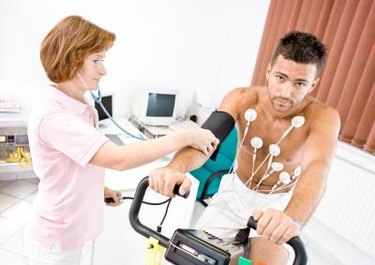
The workout heart rate for a man 55 years of age will depend on his physical condition and his exercise goals. You can improve your heart and lung capacity by beginning at a pace that raises your heart rate to half of its maximum. You can further benefit by pushing yourself to exercise at a pace that increases your heart rate to 70, 80 or even 90 percent of its maximum -- if you are fit enough. The first step to choosing your target heart rate is to estimate your maximum heart rate. Then you can select an appropriate range of heart rates for your workouts.
Estimating Your Maximum Heart Rate
Video of the Day
The standard formula for estimating a man's maximum heart rate hasn't changed in nearly four decades. Simply subtract your age from 220. A 55-year-old man's maximum heart rate would be 165 beats per minute. His actual maximum would probably lie between 155 and 175 beats per minute, depending on his health and fitness level. The estimated figure is sufficient for setting target heart rate goals for routine fitness training.
Video of the Day
A Range of Exercise Heart Rates
There is no single, workout heart rate specifically designated for someone 55 years of age. Instead, there are target heart rate ranges. The American Heart Association and the American Council on Exercise suggest exercising at an intensity that raises your heart rate to between 50 and 80 percent of its maximum capacity. That means between 83 and 132 beats per minute.
Build Up Your Level of Fitness Gradually
If you are starting a new exercise program at age 55, spend a few weeks working out at a pace that raises your heart rate to just 83 beats per minute, 50 percent of your maximum. Then, begin to slowly increase the intensity until you are exercising at 75 percent of maximum, or 124 beats per minute. The American Heart Association says you might increase the intensity of your workouts over the following six months until you reach 85 percent of maximum, or 140 beats per minute. It is not necessary to exercise at this pace, however, to gain and maintain cardiovascular fitness, according to the Association. You can get fit by working out at less than 85 percent of maximum.
Safety Precautions
These recommendations assume you are in good health. Before beginning an exercise program, get the approval of your physician. Be sure to ask your doctor if any medications you are taking could affect your ability to exercise. Some prescriptions, such as blood pressure medications, lower your maximum heart rate. After you begin your exercise program, pay attention to how you feel while working out. Don't try to adhere rigidly to a constant elevated heart rate if you feel dizzy, weak, nauseated or experience pain. Stop exercising and determine the cause of your discomfort before continuing.