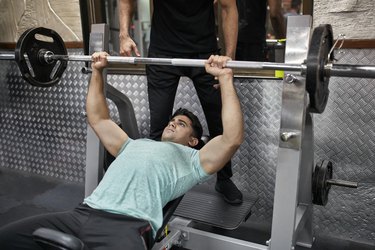
At first glance, there doesn't seem to be a lot of difference between an incline barbell bench press and an incline dumbbell press. After all, in both, you're lying on a slanted bench and pressing weight above your chest. Both activate the fronts of the shoulders and the upper portion of the chest more than a flat bench press.
The two exercises round out a comprehensive chest training routine — but is there an advantage to using one piece of equipment over the other? We asked Brooke Van Paris, CPT, personal trainer at Life Time Fitness in Boca Raton, Florida, to explain and show the difference.
Video of the Day
Incline Dumbbell Press Basics
An incline dumbbell press is a bench press that's done with a set of dumbbells. It does a great job at targeting your pectoralis major, which is the upper chest muscle, Van Paris says.
The back of your shoulders (posterior delt), triceps, and front of your shoulders (anterior delt), also engage to some extent, but your pecs take on the brunt of the exercise.
The exercise is done by lying on an exercise bench with the backrest up at an incline of about 30 degrees. After lifting a set of dumbbells to chest height, you then lower the weights toward your chest, and then press them in front of your chest until your arms are straight.
Because you don't need to worry about racking and unracking a bar, you have more flexibility over the exact incline of the bench. Specifically, you can incline it further back so that you can more squarely hit the chest muscles and avoid involving the shoulders.
Incline Dumbbell Press
- Start by making sure the bench is adjusted to a 30-degree incline, your feet are firmly planted on the ground, butt planted on the seat, back flat against the backrest and lats retracted. (If your feet don't naturally hit the ground without arching your back, lift your feet up off the ground to plant them on the front of the bench.)
- Grab the dumbbells off the ground and rest the heads of both dumbbells on each leg.
- Kick up your legs to create momentum for the dumbbells to get in position at chest height. (If necessary, ask a spotter to assist.)
- Your elbows should be positioned at a 45-degree angle away from your body.
- Then press the weights in front of your body, fully extending your elbows at the top.
- Once your elbows are fully extended, slowly begin lowering the weights to upper chest level, stabilizing and maintaining control of the weight.
- Repeat.
Benefits
Focuses on your pecs: If you're looking to really hammer your chest, the incline dumbbell press is a great choice. "It focuses more directly on the pecs," Van Paris says, thanks to the ability to set the bench at more of an incline.
More functional: "The incline dumbbell press allows for a more functional movement where the arms can work independently of each other to stabilize and press the weight away from the body," Van Paris says. Because the reality is that on a day-to-day basis, you may need to lift or press something with just one arm or with an unequal weight on each arm. Having each arm work independently also "naturally helps the body to develop muscular balance/symmetry," Van Paris says. That's because the stronger side can't surreptitiously take over for the weaker one.
Works your core: The element of instability adds more of a challenge for your core and stabilizer muscles, Van Paris says, "because the hands aren't holding onto the same piece of equipment." This forces your midsection, and all the small stabilizer muscles in your core and shoulders, to engage.
Greater range of motion: "We are also able to achieve a greater range of motion with the dumbbell version because the barbell itself limits how internally rotated the elbows can move inward as well as how far the bar can actually descend," Van Paris says. "The dumbbell variation allows the chest to expand more, and the weight to move an inch further past the chest than the barbell."
Drawbacks
Harder to set up: "With the barbell rack above and the bench in a fixed position, the barbell incline variation is easier to set up," Van Paris says. The dumbbell version can be more tricky to set up. "Moving the dumbbells from the floor to chest height can be more challenging than the barbell variation with the rack set up above the bench."
Requires many weights to keep progressing: Dumbbells come in so many different weights, so they are great for being able to progress slowly. The downside is that this means you need a huge variety of dumbbells to keep progressing. If you belong to a gym, that's not likely a problem, but it can be an issue if you're exercising at home and don't have space for that many sets of dumbbells.
Incline Bench Press Basics
The incline bench press is a pressing exercise that's done with a barbell. It primarily works your pectoralis major, the main muscle in your chest, but also works the front of your shoulders, triceps, and back of your shoulders, says Van Paris.
It works these muscles much more than the dumbbell incline press, because the angle of the backrest is greater — you're sitting more upright and pressing the weight a little more overhead versus more out in front of your chest.
You do it lying on an exercise bench with the backrest up at an incline of about 45 degrees. After unracking the bar, you then lower it toward your chest and then press it back up until your elbows are straight.
Incline Bench Press
- Start by making sure your feet are firmly planted on the ground, your butt planted on the seat, with your back flat against the backrest and lats retracted. (If your feet don't naturally hit the ground without arching your back, lift your feet up off the ground to plant them on the front of the bench.)
- Space your hands evenly apart on the barbell overhead.
- Lift the bar off the rack overhead or use a spotter to assist.
- Internally rotate your elbows into your body as if you are trying to bend the bar in half.
- Slowly begin lowering the bar to the upper portion of your chest, stabilizing and maintaining control of the weight.
- Once at chest level, push the bar back up to the starting position, being mindful to have full extension of the arms at the top.
- Repeat.
Benefits
Works both the chest and shoulders: Since this chest press is done at an incline, it works to develop the upper portion of the pectorals and the shoulder complex, Van Paris says. "It's essentially a cross between a bench press and a shoulder press."
Great for heavy lifting and gains: If you want to move the most mass possible and gain muscle mass, a barbell is the right choice, according to a March 2011 study published in the Journal of Sports Science. Researchers compared the one-rep maximum of participants using a barbell press and a dumbbell press. The max dumbbell lift weight was 17 percent lower than the barbell press. Simply put: "You can move more weight with both arms and pecs doing the work," Van Paris says. More weight translates to bigger strength and muscle gains. And as you get stronger, you can easily add heavier plates to the barbell and progress.
Drawbacks
Can strain your shoulders: The shoulder is the most unstable joint in the body, which means that it's easy to tweak if you lift too heavy or move heavy weight with incorrect form. "All pressing movements put the unstable shoulder complex at risk," Van Paris says. She stresses the importance of warming up your chest and shoulders before doing this move.
May increase muscle imbalances: "When we have both of our hands on the same piece of equipment, like with a barbell, it will allow the weaker side or muscle group to rely on the strength from the dominant side, thus exacerbating the imbalance," Van Paris says.
Incline Bench Press vs. Incline Dumbbell Press: What's the Difference?
The main differences between the incline bench press and incline dumbbell press are the equipment you use — and that can affect everything from the angle of the bench to which muscles get more love.
Here's why: The bench has to be fixed at a certain point so you can reach and unrack the barbell. For this reason, the incline bench press with a barbell is done at 45 degrees, whereas the dumbbell incline press can be positioned lower, around 30 degrees, Van Paris says.
The 45-degree incline works your chest and also shows the front of your shoulders some love. The 30-degree incline allows you to focus more specifically on your chest. It all depends on what you're looking for out of your lift.
The incline bench press is typically a better choice for advanced exercisers who know their way around a barbell and can press a minimum of 35 pounds — and who want to lift super heavy.
"Usually the beginning weight will range from 35 pounds (training bar) to 45 pounds (Olympic bar)," Van Paris says. On the other hand, a dumbbell press allows you to start modestly, with a press of 8, 10 or 15 pounds, and increase in smaller increments.
Remember as you progress, you have to use the increments that the dumbbells or weight plates come in. It's going to depend on what you have available at home or at the gym, but as you get into higher weights, it might be more difficult to increase by small percentages with dumbbells: After 15 pounds, they are usually in increments of 5 pounds, whereas 2.5-pound weight plates are usually an option.
Like most things, the right choice comes down to where you're at and what your fitness goals are. If you have uneven pec development, choose dumbbells to force your weaker side to buck up.
Dumbbells may also be your choice if you usually use only the flat bench barbell press as your go-to exercise. Finishing your workout with an incline dumbbell press hits your muscles from a different angle and benefits your overall development.
How to Choose
"Both are great exercises for anyone looking to develop the different muscles of the pecs and work on functional fitness," Van Paris says.
She also cautions against doing either if you have rotator cuff issues, cannot comfortably get into the right position for the lift, or have any other issues that limit your ability to train your chest or shoulders.
Dumbbell | Barbell |
|---|---|
Targets pecs | Targets pecs and delts |
More functional | Easier to set up |
More stability and core work | Better for building muscle mass and strength |
Helps correct muscle imbalances | |
Easy to progress in small increments |
Was this article helpful?
150 Characters Max
0/150
Thank you for sharing!
Thank you for your feedback!