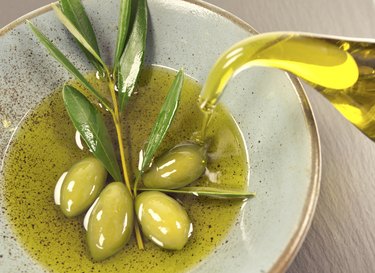
There are many different types of olive oil. You can buy extra virgin olive oil, virgin olive oil, regular olive oil and even pomace olive oil. However, pomace is produced as a byproduct of olive oil; it is treated with chemicals and blended with olive oils to create pomace olive oil.
Tip
Olive oil is extracted from olives and comes in many different types. Pomace is produced during the process of making olive oil. Pomace olive oil is made by treating the pomace with chemicals to extract the remaining oil from it, then blending it with olive oil.
Video of the Day
Video of the Day
Making Pomace Olive Oil
According to the International Olive Oil Council, olive pomace is a solid material that is produced when making olive oil. Keep in mind that pomace is not restricted to olives. This solid material can be produced by crushing any fruit.
When making olive oil, pomace is usually considered a waste product. However, it can be used to make a different oil of its own, known as pomace olive oil. To make pomace olive oil, the solid pomace needs to be treated with chemicals. At this stage, the oil isn't edible, however. It's known as crude pomace oil. Crude pomace oil is then refined to make it edible. This is known as refined olive pomace oil.
However, most refined olive pomace oil is not sold as is — at least, not when it's intended to be used for culinary purposes. Instead, most refined olive pomace oil is mixed with virgin olive oil to enhance its flavor, nutritional benefits and antioxidant properties. The resulting product is known as olive pomace oil.
Read more: 9 Delicious Recipes Made With Healthy Fats
Health Benefits of Pomace
Although pomace is considered a waste by-product, it's not without benefits. Nutritionally, a December 2018 study in the journal Science of the Total Environment reported that olive pomace is rich in healthy unsaturated fats, vitamin E and antioxidants.
Olive pomace also contains a range of healthy fats and beneficial bioactive compounds, like antioxidants and pentacyclic triterpenes. These <ahref="https: www.tandfonline.com="" action="" showcitformats?doi="10.1080/10408398.2019.1698005""> </ahref="https:>compounds are thought to help:
- Combat bacteria, fungi and other microbes.
- Combat cardiovascular diseases like atherosclerosis.
- Combat the negative effects of diabetes.
- Combat inflammation.
- Lower cholesterol.
- Protect various organ systems, including the gastrointestinal system and liver.
Certain compounds found in olive pomace may help support the treatment of certain different diseases, including cancer, multiple sclerosis and osteoporosis.
Although they are less common, you can obtain other types of pomace oil from other plants too. In many cases, the seeds are separated from the remaining pomace to create a purer oil.
For instance, an August 2013 study in the Journal of the Science of Food and Agriculture reported that apple-seed oil is also rich in antioxidants and healthy unsaturated fatty acids. Like olive pomace oil, it has interesting biomedical properties, such as anticancer effects.
Pomace is not only used to make oil; it can also be used to produce pomace brandy and other products. Pomace brandy is usually made from grape pomace other sweet fruits, rather than olive oil.
- Journal of the Science of Food and Agriculture: "Fatty Acid Composition, Physicochemical Properties, Antioxidant and Cytotoxic Activity of Apple Seed Oil Obtained From Apple Pomace"
- Science of the Total Environment: "Olive Pomace as a Valuable Source of Bioactive Compounds: A Study Regarding Its Lipid- and Water-Soluble Components"
- International Olive Oil Council: "Designations and Definitions of Olive Oils"
- Critical Reviews in Food Science and Nutrition: "Nutritional and Other Health Properties of Olive Pomace Oil"
- The Olive Oil Times: Olive Pomace Oil: Not What You Might Think
- Olive Oil Source: Olive Classification