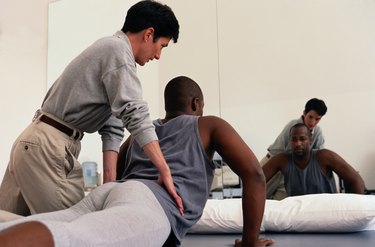
Exercises for neuromuscular reeducation are part of a therapeutic technique that addresses various adverse conditions that arise from faulty nerve and muscle activities. According to Peter Levy, D.C., more than 90 percent of the soft tissue injuries that chiropractic professionals encounter can benefit from neuromuscular reeducation exercises. The exercises are particularly beneficial for unhealthy movement patterns that persist after injuries. For example, patients sometimes continue limping months after a hip or leg problem is eliminated.
Goal
Video of the Day
Neuromuscular reeducation exercises can help you achieve a variety of goals, which include improving balance, coordination, posture and proprioception. Proprioception is your sense of the relative position of different body parts. Injuries, repetitive use, poor posture and unhealthy biomechanics can make your movement patters become inefficient. The broad goal of neuromuscular reeducation exercises involves restoring a natural mind-body connection by coordinating your mental perception with physical behavior. Neuromuscular reeducation exercises aim to restore natural and energy-efficient movement patterns, optimize joint biomechanics and reduce pain that may result from neuromuscular deficiencies.
Video of the Day
Conditions
Exercises for neuromuscular reeducation may help improve a variety of conditions associated with postural problems, aches and pains. Jacob Quihuis, D.C. administers neuromuscular reeducation exercises to patients that have back and neck pain, and problems with flexibility or joint mobility. Neuromuscular reeducation exercises can help improve persistent poor posture, which can contribute to repetitive strain injuries. Individuals with poor circulation and emotional stress may also benefit from neuromuscular reeducation exercises.
Assessment
Physical therapists that administer exercises for neuromuscular reeducation assess factors that may contribute to pain that a particular patient is experiencing. Trigger points are locations on your body that can cause pain on other parts of your body. Neuromuscular reeducation exercises can relieve pinched or pressed nerves that cause pain. Elevated stress can also adversely affect your nervous and musculoskeletal system. Neuromuscular reeducation exercises are particularly important for improving postural distortions, which weaken supporting muscles and lead to faulty movement patterns that can intensify pain.
Exercises
Neuromuscular reeducation exercises include a variety of functional strengthening, stretching, balancing and coordination activities. Practitioners that administer these exercises encourage patients to focus on joint positioning and movement. The key to many neuromuscular reeducation exercises is maintaining balance while performing specified movements. For example, pelvic tilt exercises introduce you to proper pelvis positioning, and then may encourage you to maintain the tilt while moving your legs. Unilateral balancing exercises help you establish a proper pelvic tilt while balancing on one foot. A variety of stretching and bending movements on an exercise ball also have neuromuscular applications.