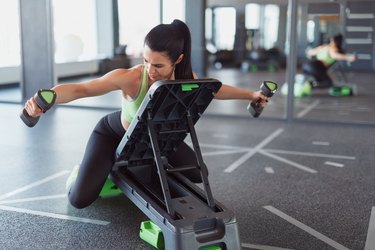
The dumbbell lateral raise enhances your physique's appearance by creating size contrasts between your shoulders, waist and hips. Building your shoulders creates an aesthetic effect similar to wearing shoulder pads on a blouse or jacket.
By making your shoulders appear wider, your waist and hips appear slimmer. The dumbbell lateral raise also works the muscles that support and stabilize your shoulders.
Video of the Day
Video of the Day
Tip
The dumbbell lateral raise primarily works your deltoid muscle, with assistance from the supraspinatus and trapezius muscles.
Posture With Lateral Raises
Perform the dumbbell lateral raise with proper posture to target the correct muscles.
- Stand up tall with your shoulder blades pulled together, holding one dumbbell in each hand.
- Rotate your forearms until your palms face forward.
- Raise your arms out to your sides until they reach shoulder-height.
- Hold for one to two seconds, then slowly lower back down.
- Perform 10 repetitions and work up to three sets in a row.
Prime Mover With Lateral Raises
A prime mover performs the main muscle action involved in an exercise. During a dumbbell lateral raise, the lateral deltoids, located on the side of the shoulder, work as prime movers. The lateral deltoid abducts, or moves the arm away from the center of your body.
Several training errors diminish lateral deltoid efficiency during the dumbbell lateral exercise. When the elbows drop below the wrists, for example, the anterior deltoids become the prime movers, thereby diminishing the exercise's benefits. Some people use momentum to bring the dumbbells to shoulder height. The spine becomes the prime mover in this situation.
Synergists for Lateral Raises
Synergistic muscle groups assist the prime mover in performing the exercise. The anterior deltoid, the supraspinatus and the trapezius muscles assist the lateral deltoids during the dumbbell lateral raise. The anterior deltoids sit at the front of your shoulders. The supraspinatus, located in the rear deltoid, initiates the abduction movement.
Your trapezius, responsible for shoulder elevation, forms a triangle from the neck to the base of your shoulders. If you feel the lateral raise exercise in your neck, you may be using too much weight, which causes the trapezius to take over the movement.
Muscles That Stabilize
Stabilizers play an important role in all types of weightlifting exercises. They take responsibility for keeping the joints surrounding the working muscle groups in a stable position. Stabilizers also prevent the action of nearby muscles, which may attempt to overcompensate for the prime movers.
The wrist extensors and flexors, for example, keep the wrists straight during the dumbbell lateral raise, and the levator scapulae, which start at the top of your shoulders and extend up the sides of your neck, stabilize your shoulder blades.
Read more: Ultimate Back & Shoulder Workouts
Rear Lateral Raise
The rear lateral dumbbell raise works the back of the shoulders. Its performance method resembles the technique used in the upright lateral raise, with one main difference. Instead of standing or sitting upright, bend forward at the waist, and lift your arms to the side from a flat back position.
The rear deltoid lateral raise also works the rhomboids, responsible for pulling the shoulder blades toward each other and improving posture. Personal trainers often prescribe this exercise to clients with muscle imbalances between their chest and upper back muscles.
Was this article helpful?
150 Characters Max
0/150
Thank you for sharing!
Thank you for your feedback!