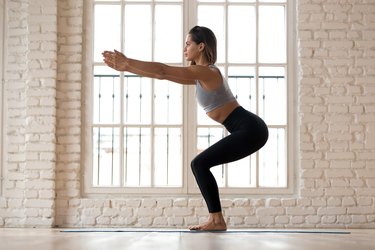
Whether you're short on time and can't get to the studio or you crave the privacy that comes with moving in your own space, doing hot yoga at home can be a rewarding experience. To get the most out of your at-home practice, there are several steps you can take before you crank up the heat and get flowing.
What Is Hot Yoga?
Video of the Day
Hot yoga moves through a series of poses in a heated space. The temperatures can vary, but sessions typically range from 90 to 98 degrees. While many studios have a set length of time for a class, you can find classes that last anywhere from 30 to 90 minutes, depending on the studio and instructor.
Video of the Day
Hot yoga first hit the scene in 1974 when instructor Bikram Choudhury introduced Bikram yoga to the masses. This style of yoga was developed to encourage participants to flow through a sequence of 26 different postures in a room heated to around 105 degrees with 40 percent humidity. According to the Bikram yoga website, the poses are designed to warm and stretch muscles, ligaments and tendons, in the order in which they should be stretched.
While Bikram yoga is known as the original "hot yoga," it's not uncommon to see other studios advertise heated classes. That said, it's important to note that a Bikram class is always 90 minutes long with 26 designated poses performed in a fixed heated environment. Other hot yoga classes can range in temperature and duration and often include different poses that vary by class and studio.
Read more: How to Sweat It Out in Your First Hot Yoga Class
How to Do Hot Yoga at Home
Having the ability to practice hot yoga at home can help eliminate excuses and provide an environment that is private, comfortable and ready whenever you are.
The first thing you'll want to consider when structuring your at-home hot yoga workout is how you can create an environment conducive to the flow. When designating a space to practice hot yoga, aim to find a room or quiet area that you can convert into a studio and modify to promote a feeling of calm and relaxation.
Jessica Fuller, instructor, and founder of The Hot Yoga Spot suggests painting the walls a soothing color, add a few paintings, a little waterfall, a plant, meditation pillows, candles or a statue to enhance the space. She also recommends designating a focal point in the room upon which to center your drishti or yogic gaze.
How you plan to heat your space is the next step. "Most people practicing at home find it is easiest to buy a small space heater to get the room to their desired temperature," explains Fuller.
Once you have your home "studio" designated, organized and toasty, it's time to consider the overall structure of a hot yoga sequence. Daily Burn fitness instructor Amanda Kerpius suggests structuring your time based on three components: the warm-up, poses and cooldown.
For example, warm up with a simple sequence to stretch major muscle groups and joints and allow your body to adjust to the heat. Then, add on a simple standing yoga sequence like a sun salutation and repeat. Finally, you will want to end in a seated position for deep breathing to bring your heart rate down.
Read more: What Are the Benefits of Practicing Yoga Daily?
How to Get the Most Out of an At-Home Hot Yoga Workout
Stay hydrated at all times. Drinking water before, during and after a hot yoga sequence is critical. Take sips of water throughout your session and hydrate immediately following your workout.
Ease into the workouts. If you're new to yoga in general or hot yoga specifically, allow your body time to adjust to the poses and the warmer environment. Kerpius recommends starting with a shorter practice (say, 20 to 30 minutes) to see how your body manages the heat. "As your body builds up the cardiovascular fitness and heat tolerance, you can add time," she explains, up to 75 minutes.
Keep your space free of clutter. One of the many benefits of yoga is giving yourself permission to free your mind and body of external stressors. This can be difficult to do if the space you're practicing in at home is cluttered with furniture, work items, your kid's toys or any other visual distractions. If you can, try to designate a space just for yoga.
Consider using a mirror. Often a pose feels different than it looks, says Fuller, and a mirror can help you self-correct and fine-tune your practice. "Many people enjoy using a mirror to ensure proper alignment and positioning, while others prefer not to use a mirror so they can focus on the way their body feels in a pose instead of how it looks," says Fuller. It may also be easier to balance if you are looking at a fixed object like a light or a candle instead of yourself in the mirror. Spend a little time deciding what is right for you in your sacred space.
Generate heat by wearing layers. To spark higher temps at the start of your practice, CorePower Yoga Master Trainer Amy Opielowski recommends wearing layers over your yoga gear. As you build heat, you can peel off your sweatpants and sweatshirt.
Be safe with your heaters. Always unplug them whenever you are not practicing hot yoga, and keep them away from curtains and other soft items.
Try This Sample Hot Yoga Sequence
A basic sequence of sun salutations is ideal for anyone getting started with a home hot yoga practice. That's because the poses are easily accessible for new practitioners, but they can be made more challenging for advanced yogis too, Fuller points out.
"New students can move through the basic postures like Mountain pose, Downward Facing Dog, plank and low lunge at their own pace and hold them for as long as they'd like. More advanced students can flow through them more quickly and repeat many times to increase heat, even adding in more difficult variations and poses as they see fit," she says.
Read more: 11 Essential Yoga Poses Everyone Should Practice
Sweat along at home with this hot yoga workout for beginners from Kerpius.
Warm Up
- Lie down on your back and rotate your knees to the right and left.
Seated Poses
- Lift your chest as you breathe in; round your back as you breathe out.
- Rotate torso right and left.
On Hands and Knees
- Extend right leg back from all fours. Draw right knee in and step right foot through your hands to Low Lunge.
- Flex your right foot between your hands. Straighten your right leg as much as you can comfortably as you sit your hips back to move into Half Split. Repeat this dynamic stretch twice.
- Move your hands to the inside of your right leg, then lift your left arm up, fingers reaching toward the ceiling. Stack your left shoulder above your right for Extended Side Angle.
- Return to all fours, then "stand" straight up on your knees.
- Repeat on the other side.
Transition to Standing
- Move into Downward Dog, then lower to the ground. Press up gently with your hands next to your chest into Baby Cobra, then return to Downward Dog.
- Walk your feet to the top of your mat and roll up.
Standing
- Lunge into Standing Crescent pose on the right and left, then return to center and fold forward.
- Send your left leg back into a low lunge. Press your left hand on the mat and lift your right hand to the ceiling as you twist to the right into High Lunge Twist.
- Move to Warrior II, hold for several breaths, then move to Side Angle pose.
- Cartwheel your hands to the ground back to Low Lunge. Step your back foot to your front foot, and repeat on the other side.
Transition to the Floor
- Lie on your mat on your stomach. Exhale as you lift your arms, shoulders, chest and legs off the mat into Locust pose, with your hands clasped behind you.
- Repeat twice.
On Your Back
- Lie on your back for Figure Four stretch. Repeat on both sides.
- Relax into Savasana, or final resting pose.
Read more: 10 Best Yoga Poses for Beginners
Hot Yoga Safety and Precautions
Even though hot yoga can be safe and enjoyable for just about anyone, Fuller says you should always consult your doctor before beginning a new workout regimen. "If you have high blood pressure, are prone to seizures, are pregnant or have any other special conditions, then it is always best to make sure your doctor is on board with hot yoga before you begin practicing," she explains.