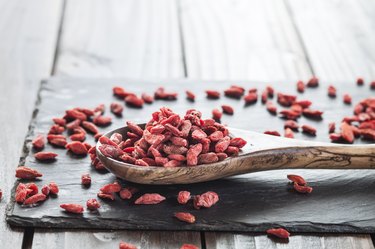
The goji berry has climbed its way to the top of the nutritious foods list, claiming a spot as a "superfood." If you take a look at goji berries' nutrition, it's easy to understand why. Goji berries are full of iron, plus they're high in antioxidants, which are linked to disease prevention.
You can eat dried goji berries or eat them fresh — either way, they're full of nutritional benefits. But you should be careful not eat more than a serving of dried or fresh goji berries, as they can be high in carbs and sugar.
Video of the Day
Video of the Day
Goji Berry Nutrition Facts
According to the USDA, a 1/4-cup serving (about 4 tablespoons) of goji berries will give you:
- Calories: 111
- Total fat: 0 g
- Saturated fat: 0 g
- Trans fat: 0 g
- Cholesterol: 0 mg
- Sodium: 138 mg
- Total carbs: 23 g
- Dietary fiber: 5 g
- Sugar: 17 g
- Protein: 4 g
Goji Berry Macros
- Total fat: A 1/4-cup serving of goji berries has 0 grams of total fat.
- Carbohydrates: A 1/4-cup serving of goji berries has 23 grams of carbs, which includes 5 grams of fiber and 17 grams of naturally occurring sugars.
- Protein: A 1/4-cup serving of goji berries has 4 grams of protein.
Vitamins, Minerals and Other Micronutrients
- Iron: 17% Daily Value (DV)
- Potassium: 8% DV
A 1/4-cup serving of fresh goji berries will only supply 111 calories. Most of these calories come from carbs, with a serving of goji berries clocking in at 23 grams. Natural fruit sugar (or fructose) accounts for around 17 grams of these carbs, while fiber supplies another 5 grams.
There is something interesting about the type of carbs in goji berries, too. They're largely in the form of polysaccharides, or more specifically, Lycium barbarum polysaccharides, according to a January 2019 report in Oxidative Medicine and Cellular Longevity.
L. barbarum polysaccharides have been revered in Chinese medicine for many years, and eating foods that are high in them has been linked decrease cholesterol and triglyceride levels and a reduced risk of heart disease. They have also been linked to improved fertility and immune health.
Dried Goji Berry Nutrition
According to the USDA, a serving of dried goji berries is equal to 1/4 cup (about 4 tablespoons). That amount will give you:
- Calories: 100
- Total fat: 0 g
- Saturated fat: 0 g
- Trans fat: 0 g
- Cholesterol: 0 mg
- Sodium: 94.9 mg
- Total carbs: 21 g
- Dietary fiber: 2 g
- Sugar: 15 g
- Protein: 3 g
Benefits of Goji Berries
Goji berries may look a little strange, but there's a lot of nutrition in those little shriveled red packages. The goji berry has been used since ancient times to improve liver and kidney function, protect vision and increase longevity, according to the report in Oxidative Medicine and Cellular Longevity.
According to the report, there are many beneficial compounds in goji berries, but one of the most significant is a class of compounds called carotenoids. Carotenoids are naturally-occurring pigments that give the goji berries their distinctive color. They also act as powerful antioxidants and are linked to a reduced risk of heart disease, diabetes and cancer. These antioxidants are also linked to improved cognitive performance, like thinking and memory.
Two specific carotenoids in goji berries — called lutein and zeaxanthin — are associated with protecting your eyes and decreasing your risk of eye diseases, like age-related macular degeneration (which is one of the most common causes of vision loss as a person gets older), according to a December 2016 study in Pharmaceutical Biology.
The same study also notes that the carotenoids and other phenolic compounds (beneficial elements found in plants) are associated with improved immunity, protection against tumors and keeping your brain healthy. They've also been linked to increased fertility in men.
Red or Black Goji Berries
Although most dried goji berries that you find at your supermarket or local health food store are the red variety, there are also black goji berries. The two are similar, but when researchers compared the nutrition of red and black goji berries, they found that black goji berries had a higher antioxidant activity, and red goji berries were higher in carotenoids, per a June 2017 study in the Chemistry Central Journal.
Because people can't make carotenoids on their own, the only way to get them is through your diet, and just 15 grams of goji berries, which is less than a 1/4-cup serving, supplies all you need for the entire day, per the report in Oxidative Medicine and Cellular Longevity.
Goji Berries Side Effects
Ounce for ounce, dried fruits have more antioxidants than their fresh counterparts, so while eating them is linked to protection against chronic diseases, it also comes with potential problems.
It's unlikely that you'd eat several servings of fresh fruit in one sitting, but it's a lot easier to overdo it when that fruit is dried, according to Harvard Health Publishing. That's because dried fruit has most of its water removed, so it has less volume and is also less filling.
Because of this, it's a lot easier to go over your calorie needs by eating dried fruit. And, even though the sugar is natural, you may be taking in more carbs and sugar than you want to, especially if you're on a low-carb diet.
Dried fruits also contain more fiber per ounce than fresh fruits, so if you're eating a lot of goji berries, side effects like bloating and diarrhea may develop as a result of all that fiber, especially if you don't get a lot in your diet already. According to Duke Student Health Nutrition Services, too much fiber can cause:
- Gas
- Bloating
- Constipation/diarrhea
- Abdominal cramps
- Decrease in appetite
- Weight loss or weight gain
But you can avoid these side effects by paying attention to your serving sizes. Stick to a serving size of 1/4 cup of goji berries, and stay at one or two servings per day to make sure you're not taking in too much sugar and that your stomach can handle the fiber.
- Oxidative Medicine and Cellular Longevity: "Goji Berries as a Potential Natural Antioxidant Medicine: An Insight Into Their Molecular Mechanisms of Action"
- Duke Student Health Nutrition Services: "Fiber - How Much is Too Much?"
- Harvard Health Publishing: "Is Eating Dried Fruit Healthy?"
- Produce for Better Health Foundation: "What is the Serving Size of Dried Fruits?"
- USDA National Nutrient Database: "Goji Berries, Dried"
- National Institutes of Health Office of Dietary Supplements: "Vitamin A"
- Chemistry Central Journal: "Comparative Studies on Phenolic Profiles, Antioxidant Capacities and Carotenoid Contents of Red Goji Berry (Lycium Barbarum) and Black Goji Berry (Lycium Ruthenicum)"
- Pharmaceutical Biology: "Phytochemical Analysis and Antioxidant Activity of Lycium Barbarum (Goji) Cultivated in Greece"
- Archives of Biochemistry and Biophysics: "Carotenoids in Human Nutrition and Health"
- USDA MyFoodData: Goji Berries