





















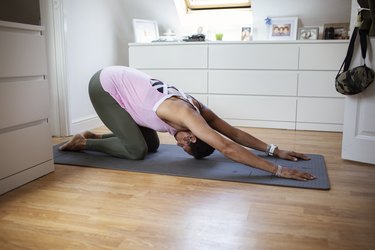














Bikram yoga is a series of 26 hatha yoga postures developed by yogi Bikram Choudhury. It is designed to be performed in a room heated anywhere from 80 to 120 degrees Fahrenheit. Bikram adherents claim that the high temperature loosens up muscles and joints, allowing the body to move more deeply into the postures and release toxins through breath and sweat. Bikram yoga practice focuses on mobilizing and protecting the spine, and when practiced correctly, should be safe or beneficial during breastfeeding, as long as you follow some simple guidelines.
Start Slowly
If you're immediately postpartum, you're probably not ready for such a vigorous practice as the Bikram sequence. Your breasts may be engorged with milk, making it difficult to perform forward bends or lay on your stomach, both of which are part of the Bikram sequence. Your pelvic floor muscles will be much weaker than normal and muscles in your abdomen and hips may not provide as much support as they once did. This strength will come back, but it takes time. Practice Kegel exercises -- squeezing the muscles of your pelvic floor -- at increasingly longer intervals, take slow walks, and be patient.
Get the Green Light
Your body goes through some profound changes carrying and giving birth to a child. Many health professionals, such as those at the American College of Nurse-Midwives, recommend waiting until six or eight weeks postpartum before engaging in any strenuous exercise. Others say that if your delivery was uncomplicated, you may begin as soon as you feel ready. Ask your doctor or midwife when it's safe to take part in a heated yoga practice, and tell your yoga instructor that you are postpartum and breastfeeding; he may be able to provide you with some modifications. Take it easy your first few classes -- getting used to the heat should be your first step. It is always all right to simply lie down on your back and rest during a Bikram class.
Avoid Dehydration
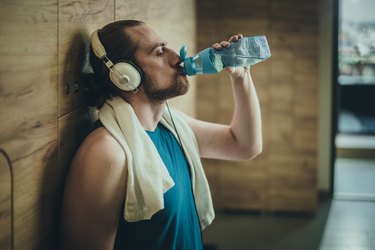
Successful breastfeeding requires that you stay healthy and hydrated. The Mayo Clinic recommends the 8 by 8 rule, which means drinking eight 8-ounce glasses of water per day. However, Bikram yoga can cause excessive sweating, and you should add at least 2.5 cups of liquid for each session you attend; many Bikram students drink a liter bottle of ice water during the course of one class. Consider a drink that contains electrolytes to replace those lost in your sweat. Shari Waxman of the "Yoga Journal" describes the signs of heat exhaustion as a high pulse rate, dizziness, nausea, confusion, cramps, and muscle weakness. If you notice any of these symptoms, lie down. If they persist more than a minute or two, immediately leave the room, lie down in a cooler area, and ask for help.
What About My Milk?
Rumors abound that exercise reduces essential nutrients in your breast milk or increases lactic acid in breast milk, causing your baby to reject it due to its flavor. The Clinical Practice Obstetrics Committee of Canada, the Australian Breastfeeding Association and the Mayo Clinic all report that moderate exercise has no observable effects on quality or quantity of breast milk. For more vigorous activity like Bikram yoga, the Mayo Clinic suggests feeding or pumping just before practice, to make it more comfortable for you. If your baby seems averse to your milk after vigorous exercise, consider pumping and discarding the milk 30 minutes afterward. After about five months, exercise will have less of an effect, since your milk will be mainly produced on demand -- at feeding time.
References
- American College of Nurse-Midwives; Recovering From Pregnancy
- "Yoga Journal"; Facing the Heat; Shari Waxman
- The Mayo Clinic: Water: How Much Water Should You Drink Every Day?
- Australian Breastfeeding Association; Exercise and Breastfeeding; Kate Mortenson
- Joint SOGC/CSEP Clinical Practice Guidelines: Exercise in Pregnancy and the Postpartum Period; Gregory A. L. Davies, et al.; 2003
- The Mayo Clinic: Labor and Delivery, Postpartum Care


Member Comments