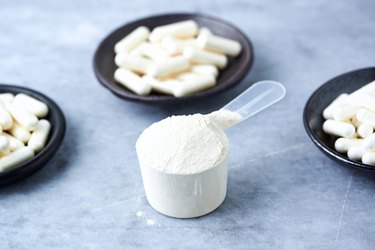
If you've spent any time in the gym trying to make muscle gains, you've undoubtedly heard of creatine. This supplement is known as a phenomenon when it comes to getting results from your resistance training because it has positive effects on muscle growth, metabolism, exercise stamina and recovery.
If you want to add creatine to your post-workout nutrition regimen, you may question whether it's prudent to mix creatine in a protein shake. Combining protein supplements with creatine is perfectly safe and may have some positive effects. Just be sure to stick to recommended serving sizes, however, and be aware of other supplements and how they may interact with creatine.
Video of the Day
Video of the Day
Tip
Mixing creatine with whey or another protein is not contraindicated or unsafe. It's convenient to take all your supplements together after your workout, but it doesn't add value. If you prefer to take them at different times, that's OK too.
What Is Creatine?
Creatine is found naturally in muscle cells. Everyone has it stored in their muscles, but the amount depends on genetics, diet and activity levels. It plays a key role in the formation of ATP — a primary energy source. When you don't have enough creatine in your body, you have trouble producing adequate ATP to meet your muscle's demands during bouts of intense activity.
The Potential of Creatine Supplements
According to the Journal of the International Society of Sports Nutrition position paper published in 2017, creatine has the potential to enhance recovery from exercise, prevent injury and aid in rehabilitation. Creatine can also help athletes endure heavy training loads, improve exercise performance and increase fat-free muscle mass during training. The ISSN actually calls it the "most effective ergogenic nutritional supplement currently available to athletes" in terms of increasing ability to exercise intensely and improve lean body mass.
A study published in Open Access Journal of Sports Medicine in 2017 showed that creatine supplementation was effective in increasing lean tissue mass and upper and lower body muscular strength in older adults when included with resistance training.
MedlinePlus notes that, along with improving exercise performance, strength and muscle growth, creatine may be used to treat issues that affect the brain, aging and bone density, such as Parkinson's disease, multiple sclerosis and Rett syndrome.
How to Use Creatine
The Journal of the International Society of Sports Nutrition recommends loading up on creatine when you begin using it. Consume 0.3 grams per kilogram (2.2 pounds) of body weight each day for five to seven days, followed by 3 to 5 grams per day to maintain elevated stores.
The ability of your body to uptake creatine may actually be improved when it's consumed with a carbohydrate and protein. Research doesn't show that this combination improves performance beyond consuming creatine alone, as reported in a 2016 study in the Annals of Nutrition and Metabolism. But, the research suggests that taking creatine and protein powder after working out may have some benefits, though they're not completely understood.
The Potential of Protein Powder
Protein powder is a popular workout supplement often used post-workout to help muscles recover and grow. Protein powder is commonly made from whey, a derivative of milk, but may also come from hemp, soy, pea, rice or egg.
Although protein powder has no notable impact on the body composition of untrained people, supplemental protein may promote muscle growth and enhance gains in strength when taken on a regular basis in conjunction with strength training workouts. A review in Sports Medicine in 2015 confirmed this potential of protein powder and found that protein supplementation may also accelerate gains in aerobic and anaerobic power.
The benefits of protein supplementation were further acknowledged in a meta-analysis published in a 2017 edition of the British Journal of Sports Medicine. Researchers found dietary protein supplementation significantly enhanced changes in muscle strength and size during resistance training.
How to Use Protein Powder
The British Journal of Nutrition analysis determined that protein supplementation of 1.6 grams per kilogram per day (or 0.73 grams per pound) is enough to improve muscle gain in young adults.
Although whey protein is widely considered the best for athletes, most complete proteins provide you with essential amino acids to boost performance.
Generally, it's recommended that you stick to supplemental protein (particularly whey protein) after your workout for optimal results. However, this requirement to commit to a post-workout protein dose is in question. PeerJ published research in 2017 finding that this narrow post-exercise window isn't absolute. Results of the study showed that taking protein close to your workout — before or after — can be effective.
The Significance of BCAA
Protein powders, particularly whey, contain a key array of amino acids called BCAAs, or branched-chain amino acids. These are leucine, valine and isoleucine, and as a 2014 paper in Advances in Molecular Biology explains, they have special physiological and metabolic goals. BCAAs may regulate protein synthesis in the body, a key part of muscle growth and repair. Supplementation of BCAAs may prevent fatigue during extensive exercise, enhance muscle metabolism and boost performance in aerobic exercise.
A review of multiple studies on the effects of BCAAs on muscle development and exercise published in Nutrients in 2017 found that these amino acids can be helpful in reducing low-to-moderate muscle damage created during exercise. You should take a high daily intake of 200 milligrams per kilogram of body weight for 10 days, and longer, to see results.
BCAAs and Creatine
You can include BCAAs in a protein shake and can combine them with creatine. Creatine is also made up of amino acids — methionine, arginine and glycine — that naturally occur in your body.
BCAAs don't have to be consumed post-workout to be effective, though. In fact, you may have better results if you consume them prior to exercise. A study in the Journal of Sports Medicine and Physical Fitness published in 2018 found that taking BCAAs before exercise had a better effect on preventing excessive muscle soreness than repeated supplementation afterward.
Creatine also doesn't need to be taken immediately after exercise. You can take it before, during or afterward or even spread it out throughout the day. Including creatine and BCAAs in your post-workout shake is good, but your results may be better if you include them in a pre-workout supplement.
When to Take Creatine
As noted previously, creatine's uptake may be improved if you use the supplement with carbohydrates or protein and carbs. If your protein shake has carbs along with the whey or other protein, adding your creatine to it can be a good move. If your shake doesn't have carbohydrates — from a banana, milk or juice — you may save creatine for another time during the day when you're eating carbs. It's your muscle concentration of creatine that matters most to performance, not the timing of its intake.
A 2015 study published in Applied Physiology, Nutrition and Metabolism showed that regardless of when creatine was taken, it improved muscle strength and muscle mass when combined with resistance training. Creatine with resistance training had greater effects on workout results than resistance training alone.
Creatine and Protein Powder
Creatine and protein powder, especially those with BCAAs, are valuable to muscle recovery and growth. While you may choose to consume them together for convenience, as long as you're taking both, you should get the benefits.
Warning
While creatine does occur naturally in your body, it’s not entirely clear that taking supplemental creatine is safe. Doctors aren’t sure of the long-term effects of taking creatine. Side effects include possible nausea and dehydration.
- Open Access Journal of Sports Medicine: "Effect of Creatine Supplementation During Resistance Training on Lean Tissue Mass and Muscular Strength in Older Adults: A Meta-Analysis"
- Journal of the International Society of Sports Nutrition: "International Society of Sports Nutrition Position Stand: Safety and Efficacy of Creatine Supplementation in Exercise, Sport, and Medicine"
- American Council on Exercise: "Creatine Creates a Sensation"
- MedlinePlus: "Creatine"
- Cleveland Clinic: "Creatine"
- Annals of Nutrition and Metabolism: "A Pilot Study Examining the Effects of 8-Week Whey Protein versus Whey Protein Plus Creatine Supplementation on Body Composition and Performance Variables in Resistance-Trained Women"
- Sports Medicine: "The Effects of Protein Supplements on Muscle Mass, Strength, and Aerobic and Anaerobic Power in Healthy Adults: A Systematic Review"
- British Journal of Sports Medicine: "A Systematic Review, Meta-Analysis and Meta-Regression of the Effect of Protein Supplementation on Resistance Training-Induced Gains in Muscle Mass and Strength in Healthy Adults"
- Advances in Molecular Biology: "Metabolic and Physiological Roles of Branched-Chain Amino Acids"
- Nutrients: "Is Branched-Chain Amino Acids Supplementation an Efficient Nutritional Strategy to Alleviate Skeletal Muscle Damage? A Systematic Review"
- The Journal of Sports Medicine and Physical Fitness: "Effect of BCAA Supplement Timing on Exercise-Induced Muscle Soreness and Damage: A Pilot Placebo-Controlled Double-Blind Study"
- Applied Physiology, Nutrition and Metabolism: "Strategic Creatine Supplementation and Resistance Training in Healthy Older Adults"
- PeerJ: "Pre- Versus Post-Exercise Protein Intake Has Similar Effects on Muscular Adaptations"