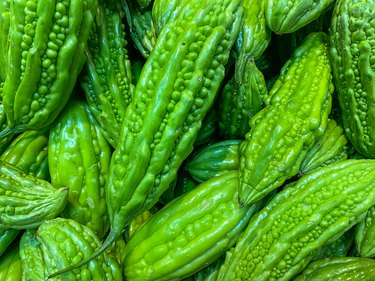
High blood pressure affects billions of people worldwide, so it's no surprise that word of a food to combat it might spread quickly. But in the case of bitter melon, don't believe everything you hear. It does have an array of health benefits, but blood pressure control isn't one of them.
Video of the Day
Video of the Day
A vine fruit grown in tropical and subtropical environments, bitter melon — Momordica charantia — is related to cucumbers, squash and pumpkins.
In the United States, you can find it at specialty groceries and perhaps in your own store's produce aisle. Juice of bitter melon and supplement options are also available in stores and online. It's also sometimes known as bitter gourd, bitter apple, wild cucumber, bitter cucumber, balsam apple, balsam pear, leprosy gourd, karela and kugua, says Memorial Sloan Kettering Cancer Center.
Since ancient times, the fruit, as well as its vines, leaves and roots, have been used as medicine, according to a May 2019 report in the journal Biomolecules. However, there's currently little to no scientific evidence supporting the claim that bitter melon can help lower blood pressure. More robust research, however, suggests that the fruit may be effective for treating a wide range of other ailments and diseases.
Potential Benefits of Bitter Melon
Bitter melon contains several important nutrients, including vitamins C and A, along with folate and zinc, explains Steven Reisman, MD, a cardiologist and director of the New York Cardiac Diagnostic Center in New York City. "It also has several antioxidant compounds which can help protect against certain types of inflammation in the body," he says.
Memorial Sloan Kettering says that this edible fruit is used as food and in medicine for treating diabetes, cancer, viral infections and immune disorders. In supplement form, bitter melon is used to treat osteoarthritis, it adds.
Research published in April 2018 by the Journal of Ethnopharmacology suggests that the fruit can help lower blood sugar levels in people with prediabetes or diabetes. Studies also indicate that it may have some potential for helping people with Type 2 diabetes by increasing insulin sensitivity, says Memorial Sloan Kettering.
However, it also notes that bitter melon cannot be recommended as a replacement for insulin or drugs for treating diabetes since research has not established the proper dosage for lowering high blood sugar levels.
Research published in August 2018 by Complementary Therapies in Clinical Practice found that people with knee osteoarthritis who took three 500-milligram capsules of Momordica charantia three times a day experienced weight loss, reduced fasting blood glucose and significant improvements in knee injury and osteoarthritis (reducing the need for pain relievers), compared with people who took a placebo. The study also found that those benefits were seen in as few as three months.
In addition, a May 2018 study published by Evidence-Based Complementary and Alternative Medicine, found that people who took a water-soluble extract of bitter melon experienced lowered low-density lipoprotein (LDL) cholesterol levels, compared with those who did not take the extract. High cholesterol has been linked to a range of diseases, including Type 2 diabetes, stroke and heart disease, as well as high blood pressure, reports the Cleveland Clinic.
How It Works
More research is needed to understand the mechanisms behind how bitter melon is able to provide the health benefits that have been researched to date.
The Biomolecules journal points to the fruit's complex chemical composition as the source of its potency. In addition to a wealth of vitamins, bitter melon contains phenolic compounds and flavonoids — compounds that are used in many medicinal applications for promoting health benefits.
Flavonoids and other phenolic compounds are known for their antioxidant effects, antibacterial effects, anti-cancer benefits, immune system bolstering, skin protection and anti-inflammatory properties, according to a report in the journal Medicines in August 2018.
Some purported uses of bitter melon, including cancer prevention, lack evidence from clinical trials in humans, per Memorial Sloan Kettering. Even as a potential therapy for lowering blood sugar levels, the evidence is lacking — larger and better-designed studies are needed.
Considerations and Warnings
"In large amounts, [bitter melon] can have adverse side effects," cautions Dr. Reisman. "Before using, it is important to consult your physician regarding safety and dose, which may depend on one's age, health and any other medical conditions."
Despite the potential for health benefits, there's also a fairly long list of potential risks, according to the Memorial Sloan Kettering, including the following:
- Do not take bitter melon if you are pregnant as it can cause premature contractions, vaginal bleeding and spontaneous abortion.
- Bitter melon may interfere or negatively interact with medications you are taking, including insulin, hypoglycemic medicines and anti-malaria medications.
- Eating the seeds of bitter melon can cause headache, fever, abdominal pain and coma.
- There have also been reports of atrial
fibrillation and acute gastric ulceration after consumption of homemade liquid bitter
melon extract.
- Biomolecules: “Investigation of Biological Activities of Wild Bitter Melon (Momordica charantia Linn. Var. Abbreviata Ser.)”
- Steven Reisman, MD, cardiologist and director, New York Cardiac Diagnostic Center, New York City
- Memorial Sloan Kettering Cancer Center: “Bitter Melon”
- Journal of Ethnopharmacology: “Bitter Gourd Reduces Elevated Fasting Plasma Glucose Levels in an Intervention Study Among Prediabetics in Tanzania”
- Complementary Therapies in Clinical Practice: “The Effects of Momordica charantia (Bitter Melon) Supplementation in Patients With Primary Knee Osteoarthritis: A Single-Blinded, Randomized Controlled Trial”
- Evidence-Based Complementary and Alternative Medicine: “Effect of Bitter Melon Extracts on Lipid Levels in Japanese Subjects: A Randomized Controlled Study”
- Cleveland Clinic: “Cholesterol: High Cholesterol Disease”
- Medicines: “Flavonoids and Other Phenolic Compounds from Medicinal Plants for Pharmaceutical and Medical Aspects: An Overview”
Is this an emergency? If you are experiencing serious medical symptoms, please see the National Library of Medicine’s list of signs you need emergency medical attention or call 911.