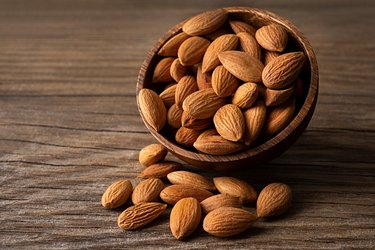
If you're among the nearly half of the U.S. adult population that has high blood pressure (BP), notes the American Heart Association (AHA), there's some good news: Lifestyle changes, including a heart-healthy diet, can support healthy BP. And magnesium-rich almonds may play a key role.
Blood Pressure Explained
Video of the Day
Chances are you've had your blood pressure measured at some point during a visit with your doctor. The AHA recommends yearly BP checks for people 20 and older. This painless procedure involves placing a pressure cuff around your upper arm. The cuff is inflated, which compresses a main artery, temporarily stopping blood flow. When the pressure in the cuff is released, a measure of the pressure that's being exerted against the artery wall is recorded.
Video of the Day
A blood pressure reading is captured in two numbers: Systolic blood pressure is the top number and represents how much pressure is exerted during heartbeats. Diastolic blood pressure is the bottom number, representing the pressure exerted between beats.
A normal blood pressure reading is less than 120/80 millimeters of mercury. A systolic number of 120 indicates elevated blood pressure, and if that number increases to 130 or higher, high blood pressure is diagnosed. A diastolic number over 80 indicates high blood pressure.
Read more: 7 Delicious Foods That Can Help Lower Blood Pressure
The Awesome Benefits of Almonds
If you're diagnosed with high blood pressure, medications may be in order. Your doctor is also likely to recommend lifestyle modifications that include a heart-healthy diet. As part of that, magnesium-rich almonds can be a great option to include as a snack or recipe ingredient.
A review of 34 randomized trials, published in the journal Hypertension in July 2016, found that magnesium supplementation resulted in significant reductions of both systolic and diastolic blood pressure measurements. Magnesium seems to be a key mineral for your body to keep your BP in check.
To this end, the AHA notes that the daily recommended value of magnesium can be obtained through a heart-healthy diet and, therefore, supplements may not be necessary for most people.
"Almonds can help lower high blood pressure when they are part of a diet rich in fruits and vegetables," says Kailey Proctor, MPH, RDN, a registered dietitian at St. Joseph Hospital in Orange, California. "Almonds are high in magnesium, which can help lower blood pressure by relaxing blood vessels. It is estimated that one ounce of almonds has 80 milligrams of magnesium, which is 20 percent of the recommended daily value based on a 2,000 calorie diet."
"Potassium is another mineral that can reduce blood pressure," Proctor says, "and almonds have a little more than 200 mg, or about 6 percent of the recommended daily value based on a 2,000 calorie diet."
For a study that involved adults with overweight and obesity, published in November 2016 in The Journal of Nutrition, participants were asked to eat either an energy-restricted but almond-rich diet or an energy-restricted nut-free diet. After 12 weeks, the healthy but overweight participants who consumed the almond-enriched diet had more improvements in blood pressure measurements and body composition than those who consumed a nut-free diet.
Both groups in the study lost weight and had reductions in systolic blood pressure, but the group that consumed almonds had significantly greater reductions in abdominal fat and diastolic blood pressure measurements.
Obesity is a risk factor for high blood pressure, says Steven Reisman, MD, a director and cardiologist at New York Cardiac Diagnostic Center — one more reason to add almonds to your grocery list.
Adding Almonds to Your Diet
Finding ways to add almonds to your diet can be easy to do. For instance, you can snack on them by the handful or sprinkle them into recipes. "Both raw and dry roasted and oil roasted nuts have similar amounts of calories, fat, carbs and protein," says Dr. Reisman.
Proctor adds that "while there is no magical number or amount of almonds to eat for maximum health benefit, it is important to keep portion size in check."
"Almonds are a good source of plant-based protein and heart-healthy fat, but because of their high fat content, they are calorie dense," she explains. "About ¼ cup or 1 ounce of almonds per day will offer the health benefits of magnesium, potassium and fiber for reducing blood pressure."
Read more: 4 Unwanted Side Effects of Eating Too Many Almonds
- Steven Reisman, MD, cardiologist, New York Cardiac Diagnostic Center, New York,
- Kailey Proctor, MPH, RDN, dietician, St. Joseph Hospital, Orange, California
- The Journal of Nutrition: “Almond Consumption during Energy Restriction Lowers Truncal Fat and Blood Pressure in Compliant Overweight or Obese Adults”
- American Heart Association: “Magnesium May Modestly Lower Blood Pressure”
- Hypertension. “Effects of Magnesium Supplementation on Blood Pressure”
- AHA: “The Facts about High Blood Pressure”
Is this an emergency? If you are experiencing serious medical symptoms, please see the National Library of Medicine’s list of signs you need emergency medical attention or call 911.