Back pain can make you nervous about tying your shoes, and a workout might seem out of the question. However, this doesn't mean you can't do a leg workout with back pain.
Rest may help for a time but often getting back in the gym and moving makes it feel better, according to the experts at Harvard Health Publishing. You can even do lower body exercises, as long as you choose the ones that are safe for your back.
Video of the Day
Choosing the Right Exercise
One of the most common ways that you can hurt your back in the gym is from lifting something too heavy. Whether your form was off or you used too much weight, lower body exercises like the deadlift can cause too much movement of the spine. This can cause an injury like a disc herniation or fracture of the spine that might be the source of your back pain.
If you've been cleared by a doctor to exercise again but aren't sure what to do, it's best to start simply. Some cable machine exercises, like the leg extension or leg curl, are safe since they don't put pressure on your back.
When you start doing these exercises, even though they're relatively safe for your back, you should still be cautious. Start with light weights and avoid exercises that aggravate your back pain. Don't push through, stop if you feel sharp pain or tingling.
One Leg Vs. Two
Generally, single-leg exercises are also easy on the back. That's because you can keep your torso straight and tall, minimizing movement of the spine, and still get a good leg workout because all of the weight is on one leg.
In two-legged movements, like the squat and deadlift, you're at a higher risk for injury because you have to lean forward more at the torso and, since those movements are more powerful, you're going to be using more weight. Some two-legged exercises, like the glute bridge, are fine because they don't put much pressure on the back.
1. Split Squats
You'll be able to keep your back completely straight and even add some weight with the safe split squats exercise.
Put a pad or soft surface on the floor. Step one foot in front of the pad and keep one foot behind. Keeping your torso tall, drop your back knee down to the pad and the rise back up, driving through both legs. Do 10 repetitions on one leg and then switch sides. You can hold a dumbbell in front of you in a goblet position or hold one in each hand.
2. Leg Extension
Sitting at a machine to perform leg training with back pain might not be ideal, but it is enough to get the job done while your back heals.
Sit at the leg extension machine and put your legs behind the pads. Extend your legs until your knees are straight, then lower them back down under control. You can also do this exercise with one leg at a time to make sure they stay balanced.
3. Leg Curl
Just like with the leg extension, the leg curl is a back-friendly hamstring exercise that allows you to keep these muscles in shape while you recover.
Sit down at the machine and adjust it so that your legs are straight from the beginning. Slowly pull your heels toward your butt and then let them come back up under control. You can perform this exercise with one leg at a time as well.
4. Exercise Ball Leg Curl
If you don't have access to a machine, use an exercise ball for your leg workout.
Start by sitting on the floor with an exercise ball in front of you. Lie on your back and put your heels on the ball. Your knees should be straight. Pull your heels toward your butt, rolling the ball toward you, as you bring your hips up into the air like you're doing a bridge.
Keep going until your body forms a straight line from your knees to your shoulders and the ball is close to your butt. Then, slowly extend your legs and drop your hips back down to the floor.
5. Glute Bridge
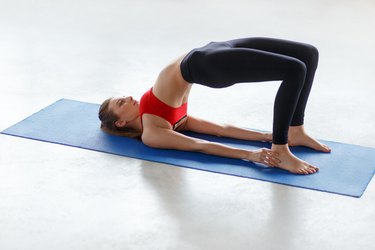
The glute bridge exercise puts very little pressure on your back and can even help prevent back pain in the long run. Include this exercise in your back pain workout plan.
Lie on your back with your knees bent and feet flat on the floor, a foot in front of your butt. Drive your hips up into the air until you form a straight line from your knees to your shoulders. Squeeze your butt at the top and then lower yourself back down to the floor.
6. Step-Up
Start by standing in front of a flat surface at least knee high, like a workout bench or box.
Put one foot flat on the surface near the edge. Lean forward and step up onto the surface with your other foot. Then, step down with the same foot. Repeat 10 times and switch sides to the other leg.