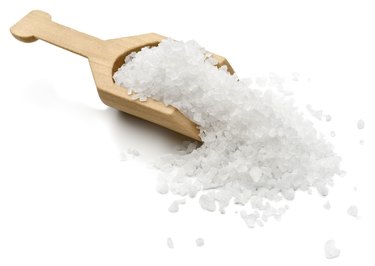
On average, Americans consume approximately 1.5 teaspoons of salt, which provides 3,400 milligrams of sodium, per day, according to the Harvard T.H. Chan School of Public Health. Most of this salt comes from processed foods and foods eaten at restaurants, but some of it comes from the salt that's added to food during or after cooking.
Because of increasing knowledge surrounding processed foods and food products, many consumers have switched from table salt to sea salt. Unlike table salt, which is processed, sea salt is extracted from the earth naturally and does not have any iodine in it.
Video of the Day
Video of the Day
Tip
Sea salt doesn't contain iodine, a necessary trace element that's vital to the proper functioning of the thyroid gland. If you use sea salt instead of iodized salt, you may need to add other iodine-rich foods, like kelp, nori, wild cod, shrimp and eggs, to your diet.
Functions of Iodine
Iodine is a trace element that's necessary for proper thyroid function. Your thyroid uses iodine to make the thyroid hormones thyroxine (T3) and triiodothyronine (T4), which help regulate your metabolism and keep your heart, brain and other organs functioning optimally. T3 and T4 also play roles in activating thyroid-stimulating hormone, or TSH.
Every single cell of your body relies on the proper functioning of your thyroid gland, and your thyroid cells are the only cells in your body that can absorb iodine. According to a report published in Annals of Pediatric Endocrinology and Metabolism in 2014, a healthy adult has between 15 to 20 milligrams of iodine in the body, and 70 to 80 percent of that is stored in the thyroid.
Iodine Deficiency and Hypothyroidism
Your body can't make iodine, so if you don't get enough from your diet, you may develop an iodine deficiency. If you're deficient in iodine for an extended period of time, it can lead to hypothyroidism, a condition in which the thyroid gland isn't able to make enough of the thyroid hormones.
Hypothyroidism affects your whole body, so the symptoms are widespread and may include:
- Fatigue
- Weight gain
- Constipation
- Depression
- Slowed heart rate
- Joint pain
- Muscle pain
- Sensitivity to cold
- Dry skin
Other Problems With Iodine Deficiency
In addition to hypothyroidism, an iodine deficiency can also cause a goiter, which is an abnormal enlargement of the thyroid gland. By itself, a goiter may not mean that your thyroid isn't working correctly, but it can be uncomfortable. Some goiters are so small that they go unnoticed, but when symptoms do occur, they may include:
- Swelling in the neck
- Coughing
- Hoarse voice
- Difficulty swallowing
- Difficulty breathing
Iodine deficiency is also linked to decreased motor skills, decreased cognition and ADHD. If a woman is iodine deficient when she's pregnant, it can affect the developing baby and cause cognitive problems and a lower IQ later in life, notes the Academy of Nutrition and Dietetics. To avoid iodine deficiency, the Food and Nutrition Board recommends that adults get 150 micrograms of iodine every day. For pregnant or nursing women, that number increases to 220 and 290 micrograms, respectively.
Defining Table Salt
To understand the role of iodine in salt, it's helpful to have a little background on the different types of salt. Table salt comes from underground salt deposits in salt mines. After extraction, the mined salt is heavily processed to remove any impurities. This processing also removes trace minerals.
Table salt doesn't naturally contain iodine, but manufacturers started adding the trace mineral to the processed salt in Michigan in 1924, when people started noticing an increase in goiter, an enlargement of the thyroid gland. Harvard Health Publishing notes that within 10 years after adding iodine to table salt, the percentage of people in the state with goiter dropped from 30 percent to less than 2 percent.
You'll often see table salt that has added iodine labeled as "iodized salt." In addition to added iodine, table salt also contains other chemical additives, like anti-caking agents that prevent the salt from clumping and sticking together during storage.
Is Sea Salt Iodine Free?
Sea salt is made naturally, by allowing ocean or sea water to evaporate and then collecting the salt that's left over after the water has dissipated. Just like with table salt, sodium and chloride make up the bulk of sea salt. However, unlike table salt, sea salt contains small amounts of trace minerals, like potassium, zinc and iron, because it's not processed after harvesting.
Also, unlike table salt, sea salt does not have any iodine added to it. Because sea salt's iodine free, you'll often see a warning on sea salt labels that says something to the effect of "does not supply iodine, a necessary nutrient."
Read more: 8 Facts That'll Make You Rethink Salt's Bad Rap
What About Pink Himalayan Salt?
Pink Himalayan salt, or pink salt, comes from salt mines in Pakistan, but unlike table salt, it's not processed after harvesting. Because it's not processed, Himalayan salt also contains trace amounts of the minerals calcium, potassium, magnesium and iron.
The characteristic pink color of Himalayan salt comes from the iron oxide that's in it. Like sea salt, Himalayan salt doesn't contain any added iodine.
Which Salt Should You Use?
According to Harvard Health Publishing, iodized salt only contributes a small fraction of daily iodine for most people. To add to that, you would need to take in more than a half of a teaspoon of iodized salt, which provides more than the daily recommended intake of sodium, to meet your iodine needs.
Because of this, it's not necessary to choose iodized table salt if you prefer natural sea salt. You can get your iodine from some other foods instead.
Other Sources of Iodine
Because the amount of iodine in foods isn't listed on nutrition facts labels, it's often difficult to know how much you're getting from foods, but some good sources of dietary iodine include:
- Seaweed (kelp, nori, dulce)
- Saltwater fish (wild cod, wild Atlantic salmon)
- Shellfish (shrimp, scallops)
- Cheese
- Cow's milk
- Yogurt
- Eggs
If you're using sea salt in place of iodized table salt, make sure you're including enough of these foods in your diet to meet your iodine needs.
- Academy of Nutrition and Dietetics: Iodine, a Critically Important Nutrient
- American Thyroid Association: Iodine Deficiency
- The American Journal of Clinical Nutrition: FDA Regulations Regarding Iodine Addition to Foods and Labeling of Foods Containing Added Iodine
- Harvard Health Publishing: Cut Salt - It Won't Affect Your Iodine Intake
- U.S. News & World Report: What's the Difference Between Table Salt and Sea Salt?
- Harvard T.H. Chan School of Public Health: Salt and Sodium
- State of Rhode Island Department of Health: Salt (Sodium)
- National Institutes of Health: Office of Dietary Supplements: Iodine
- Food and Nutrition Research: Natural Sea Salt Consumption Confers Protection Against Hypertension and Kidney Damage in Dahl Salt-Sensitive Rats
- National Institute of Diabetes and Digestive and Kidney Diseases: Hypothyroidism (Underactive Thyroid)
- Annals of Pediatric Endocrinology and Metabolism: Iodine and Thyroid Function
- Mindd Foundation: Autoimmune Thyroid Disease Begins with the Diet, Not in the Thyroid
- Food and Nutrition Board: Dietary Reference Intakes (DRIs): Recommended Dietary Allowances and Adequate Intakes, Elements
- Mayo Clinic: Goiter