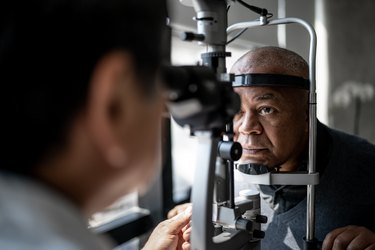








































Cataract surgery is a safe procedure; 95 percent of people having cataract surgery have no problems, according to the Harvard Medical School. But as with any surgery, complications can arise. Cataract surgery can cause complications in the retina, the tissue that lines the back of the eye and contains the photoreceptive cells that make vision possible
Retinal Detachment
Retinal detachment (RD) occurs in approximately 1.5 percent on average for all cataract surgeries, according to the Digital Journal of Ophthalmology. Retinal detachment is caused by fluid from the vitreous humor, the transparent gel that fills the middle of the eye and gives the eye its shape, leaking through a tear in the retina. This pushes the retina off the wall of the eye and separates it from its oxygen and blood supply in that area.
RD after cataract surgery is more common in people with severe myopia (6 diopters or more). Symptoms of retinal detachment are a curtain or veil across part of the field of vision, an increase in flashes and/or floaters, and or a loss of central vision, if the retina has detached at the macula, the part of the retina responsible for visual central vision. RD needs to be treated quickly to prevent permanent vision loss. RDs can be treated with surgery, laser or both.
Cystoid Macular Edema
After cataract surgery, the blood vessels in the retina may become inflamed and leak fluid, a condition known as cystoid macular edema, or CME. CME generally occurs within the first two to four months after surgery in 1 to 3 percent of patients, but can occur up to a year later, according to the University of Michigan's Kellogg Center. CME causes painless vision loss and is treated with steroid injections into the eye, steroid or non-steroidal anti-inflammatory eye drops, or surgically, according to the Harvard Medical School.
Choroidal Hemorrhage
Blood vessels that supply the retina are called choroidal vessels. Cataract surgery can cause bleeding within the choroidal vessels known as choroidal hemorrhage. This serious complication occurs during surgery; if severe, it can cause extrusion of intraocular contents through the surgical incision, according to the Merck Manual. Choroidal hemorrhage is more common in elderly patients and patients with glaucoma or high blood pressure, according to the Eye Surgery Education Council. Choroidal hemorrhage can cause severe pain and substantial vision loss.


