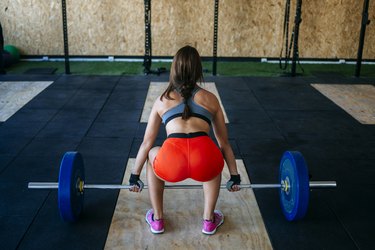
If you're looking to build a strong upper back, be sure to include rhomboid exercises. These muscles sit between your shoulder blades and are important for posture and stability.
Your rhomboids are muscles that help form your shoulder girdle, according to Kean University. Strengthening with rhomboid exercises helps keep your scapulae pressed against your thoracic spine for stability.
Video of the Day
Video of the Day
These muscles also work with the trapezius and other back muscles to facilitate shoulder movement.
1. Standing Back Fly
This exercise emphasizes shoulder retraction while contracting muscles along your spine to build stability, as described by ExRx.net.
- Stand with your left foot in front of you and hold each end of an elastic band with each hand facing down in front of you.
- Exhale and pull your arms out to the sides, squeezing your shoulder blades together.
- Do not move your body or legs as you pull.
- Hold this position for two seconds and slowly return your arms to the starting position. Perform three sets of eight to 12 reps.
2. Incline Pull-ups
This rhomboid workout uses your own body weight to strengthen your rhomboids, and other shoulder and back muscles to pull your body up.
Use a low horizontal bar between two to three feet off the ground, such as a squat bar on a rack or Smith machine.
- Grab the bar with both hands about shoulder-width apart, and crawl under the bar so your chest is below it.
- Place your feet about hip-width apart, and tighten your buttocks to prevent it from sagging down.
- Exhale and pull yourself up until your chest barely touches the bar.
- Exhale and lower your body until your arms are fully extended. Perform three sets of eight to 12 reps.
3. Posterior Capsule Stretch
This exercise stretches your muscles and connective tissues in the back of the shoulder, according to the American Academy of Orthopaedic Surgeons, and relaxes the muscles to alleviate fatigue and soreness after your workout.
- Stand and bring your left arm horizontally across your body.
- Press your right forearm against your left forearm as you reach to your right with your left arm.
- Push your left shoulder to your right to increase the stretch without rotating your torso.
- Hold this stretch for five to six deep breaths. Repeat the stretch on the right shoulder.
4. Four Point Back Relaxation
These rhomboid exercises retract the shoulder blades together passively by using gravity and deep breathing. It is used to relax the spine and alleviate pressure.
- Kneel on your hands and knees with your hands below your shoulders and your knees below your hip joints.
- Inhale into your belly and let it expand toward the ground.
- With each exhalation, allow your belly to move closer to the ground and your shoulder blades to pull toward each other without conscious effort. Your lower back should increase its extension.
- Let your head drop so that your chin is near your chest.
- Perform this breathing exercise for two to three minutes in two to three sets.