There's not an injury out there that's pleasant, but ACL tears are unique in that they make your knee feel incredibly vulnerable. The ACL is instrumental in holding your knee in place, which means tearing it can make you feel very wobbly.
After surgery — which will very likely be required — it's time to do ACL recovery exercises in the gym to build back your muscles and confidence. Get clearance from your surgeon or physical therapist and guidance on the best ACL exercises after surgery. Start with easy exercises and progress slowly to more advanced moves like squats and lunges.
Video of the Day
Video of the Day
ACL Recovery Workouts
Tearing your ACL, or anterior cruciate ligament, will keep you from doing your regular lower-body workouts for months. During that time, there are still things you can and should do to speed up the recovery process and prevent your leg muscles from getting too weak.
From the time you get out of surgery to the point where your knee is fully recovered, you'll keep progressing the difficulty of your ACL recovery workout For the first month or so, there aren't many exercises you can do. After that, though, start with light machine and supported bodyweight exercises, such as partial wall squats. Once that feels mastered, move onto full bodyweight exercises like squats.
Read more: Can You Run with a Torn ACL?
Once you're comfortable with these leg exercises, you can move on to lateral exercises, in which you move side-to-side. This tests the strength of your ACL because it resists side-to-side movement of your knee. You can also begin walking after about a month to get used to putting weight on your leg again. After that, you move on to biking and, finally, running.
1. Low-Intensity ACL Recovery Workout
After about a month, you can start to get into the gym and lift some light weights. These exercises give you a smooth segue into some of the advanced movements you'll be doing in the months to come.
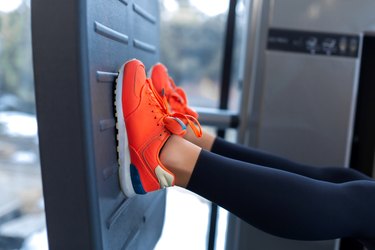
Move 1: Leg Press
Start by adjusting the leg press machine to the proper height. The seat should be close enough to the platform that you start in a squat position and finish with your knees straight. Use light weight to avoid damaging your knee. Sit in the chair and place your feet on the platform in the same stance you would use to squat. Press for 15 repetitions.
Move 2: Leg Extension
Sit on a leg extension machine with the bottom pad against the bottom of your shin and your knees bent as much as possible. With a light weight, kick your legs out straight until your knees are locked out, then slowly lower the weight back down. Do 15 reps.
Move 3: Leg Curl
This is the opposite of the leg extension motion and works your hamstrings. Sit in the leg curl machine with your legs straight at the top. Pull the pad down, bringing your heels towards your butt for 15 reps.
Read more: TheraBand Exercises for Legs
Move 4: Abduction/Adduction Machine
You can use this machine to work both the inside and outside of your thighs. Start with the pads half a foot from each other and squeeze your legs between them. Press out to the side to work your abductors for 10 reps.
Then, start with the pads out as wide as you can and pull them in close together to work your adductors for 10 reps.
Move 5: Aerobics
Picking an aerobic exercise that's low-impact, but still works your legs will help move blood through your injury and boost recovery. You can start by riding the bike, swimming or walking on the treadmill for 30 minutes to an hour at a moderate intensity.
2. Higher-Intensity ACL Recovery Workout
After six to eight weeks, you should be ready to put some weight on the knee in the form of squats or step-ups to a low box. Go slow with these and avoid anything that feels uncomfortable.
Move 1: Squat
Start standing, using just your body weight as resistance. Squat down as low as you feel comfortable, then stand back up. Perform 20 repetitions. If you can do that without pain, try holding a dumbbell at chest-height for 10 reps.
Move 2: Step-Ups
When you begin this exercise, use a 2-inch box and step up and down with the same foot 10 times on each side. You can go up to 6 inches during the rehab phase, without any weight.
Move 3: Lateral Lunge
Begin the lateral lunge standing with a dumbbell in each hand. Step out to the side, sticking your butt back. Lean towards the side you stepped to and straighten out the other leg. Step back to the center and step out to the other side. Try to keep your feet pointed forward the whole time. Do 10 reps on each leg.
Move 4: Aerobics
In addition to walking, swimming, and riding an exercise bike, you can start using an elliptical or even a stair climber for your aerobic workout. Jogging still isn't the best idea because of the sudden impact to your knee. Try to up the intensity slightly in this workout and keep the cardio portion between thirty minutes to an hour long.