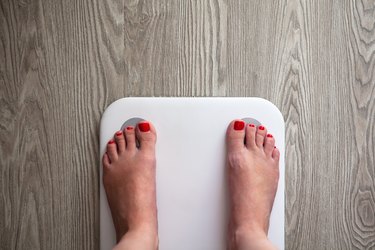
You're not hallucinating if it seems like you're struggling to lose weight while the men in your life drop pounds easily. Men often have an upper hand when it comes to shedding pounds due to genetic factors, according to the U.S. Department of Health and Human Services.
Related Reading
Video of the Day
Why Losing Weight Is Hard for Women
Women naturally produce less testosterone than men. Since testosterone production affects your ability to build muscle, the muscle-building process can be slower and more difficult for women.
Video of the Day
Less muscle means a higher body fat percentage and a lower metabolic rate. "The amount of muscle mass we carry directly impacts our metabolic rate, or how many calories we burn at rest," says Lais DeLeon trainer at Plankk Studio. Simply put, maintaining muscle burns more calories at rest than fat, and since women naturally have less muscle mass, it's more difficult to lose weight.
Other hormones play a role, too. "Our hormones are a very complex system that help to regulate metabolism, insulin sensitivity and body weight among many other processes," says DeLeon. "Women experience various hormonal changes as they enter different seasons of life: Puberty, pregnancy, breastfeeding, menopause and beyond." In addition to estrogen, other hormones are also involved in regulating metabolism and body weight, such as insulin, testosterone, leptin, ghrelin, HGH, T3, T4 and cortisone.
But this isn't a bad thing! While estrogen — and the fact that women produce more of it than their male counterparts — gets most of the blame for women's higher body fat percentage, we actually need enough estrogen to stay lean and healthy. Low estrogen in women can inhibit ovulation, lower progesterone, increase the chances of insulin resistance and increase cortisol, DeLeon explains. This is a recipe for increased fat storage and weight loss resistance. One October 2014 study published in the journal BioMed Research International found that estrogen deficiency was linked to obesity in menopausal women.
Don't Forget About Your Diet
If weight loss is your main goal, DeLeon suggests starting with your diet before tackling a workout. Exercise alone — as in, without calorie restriction — is unlikely to achieve clinically significant weight loss, according an October 2013 published in Progress in Cardiovascular Diseases.
"While exercise is very beneficial for health and can support the calorie deficit required for weight loss, nutrition will play the biggest role in losing weight," says DeLeon. "Research overwhelming finds that a calorie deficit helps you achieve significant fat loss, no matter how that deficit is created or what workouts you perform."
Try keeping a food journal, and consult with a registered dietitian or nutritionist to figure out what a smart calorie target or style of eating is right for you.
Workout Plans Proven to Help Women Lose Weight
The best workout plan is one that will support a calorie deficit while building and preserving lean muscle mass. Also critical: Enjoyment. An April 2016 published in Psychology and Health reiterated what many others have found: Exercise enjoyment is one (and likely the best) predictor of how often you'll get a sweat in.
Cardiovascular Exercise
While any exercise that helps you burn calories will ultimately help you lose weight, experts agree that cardio workouts — including running, walking, cycling and rowing — are effective for weight loss. DeLeon explains that this is due to the fact that ultimately weight loss comes down to maintaining a calorie deficit over time, and cardio supports this deficit by burning calories.
"If weight loss is the goal, adding 30 to 45 minutes of cardio can increase your calorie deficit by a few hundred calories per day," she says.
Tip
No matter how much cardio you do, it's crucial to monitor your caloric intake to make sure you still have that deficit.
Another awesome thing about cardio? You can do it every day at a low- or moderate-intensity level because it's not too taxing on your body (and yes, walking counts!). Unlike strength training, you don't need to wait days between performing cardio workouts, especially if you're doing low-impact forms of cardio, like swimming or cycling.
Related Reading
Interval Training
DeLeon also endorses interval training — a style of training that alternates between one or more exercises and working or rest/recovery periods — as an effective weight loss technique, depending on how it's done.
"If the main goal for the person working out is to lose weight, burning the most amount of calories during the workout should be the objective," she says. Interval training in and of itself isn't going to help you reach burn calories, DeLeon adds. It's the exercises or activities chosen for the intervals, the intensity of each activity, the duration of each activity's interval, the duration of the rest period and total sets or rounds of the circuit that dictate the amount of calories burned she explains.
For example, consider two circuits below, which both target the biceps and back:
Circuit One
Instructions: Repeat three times.
10 Dumbbell biceps curls
30-Second rest
10 Cable rows
30-Second rest
60 Seconds moderate intensity air bike
Circuit Two
Instructions: Repeat five times.
10 (or to failure) Chin-ups
45 Seconds max intensity on the rower
10-Second rest
"The second circuit will burn more calories because it involves," DeLeon explains. Not only is it a more difficult strength exercise and more energy expending exercise, but there is less rest time, longer working interval durations, higher intensity intervals and more overall sets. "Both are examples of interval training, both very effective, but each will burn a drastically different amount of calories. The choice and the way you structure the circuits should be based on the goal."
As always, you should consult with a personal trainer before taking on a new exercise program. If you do want to increase intensity, DeLeon suggests trying one of following:
- Select compound exercises that recruit multiple muscle groups
- More sets and reps
- Take less rest time between exercises
- Use heavier weights or resistance
- Increase time under tension by incorporating slower concentric or eccentric tempos or longer contractions.
- Actively work towards progressive overload (doing a little more of any of the above with each training session)
High-Intensity Interval Training (HIIT)
High-intensity interval training (HIIT) is a strategic form of interval training where you alternate between short periods of an exercise at intense effort followed by a period of less intense recovery. Interval training just means you are doing any given exercise for a timed interval/period then moving onto either a rest interval or another working interval.
Don't be scared away by the term "high-intensity," DeLeon says, adding that both beginners and advanced trainees can perform HIIT. The high intensity interval will just be individual to each person's fitness level. "As long as the person is coming close to or training at their true maximum effort they are HIIT training," she explains. A technical way to go about this would be to use a heart rate monitor to measure what the person's baseline heart rate is versus their max heart rate. Aim to get to about 80 to 90 percent of your max heart rate during the high intensity interval.
Relating Reading
HIIT is a successful method for fat loss, according to DeLeon, due to the "afterburn effect" — or the calories your body burns after the actual work is done. This additional energy expenditure that occurs post-sweat — also referred to excess post-exercise oxygen consumption (EPOC) — is greater in HIIT workouts than steady-state running or lower-intensity circuit training, according to the American Council on Exercise (ACE).
Intervals are usually timed to keep the intensity high, then repeated until true exhaustion or a set amount of rounds have been completed. "It's a very effective — but most importantly, efficient way of training to maximize calories burned for weight loss. It also takes the body longer to recover from these workouts," she explains.
For this reason HIIT training can only be done a few times per week. Try to limit yourself to no more than three strenuous workouts per week and allow at least 48 hours of recovery time between HIIT sessions, ACE suggests.
Strength Training
Strength training is a great way to build muscle, but may not be the most efficient way to burn the most amount of calories in the shortest amount of time, explains DeLeon. Still, it cab be very effective for weight loss in other ways.
"While you may not burn as many calories lifting weights compared to a HIIT session, you will still burn many calories while actively working on building muscle," she says. Also: Keep in mind that the muscle you build over time will pay off in the long run, as it will not only help increase your metabolic rate, but also improve your body composition, according to ACE.
Sample Week of Workouts Combining These Techniques
Mixing up your exercise routine is a guaranteed way to stave off boredom and keep things interesting. Here, DeLeon offers up a snippet of what a weekly workout schedule could look like, integrating various forms of fitness:
Monday: Lower body and moderate steady state cardio
Tuesday: Active recovery
Wednesday: Upper body strength training and HIIT
Thursday: Active recovery
Friday: Full-body interval training
Saturday: Active recovery
Sunday: HIIT and cardio
Relating Reading
Keep in Mind
Once you put in all the work to lose weight, it's not all that easy to keep it off. In other words, it's hard work to lose it, and it takes dedication to keep it off. According to one August 2017 study published in Obesity, up to 40 percent of people who lose weight regain more than half of it over the subsequent two years. Still, DeLeon says it is possible — with hard work.
"Essentially your metabolism will adapt to your output and intake to reach homeostasis and a settling point," DeLeon explains. This weight loss plateau will result in the need to sustain or even continue to increase the level of workout intensity and calorie deficit to maintain the weight lost. "It's important to understand our metabolism naturally adapts, and plan for the long term," she adds.
- Progress in Cardiovascular Diseases: "The Role of Exercise and Physical Activity in Weight Loss and Maintenance"
- American Council on Exercise: "7 Things to Know About Excess Post-exercise Oxygen Consumption (EPOC)"
- American Council on Exercise: "Strength Training 101"
- Psychology and Health: "Self-Efficacy versus Perceived Enjoyment as Predictors of Physical Activity Behavior"
- BioMed Research International: "Estrogen Deficiency and the Origin of Obesity during Menopause"
Was this article helpful?
150 Characters Max
0/150
Thank you for sharing!
Thank you for your feedback!