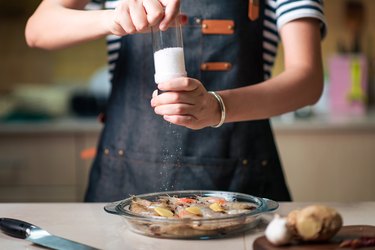
Today, we use a variety of methods to preserve foods, such as refrigeration, artificial food preservatives, vacuum-sealing and freeze-drying. Before industrialization, most foods were cured using mixtures of salt and sugar combined with smoking. Some of these methods are still used today, especially to preserve canned goods.
Salt and sugar act to increase osmotic pressure, which stops the flow of water. This destroys some bacteria and slows decay while promoting the growth of beneficial bacteria and working together to improve taste. Salt and sugar also reduce the water content in food, giving them a longer shelf life.
Video of the Day
Video of the Day
Most food preservation techniques currently used combine methods of smoking, drying, sugar and salt, preservatives, refrigeration, acidity and others with the idea that bacteria and other microorganisms cannot jump over all the hurdles in place.
Here's exactly how it works.
How Salt Preserves Food
Sodium chloride, which is your basic table salt, not only enhances the flavor of food, but can also be used to preserve meats and other foods.
It's commonly used to increase the shelf life of some foods and prevent the growth of disease-causing agents, according to the CDC. Salting meat removes water and prevents microorganisms from growing, according to the USDA.
"Salt preserves food by preventing bacteria from growing, including foodborne pathogens like salmonella," says Dana Ellis Hunnes, RD, a registered dietitian and senior clinical dietitian at UCLA medical center. "Salt inhibits bacteria enzymes through dehydration. Salt is hydrophilic (aka water-loving), so salt draws out water from the food product and creates an environment that is hostile to bacteria."
This process creates a hypertonic environment, which prevents bacteria from growing and therefore safely preserves food. Some salts used to cure foods also contain nitrates, which are antioxidants and prevent decay and spoilage through oxidation.
Though salt isn't the main method of food preservation these days, it's still used to cure some meats like country hams, bacon, frankfurters and corned beef, per the USDA.
How Sugar Preserves Food
Similar to salt, some forms of sugar can draw water out of food and tie up water within the food so it is not available for biochemical reactions. Sugar solutions are also antimicrobial, according to September 2020 research in Letters in Applied Microbiology.
"Using sugar to preserve food works in much the same way as salt," Hunnes says. "Sugar creates a hypertonic environment that draws water out of the food, which therefore inhibits microbial growth. It's the drawing out of water that lowers a food's water activity, which is what is responsible for the safety and preservation factor."
Fructose and sucrose are more effective at preserving food than glucose. Sucrose, also known as regular table sugar, is the most common type of sugar used in food preservation and canning, according to Ohio State University Extension. This helps to extend the shelf life of fruit-based foods like jams and jellies while also preserving the texture, color and taste.
Sugar can also be used as a preservative to offset flavors in savory canned foods like pickles.
Adding sugar to canned fruit is a popular at-home preservation method that improves the taste, according to PennState Extension. But this method increases the amount of added sugars, which can have negative health effects.
Some sugar substitutes, such as sucralose (aka Splenda), can be used instead of granulated sugar to sweeten jams and jellies, but they won't preserve the texture as regular sugar would.
Tip
Preserved foods should be kept in a cool and dry environment to discourage bacterial growth and spoilage.
- USDA: "How is salt used to make food shelf stable?"
- CDC: “The Role of Sodium in Your Food”
- Letters in Applied Microbiology: "Assessing the individual microbial inhibitory capacity of different sugars against pathogens commonly found in food systems"
- Ohio State University Extension: "Preserving Food With Less Sugar"
- Penn State Extension: "Sugar and Sucralose in Home Food Preservation"